

Why Crypto Withdrawal Speeds Vary Across Exchanges And Wallets
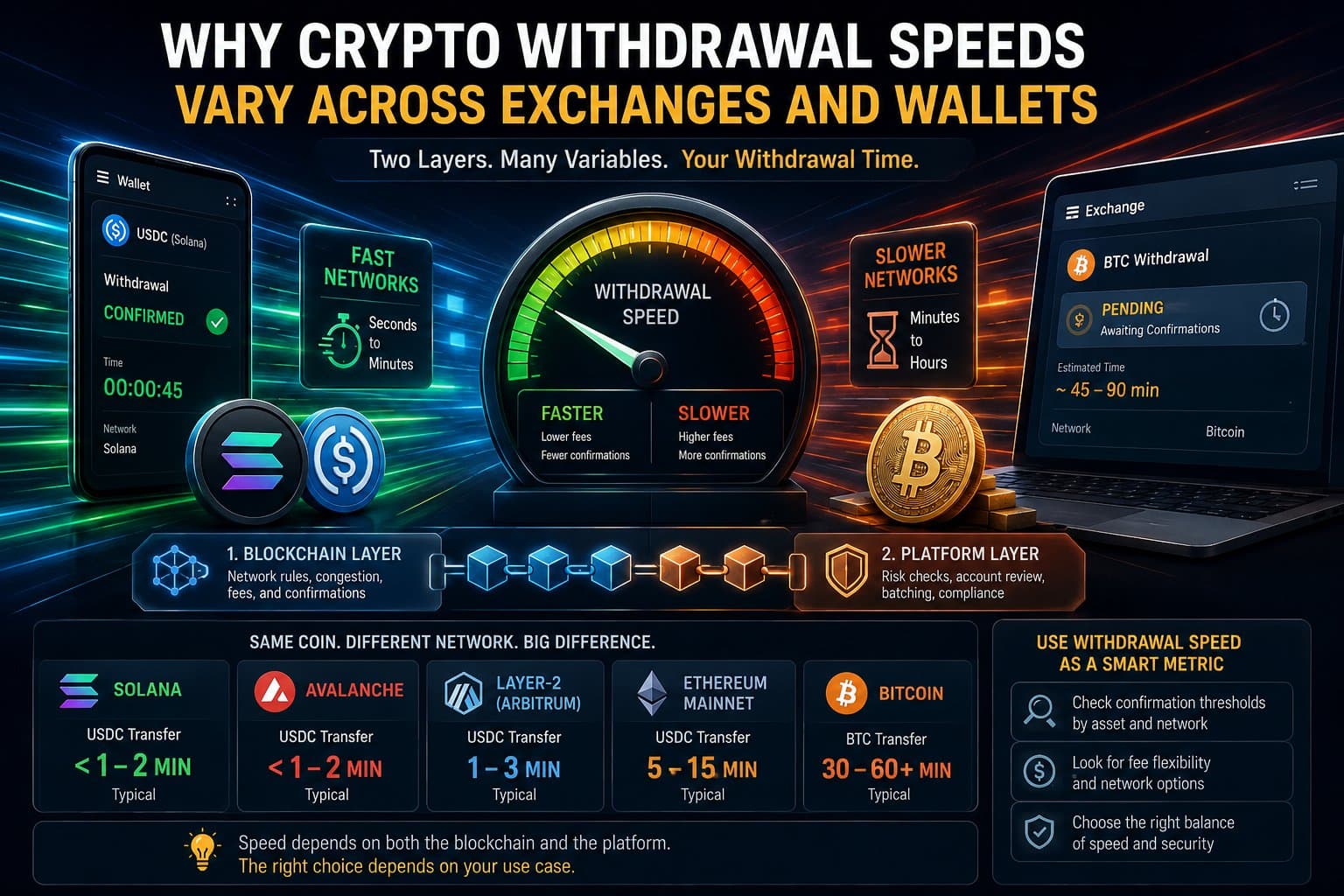
Anyone who has waited on a pending withdrawal knows the frustration of watching a transaction sit unconfirmed while the market moves. What feels like a simple click-to-transfer action is actually the product of two separate systems working in sequence: the blockchain's own settlement rules and the platform's internal risk checks. Understanding both layers helps traders set realistic expectations and choose services that match their needs.
Withdrawal speed isn't a single number you can look up once and forget. It shifts with network demand, the asset being moved, and the policies a given exchange or wallet has built around security. Breaking down these variables gives a clearer picture of why the same coin can settle in seconds on one platform and take an hour elsewhere.
Blockchain Confirmation Times And Network Congestion Factors
Every blockchain has its own rhythm. Bitcoin blocks arrive roughly every ten minutes, but that average masks huge swings depending on how many people are trying to transact at once. Ethereum, since its move to proof-of-stake, organizes activity into 12-second slots grouped into epochs, with many custodial services treating two epochs, or roughly 13 minutes, as a reasonable threshold for high-value transfers.
Faster chains like Solana and Avalanche routinely confirm in seconds rather than minutes, which is why stablecoin transfers on those networks feel almost instant compared to Ethereum mainnet activity. Congestion is the wildcard in all of this. When blockspace becomes scarce, users compete on fees, and confirmation times can stretch dramatically beyond their typical range, regardless of how well-designed the underlying network is.
How Exchange Processing Policies Affect Withdrawal Delays
Blockchain mechanics only explain part of the story. Exchanges add their own layer of processing before a transaction is even broadcast, running anti-fraud checks, verifying account history, and sometimes batching multiple withdrawal requests together to save on fees. These internal steps can add anywhere from a few seconds to several hours, entirely separate from network conditions.
This is also where withdrawal speed becomes a genuine differentiator between platforms. Traders comparing options often look at how quickly funds clear the internal review stage before hitting the chain. DeFi lending protocols publish real-time liquidity pool withdrawal queues so users can gauge settlement timing before committing. Cross-border crypto remittance platforms display estimated clearing windows per corridor so senders know exactly when recipients receive funds.Crypto gambling providers have built the same transparency into their payout systems — top-rated instant withdrawal crypto casinos process withdrawals instantly with blockchain verification and no manual approval step.
Comparing Withdrawal Speed Across Platforms And Use Cases
Not all withdrawals are created equal, even for the same coin. A stablecoin transfer routed through Solana or a low-cost layer-2 network can settle in under two minutes, while the identical asset moved over Ethereum mainnet often takes five to fifteen minutes because exchanges wait for a higher number of confirmations before releasing funds. Recent network comparisons from Eco's withdrawal timing analysis show just how consistently network choice outweighs almost every other factor in determining end-to-end settlement time.
This matters for anyone moving funds regularly. Traders chasing arbitrage opportunities or rebalancing positions quickly tend to favor faster rails, while those transferring larger sums may accept slower settlement in exchange for stronger finality guarantees. The right choice depends entirely on whether speed or assurance matters more for a given transfer.
Using Withdrawal Speed As A Platform Evaluation Metric
Withdrawal speed deserves the same scrutiny traders apply to fees and liquidity when judging a platform. A useful starting point is checking whether an exchange publishes clear confirmation thresholds by asset and network, since transparency here often signals a well-run operation. Bitcoin's average confirmation time has itself become more variable recently, sitting at roughly 33.78 minutes as of July 2026 according to YCharts' daily tracking data, a sharp increase year-on-year that reflects growing competition for blockspace.
Ultimately, the fastest platform isn't always the best one. Traders should weigh confirmation policy, fee flexibility, and network choice together, rather than judging speed in isolation. A platform that's transparent about its processing logic gives users the tools to make that trade-off intelligently.