

What the Data Says About Crypto and Inflation
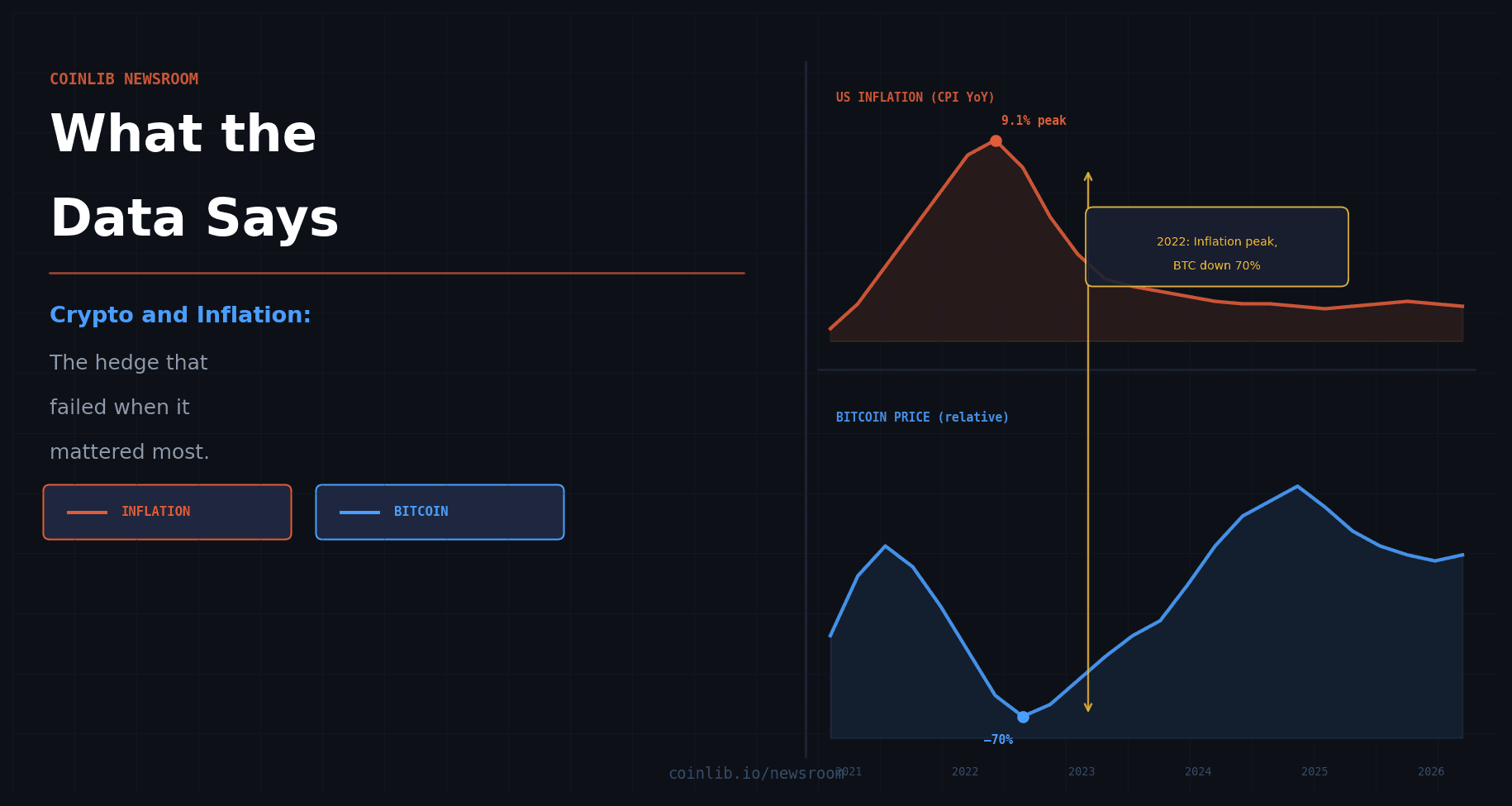
The claim that Bitcoin is a hedge against inflation became one of the most repeated arguments in crypto between 2020 and 2022. It was also one of the most consequentially wrong during the period when it mattered most. Understanding why the narrative broke down when inflation actually arrived, and what the data shows about the relationship between crypto and inflation more broadly, is more useful than either uncritical acceptance or wholesale dismissal of the inflation hedge thesis.
The data tells a more complicated story than either side of that debate tends to acknowledge.
What Happened When Inflation Actually Peaked
The inflation argument for Bitcoin rested on the assumption that as fiat currency purchasing power declined, demand for a fixed-supply asset would increase. The logic was sound in theory. What happened in practice was different.
US inflation peaked at around 9.1 percent in June 2022. Bitcoin's price peaked in November 2021, before inflation reached its high, and then declined more than 70 percent through 2022 as inflation was still running hot. If Bitcoin were functioning as an inflation hedge, the opposite pattern should have appeared: sustained or rising prices during the period of maximum inflation pressure.
The reason the theory failed in practice relates to what was driving Bitcoin's price at the time. By late 2021, Bitcoin had become sufficiently integrated into risk asset portfolios that its price behaviour correlated more closely with the Nasdaq than with any inflation metric. When the Federal Reserve signalled aggressive rate hikes to combat inflation, risk assets sold off. Bitcoin sold off with them. The inflation hedge thesis assumed Bitcoin would act like gold. The data showed it acting like a leveraged technology stock.
The Correlation Problem
Correlation between Bitcoin and traditional risk assets, particularly US equities, has been one of the more robust findings in crypto market data over recent years. During periods of market stress, correlations across asset classes tend to rise as investors liquidate positions for liquidity. Bitcoin, despite its structural differences from equities, has not been immune to this dynamic.
Research published across multiple academic and institutional studies has found that Bitcoin's correlation with the S&P 500 increased substantially from 2020 onward as institutional participation grew. Institutions that hold both equities and Bitcoin will sell both when they need to reduce risk or raise cash. That selling linkage creates correlation that did not exist when Bitcoin's holder base was primarily retail and ideologically committed.
The implication is that Bitcoin's behaviour during inflationary periods depends heavily on whether inflation is accompanied by monetary tightening. Inflation alone, in an environment of loose monetary policy, may well support Bitcoin prices. Inflation that triggers aggressive rate hikes, as occurred in 2022, creates a headwind through the risk asset channel that overwhelms any inflation-hedge demand.
Where the Inflation Hedge Data Is More Supportive
The inflation hedge case for Bitcoin is significantly stronger over longer time horizons than shorter ones. Over any five-year period in Bitcoin's history, the asset has substantially outpaced inflation in every major currency. The purchasing power of one Bitcoin purchased in 2017 is dramatically higher in 2026 than the purchasing power of the equivalent fiat amount invested in low-risk instruments over the same period.
The distinction between a short-term inflation hedge and a long-term store of value is analytically important and often conflated. Gold is the benchmark short-term inflation hedge: it tends to rise during inflationary periods and decline when inflation subsides. Bitcoin does not reliably do this. What Bitcoin has done is maintain and increase purchasing power over multi-year windows through appreciation that outpaces even significant inflation rates.
For investors with long time horizons who are willing to tolerate substantial volatility in the interim, the data supports a role for Bitcoin in a portfolio as protection against long-term currency debasement. For investors expecting Bitcoin to hold its value or appreciate during a specific inflationary episode, the historical data does not support that expectation with consistency.
Stablecoins and Inflation in Practice
While the Bitcoin inflation hedge debate remained largely theoretical for investors in developed markets, stablecoin adoption as a practical inflation response became empirically demonstrable in high-inflation economies.
In Argentina, where annual inflation has run above 100 percent in recent years, USDT adoption has been measurable and meaningful. People holding savings in Argentine pesos faced substantial real purchasing power losses. People holding USDT faced none of those losses, because USDT tracks the US dollar, which depreciated at a fraction of the rate of the peso.
The same pattern has been documented in Turkey, Venezuela, Nigeria, and a range of other economies experiencing significant currency depreciation. Stablecoin adoption in these markets is not a speculative behaviour. It is a rational response to a documented inflation problem, and it represents an inflation hedge that actually functions as described because the mechanism is direct: the asset is pegged to a more stable currency rather than relying on scarcity dynamics and market sentiment.
This is the clearest empirical evidence that crypto can function as an inflation hedge, but the asset doing the work is not Bitcoin. It is a centralised, collateralised dollar-pegged token, which carries its own set of risks distinct from inflation risk.
The Gold Comparison
Comparing Bitcoin's inflation-hedge properties to gold is instructive because gold is the established benchmark. The data on gold as an inflation hedge is itself more mixed than popular belief suggests. Over short periods, gold does not reliably track inflation. Over longer periods, gold has maintained purchasing power reasonably well. During the 2022 inflationary period, gold also underperformed relative to its inflation-hedge reputation, ending the year roughly flat while inflation ran at multi-decade highs.
Bitcoin's volatility makes direct comparison to gold difficult because the signal-to-noise ratio in Bitcoin's price data is much lower. A 70 percent drawdown swamps any inflation signal. Gold's lower volatility means that even modest inflation-related demand can show up clearly in price data. Bitcoin's volatility means inflation-related demand, even if present, may be invisible beneath the noise of speculative flows, leverage, and sentiment shifts.
Institutional analysts who have attempted to build quantitative models of Bitcoin's inflation sensitivity have generally found weak or inconsistent relationships across different time periods and inflation regimes. The relationship is not zero, but it is not stable enough to rely on for portfolio construction purposes.
What 2024 and 2025 Added to the Picture
The inflation environment of 2024 and 2025 provided additional data points. As inflation moderated in major economies and central banks began easing, risk assets including crypto generally performed well. Bitcoin's post-halving appreciation through 2024 and into 2025 occurred in an environment of declining inflation, which is consistent with the risk asset interpretation rather than the inflation hedge interpretation.
The institutional ETF inflow data from 2024 onward suggests that institutional investors are primarily treating Bitcoin as a risk asset and alternative investment rather than as inflation protection specifically. Asset allocation documents and investment committee frameworks that have incorporated Bitcoin tend to describe it in terms of uncorrelated returns potential and asymmetric upside rather than inflation hedging. That is a meaningful signal about how professional capital actually thinks about the asset.
What the Data Actually Supports
Taking the full picture together, several conclusions emerge from the data with reasonable confidence.
Bitcoin does not function as a reliable short-term inflation hedge in the way gold is theorised to. Its behaviour during inflationary episodes depends more on the monetary policy response to inflation than on inflation itself. When inflation triggers rate hikes, Bitcoin has underperformed. When inflation co-exists with loose monetary policy, Bitcoin has done well, but it is difficult to separate the inflation signal from the liquidity signal in that environment.
Bitcoin has outperformed inflation substantially over long holding periods, which supports a long-term store of value argument but is distinct from the inflation hedge claim as it is usually made.
Stablecoins represent the clearest empirical case for crypto functioning as an inflation response tool, but their mechanism is dollar pegging rather than scarcity, and they transfer currency risk from local currency to the US dollar rather than eliminating currency risk entirely.
The inflation hedge narrative for Bitcoin is not entirely wrong, but it is significantly more conditional and time-horizon-dependent than it is usually presented. Investors who positioned based on the simple version of the argument in 2022 received a rapid and expensive education in why that matters.