

What Happens to Crypto Prices During Macro Downturns
One of the persistent claims in crypto is that Bitcoin and other digital assets are uncorrelated with traditional markets — that they represent a hedge against economic conditions that drag down equities and other risk assets. The data does not support that claim, at least not consistently. What the data actually shows is more nuanced and more useful for understanding how crypto prices behave when the broader economic environment deteriorates.
The Correlation Question
Correlation between crypto and traditional markets is not fixed. It varies substantially depending on market conditions, investor composition, and the specific nature of the macro event being considered.
During normal market conditions, Bitcoin and equities have historically shown low to moderate correlation. In the years prior to 2020, Bitcoin moved largely independently of the S&P 500. The correlation coefficient between daily returns was often below 0.2, which is low enough to suggest meaningful diversification benefit.
That relationship changed materially during the COVID-19 crash in March 2020. As risk assets sold off globally, Bitcoin dropped approximately 50 percent in a matter of days — in some ways outpacing the speed of the equity decline. The correlation between Bitcoin and the S&P 500 spiked sharply as both fell together. This pattern has been observed repeatedly: in periods of acute market stress, crypto tends to sell off alongside equities rather than acting as a hedge. The diversification benefit that appears in normal conditions compresses precisely when investors most need it.
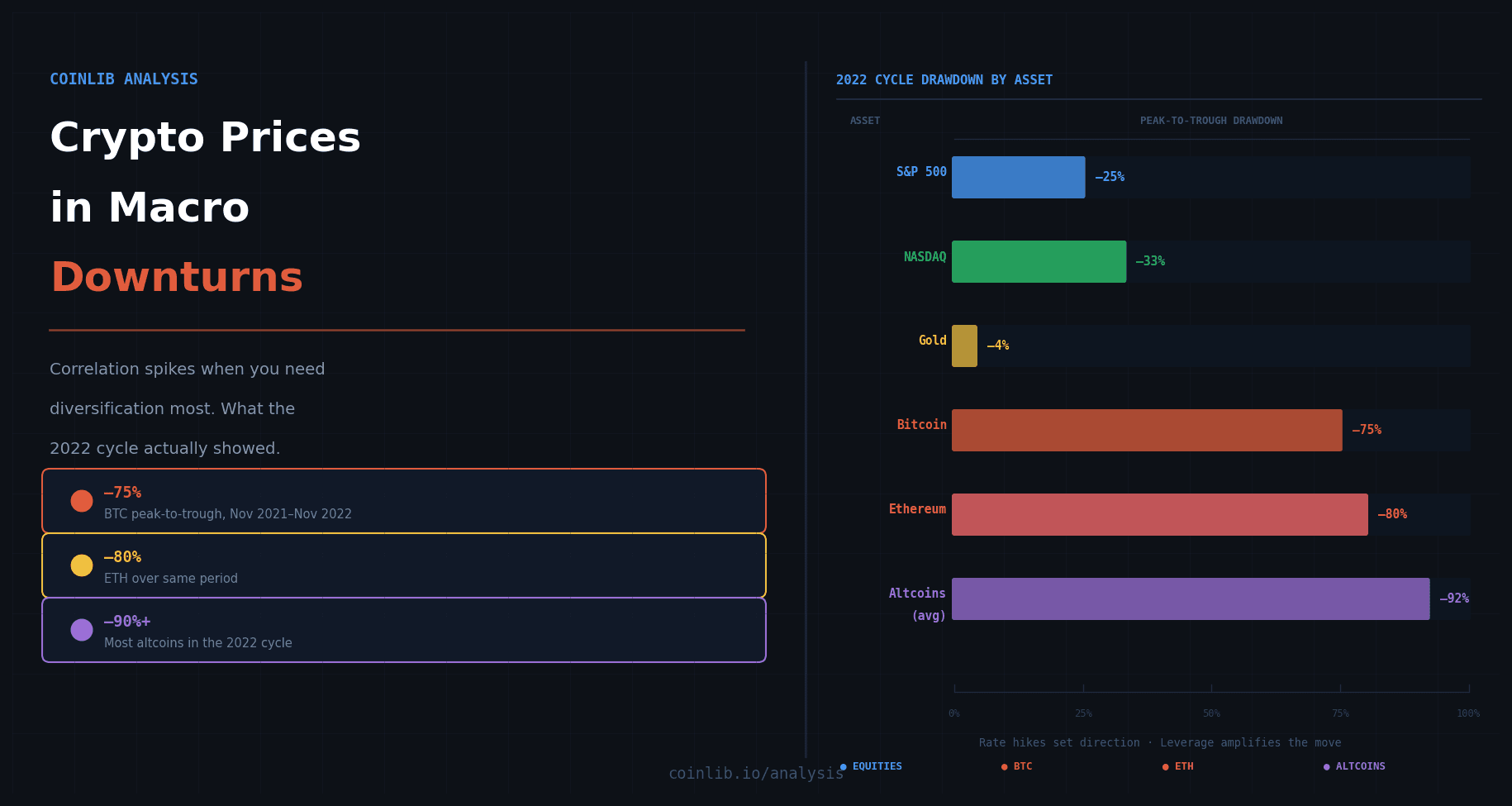
The 2022 downturn provided a more sustained test of the relationship. The Federal Reserve's aggressive interest rate hiking cycle, designed to address the highest inflation in four decades, drove a significant repricing of risk assets across markets. Bitcoin fell from roughly $69,000 in November 2021 to below $16,000 by November 2022 — a drawdown of more than 75 percent. Over the same period, the S&P 500 fell approximately 25 percent and the Nasdaq fell approximately 33 percent. Crypto underperformed substantially, moving in the same direction but with significantly greater magnitude.
Why Crypto Is Sensitive to Rate Environments
The relationship between interest rates and crypto prices is one of the more structurally important dynamics in the market, and it follows the same basic logic as the relationship between rates and growth equity valuations.
When risk-free rates are low, capital flows toward higher-risk, higher-potential-return assets. The opportunity cost of holding volatile assets is low when the alternative is a bank account yielding near zero. When rates rise, the opportunity cost increases. Safe assets become relatively more attractive. Capital rotates toward lower-risk holdings. Assets with high speculative components — which includes most of the crypto market outside of Bitcoin — face selling pressure.
There is also a leverage dimension. The crypto market has historically operated with significant embedded leverage through derivatives markets and lending protocols. When risk sentiment deteriorates and prices fall, leveraged positions face liquidation, which accelerates the selling. The cascading effect of liquidations amplifying drawdowns is a structural feature of the crypto market that makes its downturns more severe than the initial macro shock might imply.
The 2022 cycle illustrated this clearly. The macro-driven repricing of risk assets provided the initial pressure. The collapse of Terra/Luna in May 2022 amplified it by destroying approximately $40 billion in market value and creating contagion through the lending and investment ecosystem. The subsequent insolvencies of Three Arrows Capital, Celsius, Voyager, and FTX were partly products of the macro environment and partly products of leverage and mismanagement that the macro environment exposed. The macro shock and the industry-specific failures compounded in a way that made the final drawdown more severe than either would have produced independently.
Altcoin Behaviour in Macro Downturns
Bitcoin's behaviour in macro downturns is worth separating from the broader altcoin market, because the dynamics are different in important ways.
In risk-off environments, capital within the crypto market tends to concentrate toward Bitcoin. This is sometimes described as a flight to quality within the asset class — Bitcoin has the longest track record, the most institutional recognition, the deepest liquidity, and is generally considered the least speculative of the major crypto assets. When investors reduce exposure to crypto broadly, they often exit altcoins before Bitcoin, and those who remain tend to reallocate toward Bitcoin.
The practical effect is that Bitcoin dominance — Bitcoin's share of total crypto market capitalisation — typically rises during macro downturns. In the 2022 cycle, Bitcoin dominance rose from approximately 38 percent in January 2022 to above 45 percent by year end, as altcoins declined more severely than Bitcoin. Smaller and more speculative tokens with lower liquidity often declined by 90 percent or more while Bitcoin declined by 75 percent. The distinction matters significantly for portfolio outcomes.
Ethereum occupies a middle ground. It declined by approximately 80 percent in the 2022 cycle — more than Bitcoin but substantially less than the majority of smaller altcoins. Its decline reflected both the broader macro environment and Ethereum-specific factors including the uncertainty around the Merge, which was scheduled for September 2022 and introduced execution risk that some investors priced in as a discount.
What Recovery Looks Like
The historical record of crypto price behaviour after macro downturns offers relevant context, though past cycles differ enough in composition and scale that pattern recognition should be applied carefully.
After the March 2020 crash, Bitcoin recovered to its pre-crash price within approximately two months and subsequently reached new all-time highs within the year. The speed of the recovery was partly a function of the macro context: the Federal Reserve's aggressive monetary easing in response to COVID-19 created the same conditions that had driven the bull market in the first place, and global monetary expansion fuelled renewed risk appetite rapidly.
The 2022 recovery has been structurally different. The macro environment remained restrictive through 2023 as central banks continued raising rates. Bitcoin's recovery from its lows was slow relative to the 2020 cycle, reflecting the sustained nature of the rate environment rather than a sharp shock and reversal. The eventual approval of spot Bitcoin ETFs in the United States in January 2024, combined with the expectation and eventual arrival of the Bitcoin halving, provided catalysts that operated independently of macro conditions and supported the recovery.
This illustrates a key dynamic: macro conditions set the backdrop and the direction of pressure, but crypto-specific events — network upgrades, regulatory approvals, structural supply changes — can generate price movements that override or amplify the macro effect.
The Inflation Hedge Argument Revisited
Bitcoin is frequently described as a hedge against inflation, often by analogy to gold. The 2021–2022 inflation episode provided a direct test of this thesis, and the results were not supportive.
Inflation in the US reached a peak of approximately 9.1 percent in June 2022. Bitcoin peaked in November 2021 and was already well into its drawdown by the time inflation was at its most severe. The inflation hedge narrative would predict that Bitcoin should have held value or appreciated during the period of high inflation; in practice, it fell sharply.
The disconnect reflects that the relevant variable is not inflation itself but the interest rate response to inflation. Bitcoin rose during 2020–2021 in a low-rate environment where inflation had not yet arrived. Bitcoin fell during 2022 in a high-rate environment where the Fed was actively fighting inflation. The interest rate environment, rather than inflation itself, drove the direction of Bitcoin's price.
Gold's performance over the same period was more consistent with the inflation hedge characterisation: it appreciated during the period of peak inflation concern, though its gains were modest. The comparison suggests that Bitcoin's correlation with risk assets is stronger than its correlation with the inflation-hedge dynamic attributed to gold — a meaningful distinction for anyone constructing a portfolio around specific macro hedging objectives.
What This Means for Portfolio Thinking
The evidence suggests several practical conclusions about how crypto prices behave in macro downturns.
Crypto is not a reliable hedge against macro risk in most environments. In periods of acute stress, it has tended to sell off alongside equities, often more severely. This is consistent with treating crypto as a risk asset rather than a safe haven, and portfolio construction should reflect that characterisation.
Within the crypto market, the severity of macro downturns is not evenly distributed. Bitcoin has historically declined less severely than most altcoins, and altcoin declines have been more severe the further down the capitalisation spectrum you go. Concentration toward larger-cap assets reduces drawdown severity in macro downturns at the cost of lower potential upside in risk-on periods.
The macro environment shapes the floor for crypto prices, but crypto-specific catalysts can dominate over shorter time horizons. Understanding both dimensions — where the macro environment is in the rate cycle and what crypto-specific events are approaching — is necessary for making sense of price movements that might otherwise appear inconsistent with either factor alone.
Macro downturns also expose leverage within the crypto ecosystem in ways that are not always visible during bull markets. The firms, funds, and protocols that operate with significant embedded leverage amplify the impact of macro pressure. Assessing counterparty risk and leverage exposure in the broader ecosystem is therefore part of understanding how severe any given macro downturn will be for crypto prices specifically.