

What Crypto Volatility Actually Looks Like in the Data
Crypto is volatile. That much is stated constantly. What is stated less often is exactly how volatile, how that volatility compares to other assets, how it has changed over time, and what patterns appear in the data when you look at it carefully. The qualitative observation that crypto prices move sharply is not particularly useful for anyone trying to make informed decisions. The quantitative picture is more instructive and more nuanced than the general characterisation suggests.
This is what the data actually shows.
How Volatility Is Measured
Before examining the numbers, it helps to be precise about what volatility means in a quantitative context. The standard measure is annualised historical volatility: the standard deviation of daily logarithmic returns, scaled to an annual figure by multiplying by the square root of 252 (the approximate number of trading days in a year). This produces a percentage figure that expresses how much an asset's price can be expected to move in a typical year, based on observed behaviour over the measurement window.
A 30-day rolling volatility calculation uses the most recent 30 days of return data and updates daily, producing a time series that shows how volatility has evolved over time. Longer windows (90-day, 180-day) produce smoother but less responsive estimates. Shorter windows (7-day, 14-day) are more reactive but noisier.
Implied volatility is a forward-looking measure derived from options prices, reflecting what market participants collectively expect future volatility to be rather than what it has been historically. The DVOL index, which measures implied volatility for Bitcoin options, functions similarly to the VIX in equity markets and has become a widely followed indicator of market uncertainty in crypto.
Bitcoin Volatility Versus Traditional Assets
The most common quantitative comparison is Bitcoin's annualised volatility against equities, gold, and government bonds. The numbers are stark.
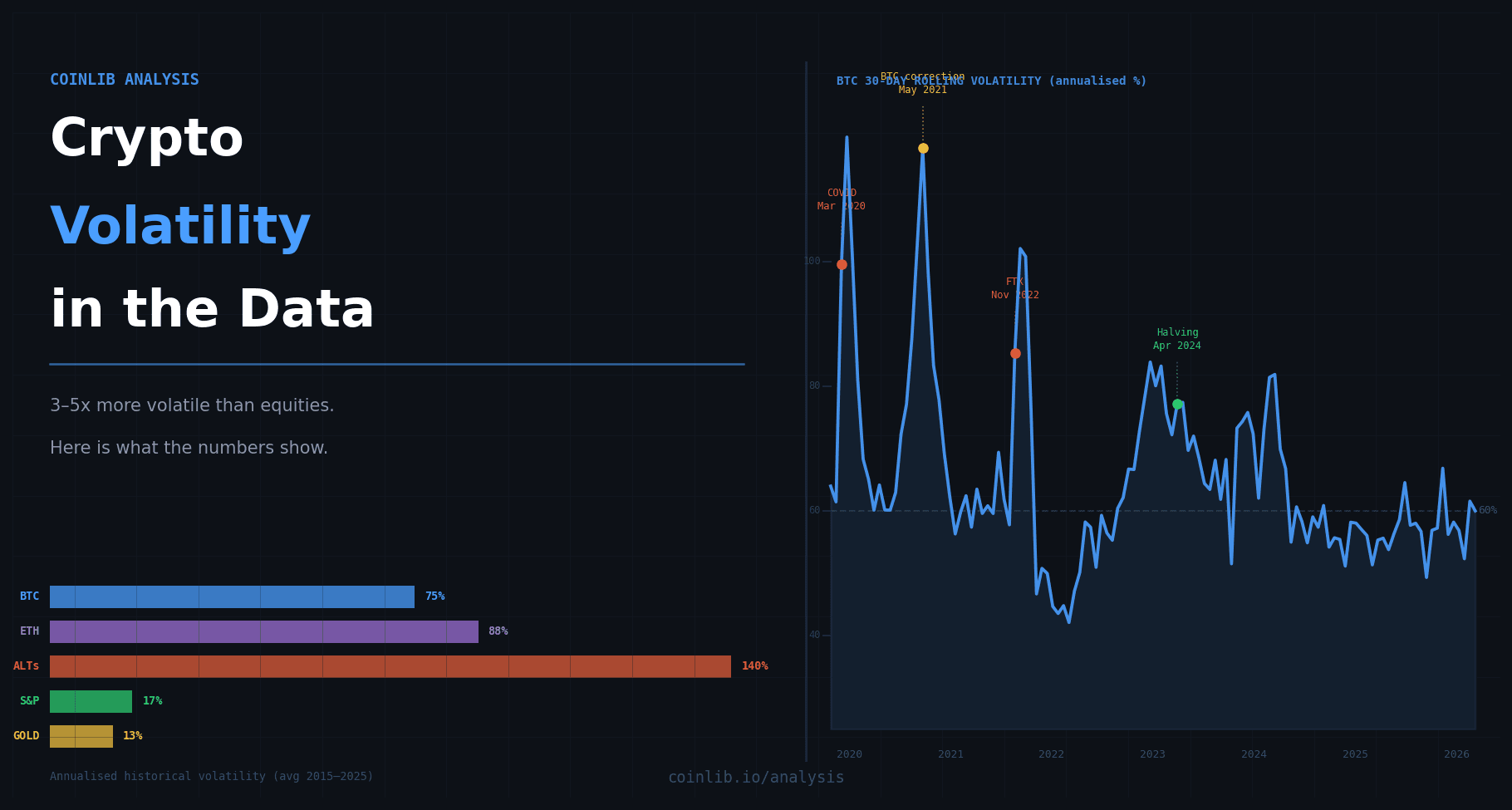
Over the period from 2015 to 2025, Bitcoin's annualised historical volatility averaged approximately 70 to 80 percent. For comparison, the S&P 500 averaged roughly 15 to 20 percent over the same period. Gold averaged approximately 12 to 15 percent. Long-duration government bonds averaged 8 to 12 percent. Bitcoin was not marginally more volatile than equities. It was three to five times more volatile.
The practical meaning of those numbers is significant for portfolio construction. At 75 percent annualised volatility, a 1 standard deviation move in Bitcoin over a year represents a 75 percent price change. In a normal distribution, roughly one third of all annual returns would be expected to fall outside that range in either direction. Two-standard-deviation moves, which occur with meaningful frequency in fat-tailed distributions, represent 150 percent moves.
Bitcoin's return distribution is not normal. It exhibits excess kurtosis, meaning that extreme moves occur more frequently than a normal distribution would predict, and negative skewness, meaning that large negative returns occur more frequently than large positive returns of the same magnitude. These properties make standard volatility measures somewhat conservative underestimates of the actual tail risk in the asset.
The Trend in Bitcoin Volatility Over Time
One of the more significant findings in long-run Bitcoin volatility data is that volatility has declined substantially as the asset has matured, though it remains high by any comparison to traditional markets.
In Bitcoin's early years (2010 to 2013), annualised volatility frequently exceeded 150 to 200 percent. The market was small, illiquid, and dominated by a relatively small number of participants. Price discovery was highly uncertain. Large movements on thin order books were common.
As market capitalisation grew, institutional participation expanded, and derivatives markets developed, volatility moderated. The 2021 to 2026 period has seen Bitcoin's annualised volatility trend toward the 50 to 60 percent range during periods of relative stability, with spikes to 80 to 100 percent during acute stress events. That is a meaningful decline from early cycle levels, but still represents volatility several times that of large-cap equities.
The maturation thesis holds that Bitcoin's volatility will continue to decline as the asset accumulates more liquidity, more diverse holders with different time horizons, and deeper derivatives markets that allow for more efficient price discovery. Whether it will decline enough to become comparable to equities on any near-term horizon is a more speculative claim than the directional observation that it has been declining.
Altcoin Volatility: A Different Scale Entirely
Bitcoin's volatility, high by traditional asset standards, is moderate by crypto standards. Altcoins, particularly smaller-cap assets, exhibit volatility levels that make Bitcoin look stable by comparison.
Ethereum has historically traded at roughly 1.1 to 1.4 times Bitcoin's volatility over comparable periods. That is a meaningful premium but not dramatically different in character. Mid-cap altcoins with market capitalisations in the single-digit billions typically exhibit annualised volatility in the 100 to 150 percent range in normal market conditions, with spikes to 200 percent or higher during market stress. Small-cap tokens can see annualised volatility figures of 300 to 500 percent, which in practical terms means the possibility of losing 70 to 90 percent of value in a matter of months even without a broader market collapse.
The pattern is consistent with liquidity-driven volatility: thinner order books mean that given amounts of buying or selling create larger price movements. A $1 million sell order has a negligible impact on Bitcoin's price and a potentially significant impact on a small-cap token's price. This liquidity difference drives much of the volatility differential across the crypto market cap spectrum.
Volatility Clustering and What It Means
One of the well-documented statistical properties of financial return data is volatility clustering: periods of high volatility tend to be followed by further high volatility, and periods of low volatility tend to be followed by further low volatility. This property is present in traditional markets and is pronounced in crypto.
The practical implication is that current volatility conditions are informative about near-term expected volatility. A period of calm, where daily price moves are consistently small and the rolling volatility measure is declining, is more likely to be followed by continued calm than by immediate turbulence. Conversely, a volatility spike is more likely to be followed by continued elevated volatility than by immediate return to calm.
This property is why traders and risk managers pay close attention to rolling volatility metrics and implied volatility indices. A sudden rise in the DVOL index for Bitcoin signals that options market participants are pricing in greater uncertainty about near-term price direction. Historically, elevated implied volatility in crypto has been a reasonable indicator of upcoming price turbulence, even if the direction of that turbulence is not predictable.
Volatility During Specific Market Events
The most extreme volatility readings in Bitcoin's history are clustered around specific identifiable events, and examining those events illustrates the mechanisms that drive volatility spikes.
The March 2020 COVID shock produced a 24-hour price decline of approximately 50 percent in Bitcoin, generating a volatility reading that briefly reached the highest level since Bitcoin's early years. The mechanism was liquidity-driven: a global rush to cash across all markets created simultaneous selling pressure, and Bitcoin's relatively thin institutional order book at the time amplified the move beyond what the underlying selling pressure would have suggested in a deeper market.
The May 2021 decline, which saw Bitcoin fall from approximately $58,000 to $30,000 over several weeks, was driven by a combination of factors including Chinese mining regulation announcements, Elon Musk's reversal on Bitcoin payments at Tesla, and the leverage cascade mechanics described elsewhere. The sustained nature of the decline, rather than a single extreme day, produced elevated volatility readings over an extended window.
The November 2022 FTX collapse produced sharp volatility concentrated over a few days as uncertainty about the exchange's solvency resolved rapidly into confirmed insolvency. The specific shock was that FTX was a systemically important exchange, and its failure created uncertainty about the health of other counterparties across the ecosystem, driving selling pressure beyond FTX-specific assets.
Each of these events shares a common feature: volatility that was substantially higher than its recent baseline, occurring during a period of genuine fundamental uncertainty rather than purely technical price fluctuation.
What 2025 and 2026 Volatility Data Shows
The 2025 period, characterised by the post-halving appreciation cycle and accelerating institutional adoption, showed a pattern consistent with previous bull markets: moderately elevated but not extreme volatility on the way up, followed by higher volatility spikes during consolidation periods.
The periods of sharpest volatility in 2025 to 2026 have been concentrated around macro events and regulatory developments rather than crypto-specific catalysts. Bitcoin's correlation with risk assets has meant that Federal Reserve communications, inflation data releases, and geopolitical developments produce measurable volatility responses. This represents a change from earlier cycles where crypto volatility was more idiosyncratic and less connected to macro drivers.
The data for 2026 year-to-date shows Bitcoin's 30-day realised volatility oscillating between approximately 45 and 75 percent annualised, with spikes to the higher end coinciding with leverage liquidation events and macro uncertainty periods. That range is consistent with a maturing but still highly volatile asset.
What the Data Means for Decision-Making
Volatility data is not just descriptive. It has practical applications for anyone allocating to or trading crypto assets.
For portfolio construction, the core insight is that a small allocation to Bitcoin significantly increases a portfolio's overall volatility due to Bitcoin's high absolute volatility and imperfect correlation with other assets. Studies consistently show that allocations above 5 to 10 percent of a traditional portfolio begin to dominate the portfolio's overall risk profile, making Bitcoin the primary driver of portfolio variance. Below those levels, the diversification benefit of crypto's low average correlation with equities and bonds can improve risk-adjusted returns depending on the measurement period.
For risk management, the volatility clustering property means that position sizing should adapt to current volatility conditions. Larger positions are appropriate when current volatility is low relative to historical norms; smaller positions when volatility is elevated and likely to remain so. This is the intuition behind volatility-adjusted position sizing, which many systematic traders apply to crypto positions.
For anyone trying to understand why crypto price moves look so extreme relative to other markets, the answer is straightforwardly in the data. The asset is simply more volatile by a factor of three to five compared to mainstream alternatives, the distribution has fatter tails than a normal distribution, and liquidity-driven amplification during stress events means that the worst days are worse than historical volatility estimates would suggest. Knowing that does not make the moves more comfortable, but it does make them less surprising.