

What Crypto Adoption Looks Like at Street Level in 2026
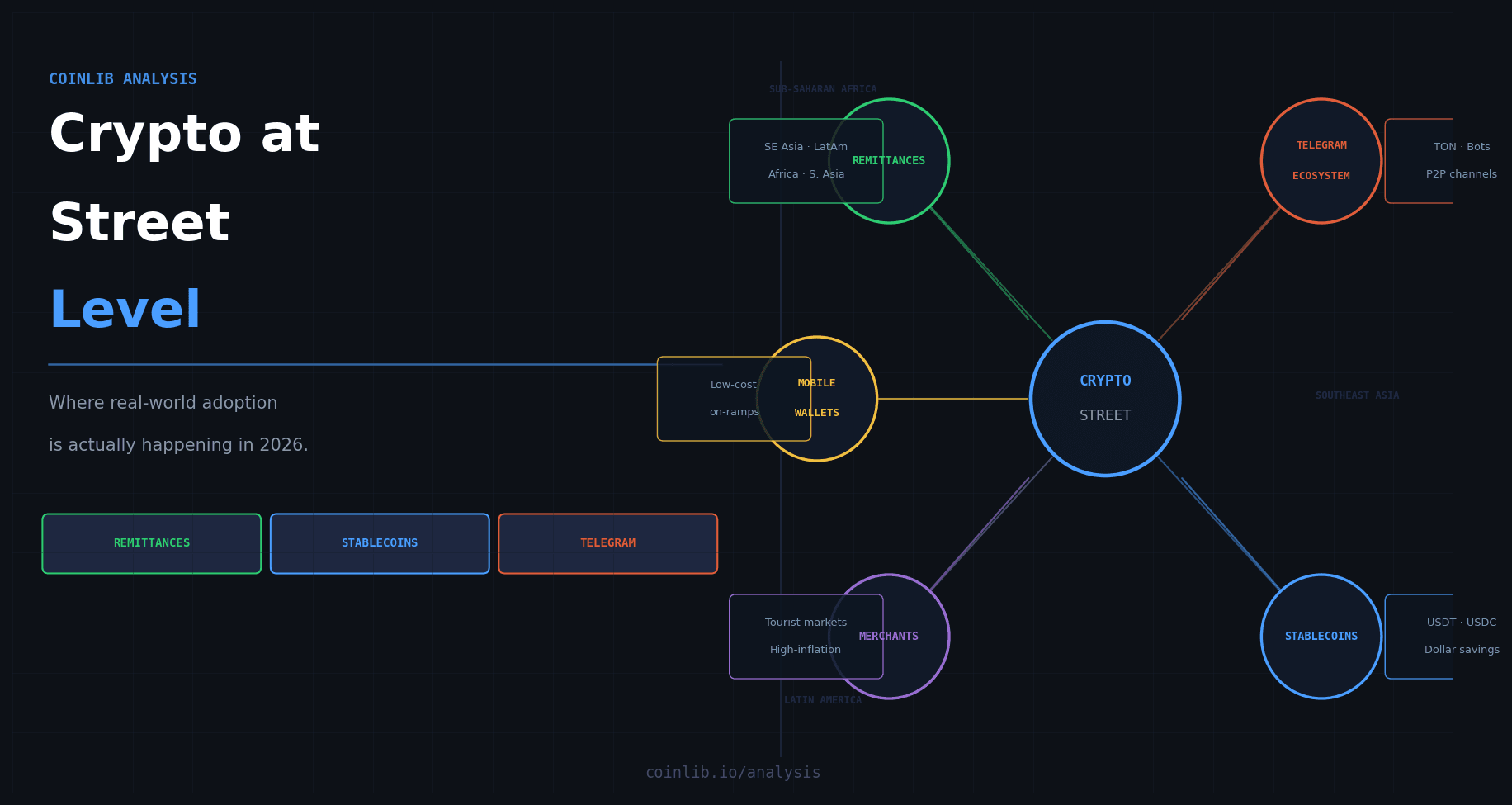
The institutional adoption story for crypto in 2026 is relatively well documented. Spot ETF inflows, corporate treasury allocations, and regulatory progress generate press releases, analyst reports, and congressional testimony. The street-level adoption story is harder to find in those sources and often more revealing about where crypto is actually going.
Street-level adoption means the person sending money home to family in a different country through a stablecoin wallet. It means the freelancer in Lagos or Manila receiving payment from a client in Germany without a bank account that supports international transfers. It means the small merchant in Istanbul accepting USDT because the Turkish lira has lost too much purchasing power to be a reliable business operating currency. These are not headline stories. They are the actual texture of how crypto is embedding itself into daily economic life.
Remittances and the Most Practical Use Case
The clearest street-level adoption signal in crypto is the remittance corridor. International remittances represent one of the largest and most consistently underserved financial flows in the world. Migrant workers sending money home through traditional channels pay fees that average 6 to 8 percent of the transaction value, face delays of several business days, and in some corridors encounter limited availability of recipient-side financial services.
Stablecoin transfers have carved out a real and growing share of this market. A worker in the United Kingdom sending USDC to a family member in the Philippines can complete the transfer in minutes for a fraction of a percent in fees, provided both parties have access to a wallet and a way to convert in and out of local currency on each end. That last step, the local currency conversion, remains the friction point, and the quality of that infrastructure varies significantly by country.
In several major remittance-receiving countries, local exchange infrastructure has matured enough to make the full flow practical for non-technical users. Peer-to-peer exchange markets, mobile-based conversion services, and informal crypto exchange networks have developed organically to serve this demand. The adoption is not top-down. It is people solving a real financial problem with the tools available to them.
Mobile-First Markets and Wallet Penetration
Smartphone penetration has been the primary enabler of street-level crypto adoption in markets where traditional banking infrastructure is thin. In Sub-Saharan Africa, where mobile money platforms like M-Pesa have demonstrated for years that financial services can scale through phones rather than bank branches, crypto wallet adoption has followed a similar pattern.
The wallet interface has improved significantly since the early years of crypto. Applications designed for non-technical users in emerging markets prioritise simplicity, local language support, and integration with local payment rails. The user no longer needs to understand private keys or blockchain mechanics to send a stablecoin payment. The experience has converged toward the simplicity of mobile money, with the added benefit of operating across borders without a central operator controlling access.
Bitcoin remains the most recognised crypto brand at street level globally, but it is rarely the asset people are actually using for day-to-day transactions. Stablecoins carry the functional volume because price stability matters enormously for anyone using crypto as a spending or transfer medium rather than a speculative holding. Bitcoin's recognition drives initial awareness. Stablecoins handle the actual use.
Telegram as a Crypto Adoption Layer
One of the less discussed but practically significant vectors for street-level crypto adoption is Telegram. The messaging platform has developed into a crypto ecosystem of its own, partly through its native TON blockchain and partly through the organic development of crypto bots, P2P trading channels, and crypto-enabled services that operate within its infrastructure.
In markets where banking access is limited and regulatory environments are unclear, Telegram channels have become coordination points for peer-to-peer crypto exchange. Buyers and sellers connect, negotiate rates, and settle in stablecoins without any formal exchange infrastructure. The model is informal and carries counterparty risk, but it works, and it has enabled crypto participation in markets where the formal on-ramp infrastructure does not exist.
The range of crypto-native services operating on Telegram has expanded substantially. Entertainment platforms, including options like a Telegram casino with no deposit bonus, have emerged as part of a broader ecosystem of crypto-native applications that operate entirely within the messaging environment, reflecting how Telegram has become a distribution channel for digital services that assume crypto as the payment layer from the ground up.
The TON blockchain, native to Telegram's infrastructure, has accelerated this by making wallet integration seamless within the app. A Telegram user can hold, send, and receive TON tokens without leaving the messaging interface. For populations who live primarily in messaging apps rather than browser-based environments, this lowers the adoption threshold substantially.
Small Merchants and the Acceptance Question
Small merchant crypto acceptance remains patchy in 2026, though the pattern of where it is and is not happening is instructive.
In tourist-facing economies where significant numbers of visitors hold crypto, particularly in parts of Southeast Asia, Eastern Europe, and Central America, crypto payment acceptance among small businesses has grown organically. Merchants in Bali, Chiang Mai, Tbilisi, and similar destinations report meaningful demand from crypto-holding travellers, and the availability of simple point-of-sale tools that convert crypto to local currency instantly has removed the price volatility objection that historically deterred acceptance.
In high-inflation economies, a different dynamic drives merchant adoption. Merchants who accept local currency face real purchasing power losses between receiving payment and spending on restocking. Merchants who convert immediately to USDT or USDC preserve value in a way that local currency denominated receipts cannot. This is not ideological crypto adoption. It is rational business behaviour in an inflationary environment.
In stable, card-dominated economies, small merchant crypto acceptance remains rare. The switching cost from card infrastructure is high, consumer demand is low, and the practical advantages of crypto payments over contactless cards are not sufficient to justify the friction. This is the part of the world where the institutional crypto narrative is loudest and the street-level adoption is thinnest.
The Trust and User Experience Gap
Talking to people who have adopted crypto at street level reveals that the decision is almost always driven by a specific, concrete problem that traditional finance was not solving. It is rarely driven by ideology, investment thesis, or technology enthusiasm. The person using stablecoins to receive freelance payments is not a crypto believer. They are someone who needed to get paid and found a method that worked.
This pragmatic adoption pattern is actually more durable than ideologically driven adoption, because it is attached to a real utility rather than a narrative that can shift. But it also means that the barriers to adoption are different from what product developers often assume. The friction is not usually technical. It is trust and familiarity. People adopt financial tools when they see someone they know using them successfully. Word-of-mouth and community demonstration effects drive adoption in ways that marketing cannot replicate.
The user experience gap between crypto and traditional financial services has narrowed considerably but has not closed. For routine transactions, well-designed stablecoin wallets are genuinely simple to use. For anything involving recovery from errors, navigating multiple chains, or understanding gas fees and network congestion, the experience still requires a level of comfort with technical concepts that most people do not have and do not want to develop.
What Street-Level Adoption Actually Measures
Street-level adoption is a better measure of crypto's long-term trajectory than price or institutional inflow data, because it reflects genuine utility rather than speculative positioning. Assets and networks that accumulate real users solving real problems with them tend to persist. Those that attract capital primarily through speculative interest tend not to.
The evidence from street-level usage in 2026 suggests that stablecoins have genuine, durable adoption in specific high-value use cases. Bitcoin has achieved cultural recognition that translates into speculative holding behaviour across a wide demographic range. DeFi protocols have a committed but relatively small active user base. Ethereum's ecosystem continues to build developer infrastructure whose consumer applications are still emerging.
The adoption that exists at street level is real, concentrated, and often invisible to the parts of the world that generate most of the crypto media coverage. It is also the foundation on which everything else eventually gets built.