

Understanding Gas Fees: What They Are and Why They Move
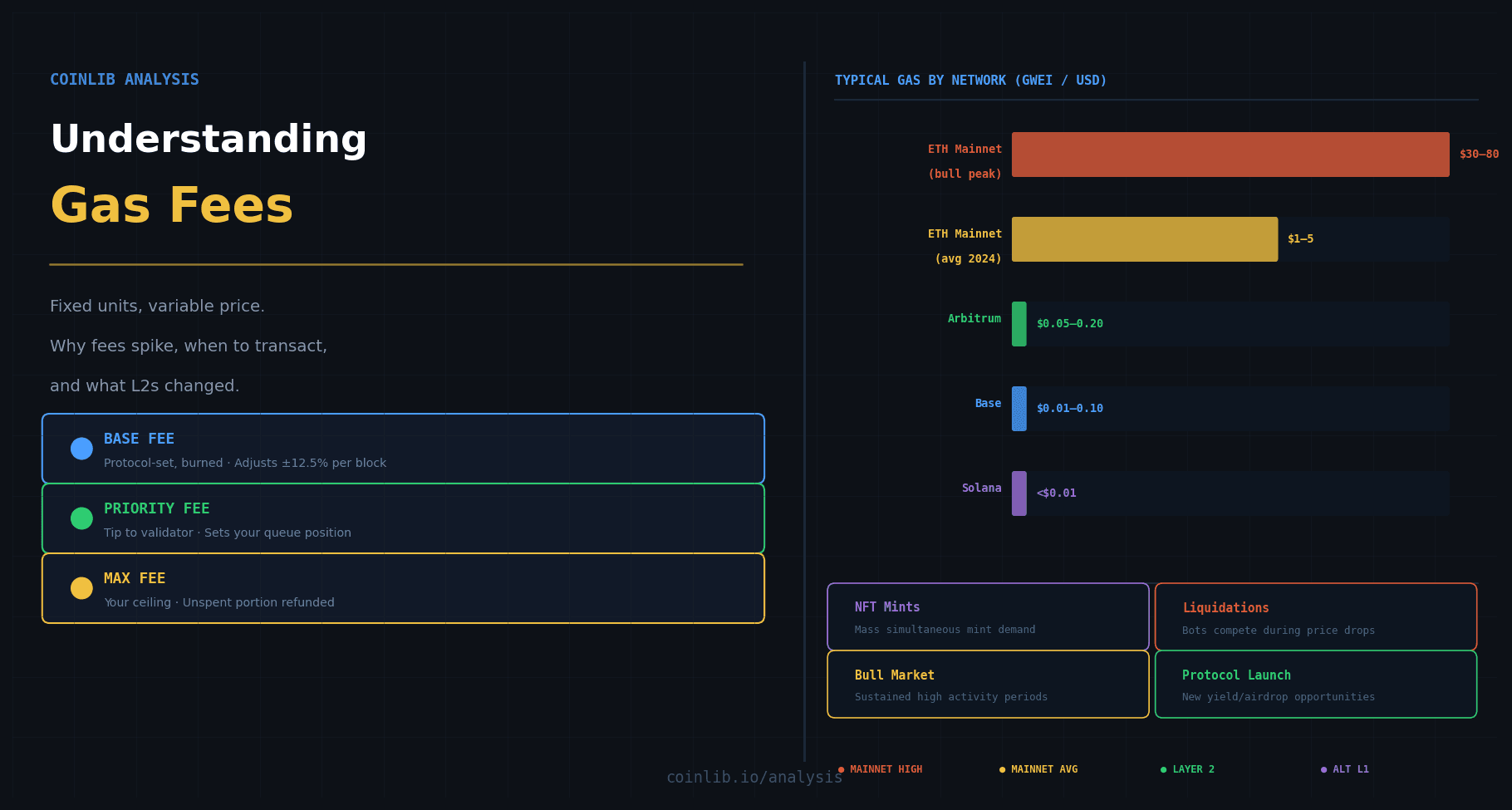
Gas fees are one of the most misunderstood costs in crypto. Users encounter them as a number that fluctuates unpredictably, sometimes making simple transactions prohibitively expensive. The underlying mechanism is logical, but the way fees are presented — and the way they behave — creates confusion that leads to poor decisions and a lot of unnecessary spending.
What Gas Actually Is
Gas is the unit that measures computational effort on the Ethereum network. Every operation a transaction or smart contract execution requires — reading from storage, writing to storage, performing arithmetic, calling another contract — has a fixed gas cost specified in the Ethereum protocol. Sending ETH from one address to another costs exactly 21,000 gas. Interacting with a complex DeFi protocol might cost several hundred thousand gas depending on how much computation the smart contract requires.
The gas cost of an operation is fixed by the protocol. What varies is the price paid per unit of gas, denominated in gwei (one gwei equals one billionth of one ETH). The total fee you pay is simply gas used multiplied by gas price. A 21,000 gas transaction at 30 gwei per unit costs 630,000 gwei, or 0.00063 ETH.
This two-part structure — fixed gas units, variable gas price — is important because it means the cost of different transaction types relative to each other is constant, while the absolute cost in ETH and dollars fluctuates with both network demand and ETH's price.
EIP-1559 and How Fees Work Today
Before August 2021, Ethereum used a simple auction mechanism: users bid a gas price and miners included transactions offering the highest price. This created significant fee volatility and made it difficult to estimate costs reliably — users often overpaid to ensure inclusion or underpaid and waited.
EIP-1559 replaced this with a two-component fee structure that remains in use today.
The base fee is a protocol-determined price per gas unit that applies to every transaction in a block. The base fee adjusts automatically based on how full recent blocks have been. When blocks are more than 50 percent full, the base fee increases by up to 12.5 percent for the next block. When blocks are less than 50 percent full, it decreases by the same amount. This creates a self-correcting mechanism: high demand drives up the base fee, which eventually prices out marginal transactions, reducing demand and allowing the base fee to fall. The base fee is burned — it is not paid to validators.
The priority fee, also called the tip, is paid directly to the validator who includes the transaction. Users set this themselves as an incentive for validators to prioritise their transaction. During low-congestion periods, a tip of 1 gwei is sufficient. During high congestion, users competing for block inclusion raise their tips.
The max fee is the maximum total the user is willing to pay per gas unit, covering both base fee and tip. If the base fee is lower than expected when the transaction is processed, the user pays less than the max fee — the difference is refunded. This protects users from overpaying if conditions improve between when they submit a transaction and when it is included.
Why Fees Spike
Gas fee spikes happen when demand for block space exceeds supply. Ethereum produces a block roughly every 12 seconds, and each block has a gas limit — currently around 30 million gas for a target of 15 million gas, with the EIP-1559 mechanism adjusting based on that target. When the volume of transactions users want confirmed requires more gas than blocks can accommodate, users compete by raising their tips.
The triggers for fee spikes are consistent across market history. NFT mint events, where thousands of users simultaneously attempt to mint tokens from a popular collection, have produced some of the most extreme spikes. In May 2022, the Otherdeed for Otherside NFT mint drove gas fees above 6,000 gwei for a sustained period, making routine transactions cost hundreds of dollars. DeFi liquidation cascades, where falling asset prices trigger automated liquidations across lending protocols simultaneously, also drive sharp fee increases as bots compete to execute liquidations first.
Bull market periods produce sustained elevated fees as general trading activity increases. The 2021 bull market saw periods where average gas fees remained above 100 gwei for weeks, making the cost of interacting with DeFi prohibitive for small capital sizes. A $500 position in a lending protocol could cost $50 to deposit and another $50 to withdraw — a 20 percent round-trip cost before any interest or loss on the position itself.
Fee Estimation and Timing
The practical skill of managing gas fees is about timing and tool selection. Ethereum gas prices follow a weekly and daily cycle driven by the geographic distribution of users.
Gas prices are consistently lower during periods when Asian and European users are asleep and US users are not yet active — broadly, weekend mornings in UTC time, roughly 00:00 to 08:00 UTC on Saturdays and Sundays. During these windows, base fees can be a fraction of weekday peak rates. For transactions that are not time-sensitive, waiting for a low-fee window reduces costs meaningfully.
Gas estimation tools including Etherscan's gas tracker and the gas estimators built into major wallets provide current base fee and recent history. MetaMask's "advanced" fee settings and similar wallet interfaces let users set custom max fees and tips rather than relying on the wallet's automatic estimates, which often overestimate in the user's favour to ensure transaction inclusion.
The tradeoff in timing transactions is always speed versus cost. A transaction submitted with a low tip during high congestion may wait in the mempool for hours or remain unconfirmed if the base fee rises above the max fee the user set. Users who need transactions confirmed quickly during congested periods should expect to pay higher fees. Users with flexible timing have meaningful room to reduce costs.
Gas Across Different Networks
Understanding gas fees on Ethereum mainnet also requires understanding how Layer 2 networks change the equation.
Arbitrum, Optimism, Base, and other Layer 2 rollups process transactions off mainnet and post compressed summaries to Ethereum. Because the cost of posting to Ethereum is spread across many transactions, the per-transaction cost falls dramatically. Typical transaction costs on major Layer 2 networks are in the range of $0.01 to $0.20 for standard transactions, compared to $1 to $50 on Ethereum mainnet depending on conditions.
The gas mechanism on Layer 2s mirrors Ethereum's in structure — there is a gas unit cost for computation and a gas price that reflects demand — but the absolute numbers are orders of magnitude lower. Layer 2 fees are not zero, and they can rise during periods of high Layer 2 activity, but the ceiling is much lower than on mainnet because the base cost of settling to Ethereum is shared across a batch of many transactions.
The introduction of EIP-4844 in March 2024, which added a new type of data storage to Ethereum specifically designed for rollup data, further reduced Layer 2 fees by lowering the cost of posting transaction batches to mainnet. After EIP-4844's implementation, fees on major Layer 2s dropped by 80 to 90 percent in many cases.
Other Layer 1 networks — Solana, Avalanche, BNB Chain — have their own fee structures. Solana uses a fixed base fee per transaction with a priority fee mechanism similar in concept to Ethereum's tip, but base fees are a fraction of a cent and the network's throughput is high enough that congestion is rare under normal conditions. The tradeoff is that Solana's fee stability comes from a different architectural approach with different security properties, which is a separate analysis from the fee question alone.
What Gas Fees Mean for Strategy
The practical implications of gas fees for how you use on-chain applications are more significant than they might appear on the surface.
Position sizing matters differently when transactions carry non-trivial costs. On Ethereum mainnet, a yield farming position that generates 5 percent annually on $500 of capital might cost $30 to enter and $30 to exit — a 12 percent round-trip cost that makes the position economically irrational at that size. The same strategy on a Layer 2 at $0.10 per transaction has negligible cost impact. Understanding where a strategy should be executed, not just what the strategy is, is part of the analysis.
Timing rebalances around fee windows reduces costs over time. A portfolio that is rebalanced monthly will incur significantly lower cumulative fees if those rebalances happen during low-congestion periods rather than during peak activity. This is worth building into any systematic on-chain strategy.
Failed transactions still cost gas. If a transaction is submitted and fails — because a smart contract condition was not met, because slippage limits were exceeded, or because the user's inputs were incorrect — the gas consumed up to the point of failure is still charged. The ETH is not refunded. Verifying transaction parameters before submission is basic discipline, and it connects directly to the broader question of crypto security when approving contract interactions — understanding exactly what you are signing before you sign it avoids both failed transactions and the more serious risk of approving malicious contracts.
Setting appropriate slippage tolerances and double-checking recipient addresses before confirming a transaction avoids costs that provide no benefit whatsoever. These habits become more important as transaction values increase.
The long-term direction of gas fees on Ethereum is toward lower costs as Layer 2 adoption increases and further protocol improvements reduce mainnet demand. The practical implication today is that most DeFi activity makes more economic sense on Layer 2s than on mainnet for the majority of users, with mainnet reserved for high-value transactions where the absolute fee is proportionally small.