

Understanding Crypto Liquidations: How and Why They Happen
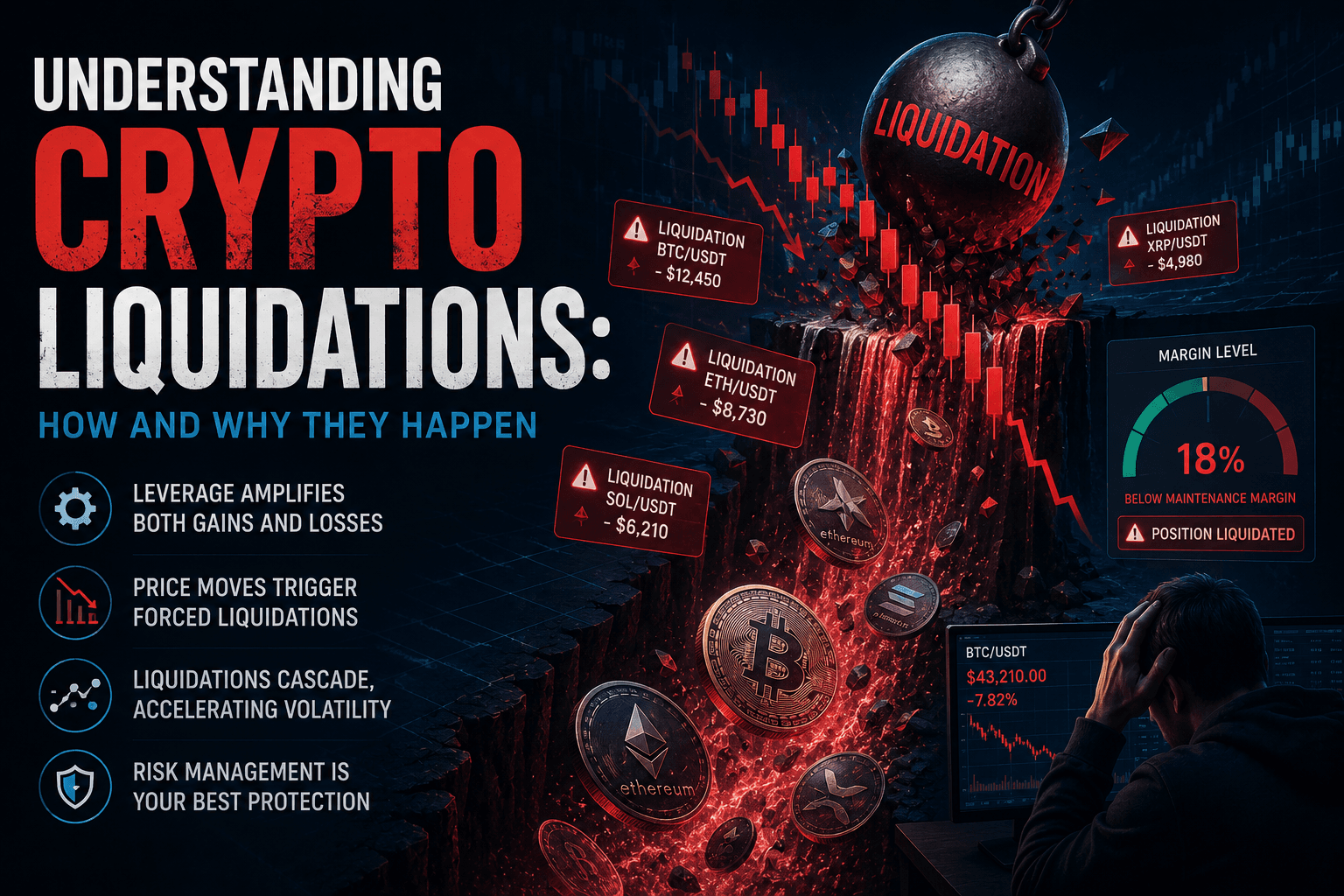
Liquidations are one of the mechanisms that make crypto markets more volatile than most other asset classes. They are also one of the least understood by retail participants until they experience one directly. Understanding how liquidations work, why they cascade, and what the data shows about when they tend to occur is practical knowledge for anyone operating in leveraged crypto markets, and useful context for anyone trying to understand why crypto prices sometimes move violently without an obvious fundamental trigger.
The short version is that liquidations are forced closures of leveraged positions when a trader's collateral falls below the minimum required to sustain the position. The longer version involves mechanics that compound in ways that can turn a moderate market move into an extreme one.
How Leveraged Positions Work
To understand liquidations, the starting point is leverage. When a trader opens a leveraged position on a crypto exchange, they are effectively borrowing capital to control a position larger than their own funds would allow. A trader with $1,000 of collateral using 10x leverage controls a $10,000 position.
The exchange extends this leverage on the condition that the trader maintains enough collateral to cover potential losses up to a defined threshold. That threshold is the maintenance margin requirement. As long as the position's unrealised loss has not eroded the collateral below the maintenance margin, the position remains open. When losses erode collateral to that level, the exchange's liquidation engine automatically closes the position to protect the exchange from losses beyond the collateral available.
The liquidation price is determined at position entry by the leverage used, the entry price, and the maintenance margin requirement. A trader using 10x leverage on a Bitcoin long position at $80,000 might have a liquidation price around $72,000, depending on the specific exchange's maintenance margin requirements. A price move of roughly 10 percent against the position is enough to trigger liquidation at that leverage level.
Higher leverage compresses the distance between entry price and liquidation price dramatically. At 50x leverage, a 2 percent adverse price move can be sufficient to trigger liquidation. This is why high-leverage trading in volatile assets like crypto carries substantial risk of total collateral loss even on relatively small price moves.
The Liquidation Engine
When a position reaches its liquidation price, the exchange's automated liquidation engine takes over. The engine closes the position at market price, using the remaining collateral to cover any losses. If the position is closed at a price worse than the liquidation price due to slippage or fast-moving markets, the shortfall is covered by the exchange's insurance fund.
Different exchanges handle the liquidation process differently. Some exchanges take over the position themselves as a counterpart before attempting to close it in the market, which can reduce the immediate market impact. Others close the position directly through the order book. The distinction matters in fast markets where large positions being liquidated simultaneously can create significant slippage.
Insurance funds exist on most major derivatives exchanges to cover situations where liquidations cannot be executed at a price sufficient to cover losses. The insurance fund is built from a portion of the gains from positions that are liquidated before they reach negative equity. When the insurance fund is insufficient to cover losses, some exchanges use an auto-deleveraging mechanism that forces profitable traders to absorb the loss by having their positions partially closed.
Why Liquidations Cascade
Individual liquidations are a normal feature of leveraged markets. Liquidation cascades are the phenomenon that creates the extreme moves visible in crypto price data and the source of the market's outsized volatility relative to unleveraged markets.
A cascade begins when a price move liquidates a cluster of positions concentrated at similar price levels. Those liquidations create sell orders in the market. The sell orders push the price lower. The lower price reaches the liquidation threshold of the next cluster of positions. Those positions are liquidated, creating more sell orders. The process repeats until either the position clusters are exhausted, a price level where buy interest absorbs the selling is reached, or the price has moved far enough that the remaining open positions are no longer near their liquidation levels.
The size of a cascade depends on two factors: how large the aggregate open interest in leveraged positions is, and how concentrated those positions are around particular price levels. When large amounts of leveraged capital are clustered at similar entries after a directional trend, the preconditions for a significant cascade are in place. A trigger event, which can be relatively small in isolation, initiates the process.
Liquidation data from blockchain analytics platforms and exchange reporting shows clear patterns in how cascades develop. The $2.5 billion in liquidations that occurred during Bitcoin's move from approximately $58,000 to $43,000 in May 2021 followed exactly this pattern: a large volume of long positions accumulated during a trend, a price reversal triggered the first cluster of liquidations, and the subsequent selling accelerated the move far beyond what the initial selling pressure would have suggested.
DeFi Liquidations: A Different Mechanism
Centralised exchange liquidations and DeFi protocol liquidations operate on the same principle but through different mechanisms.
In DeFi lending protocols like Aave and Compound, users deposit collateral and borrow against it. The protocol maintains a health factor for each position based on the ratio of collateral value to borrowed value, adjusted for asset-specific risk parameters. When the health factor falls below 1, the position becomes eligible for liquidation.
DeFi liquidations are executed not by a centralised engine but by independent liquidators, typically bots run by arbitrageurs who monitor protocol health factors and execute liquidations in exchange for a liquidation bonus. The bonus is paid from the borrower's collateral and represents the profit incentive that keeps the liquidator network functioning.
The liquidation bonus varies by protocol and collateral type, typically ranging from 5 to 15 percent of the liquidated amount. This means that a DeFi liquidation costs the borrower more than simply closing their position at the liquidation threshold. A borrower with $10,000 in collateral and a $9,000 loan approaching the liquidation threshold may lose $450 to $1,350 in liquidation penalties in addition to any collateral loss from the price move that triggered the liquidation.
The DeFi liquidation system has generally worked as designed during normal market conditions. During extreme volatility, particularly events where gas fees spike dramatically because every participant is trying to transact simultaneously, the system faces stress. Liquidator bots compete to execute liquidations, driving gas prices higher and potentially creating situations where smaller liquidations are not economically viable to execute because gas costs exceed the liquidation bonus.
Reading Liquidation Data
Liquidation data has become a widely followed market indicator in crypto. Several data providers track aggregate liquidation volumes across major exchanges, and the data is frequently cited as context for price moves.
Large liquidation spikes, typically defined as periods where the total value liquidated across exchanges exceeds several hundred million dollars over a short window, almost always coincide with significant price moves. The relationship runs in both directions: price moves trigger liquidations, and liquidation-driven sell or buy pressure amplifies price moves.
The directional composition of liquidations matters as much as the total volume. A liquidation event dominated by long liquidations occurs when the market falls sharply, forcing buyers out of leveraged positions. Short liquidations occur when the market rises sharply, forcing sellers to cover. The balance between long and short liquidations in a given event indicates the directional positioning of the market at the time.
Funding rates on perpetual futures contracts are a leading indicator of liquidation risk. Perpetual futures, which have no expiry date, use a funding mechanism where the long side pays the short side (or vice versa) periodically to keep the futures price anchored to the spot price. When funding rates are strongly positive, it indicates that long positions are dominant and that longs are paying shorts to hold their positions. Persistently high positive funding rates signal a market where the long side is crowded, which in turn means a larger pool of positions that will be liquidated if the market reverses.
Historical Liquidation Events
Several events in crypto market history illustrate how liquidation cascades develop and what their scale can reach.
March 12 and 13, 2020, known in the crypto community as Black Thursday, saw Ethereum fall more than 50 percent in 24 hours and Bitcoin fall approximately 40 percent. The move was triggered by broad risk-off selling related to the early COVID-19 market shock, but the scale of the decline was substantially amplified by liquidation cascades across the leveraged derivatives market. The speed of the move also created issues for DeFi protocols, particularly MakerDAO, where liquidation bot failures resulted in some collateral being sold for zero DAI, causing a shortfall that required a protocol-level intervention.
The November 2022 period following the FTX collapse produced another significant liquidation event, complicated by the fact that FTX itself was a major derivatives exchange whose insolvency meant that positions on that platform were frozen rather than liquidated normally, creating additional uncertainty about the true size of the market's exposure.
Each of these events produced post-mortems that contributed to improvements in exchange risk management, protocol design, and the broader understanding of how leverage amplifies volatility in crypto markets.
Managing Liquidation Risk
From a practical standpoint, managing liquidation risk requires attention to three variables: leverage used, position size relative to total capital, and distance from the current price to the liquidation price.
Lower leverage directly increases the distance to the liquidation price and reduces the probability of liquidation from normal market volatility. Position sizing relative to total capital determines how much of a portfolio is at risk in a liquidation event. Monitoring the current price's distance from the liquidation threshold and adjusting collateral when that distance narrows is the active risk management practice that leveraged traders use to avoid forced closure.
Stop-loss orders are an alternative approach that closes a position before reaching the liquidation price, allowing the trader to retain some collateral and exit on their own terms rather than being forced out by the liquidation engine. The risk with stop-losses in fast markets is slippage: the execution price may be significantly worse than the stop-loss trigger price if the market is moving rapidly.
The data on retail leveraged trading outcomes is consistent across markets and time periods. The majority of retail participants using high leverage in volatile markets lose money over time, with liquidation events being a primary mechanism for those losses. That pattern is not unique to crypto, but crypto's volatility makes the consequences of high leverage more frequent and more severe than in most other asset classes.
Understanding how the mechanism works does not change the statistical reality of its outcomes. But it does allow traders to make genuinely informed decisions about the leverage they use rather than treating liquidation as an unpredictable external event, which it is not.