

The Role of Stablecoins in a Crypto Portfolio
The Role of Stablecoins in a Crypto Portfolio
Stablecoins occupy an unusual position in crypto portfolio thinking. They are simultaneously the most boring assets in the space and some of the most consequential from a portfolio management perspective. How a portfolio uses stablecoins, when, and which ones, has a meaningful effect on outcomes that does not receive proportionate attention relative to the more exciting questions of which tokens to buy and when.
The role stablecoins play in a well-constructed crypto portfolio is distinct from their role as payment infrastructure or cross-border transfer rails. This analysis focuses specifically on the portfolio construction question.
What Stablecoins Actually Are in Portfolio Terms
From a portfolio perspective, a stablecoin is a crypto-native cash equivalent. It holds a value pegged to a reference asset, most commonly the US dollar, while remaining on-chain and therefore accessible within the same infrastructure as the rest of a crypto portfolio. The practical utility is that a portfolio can hold stablecoins without leaving the blockchain environment, without waiting for bank transfer settlement, and without paying the friction costs of converting in and out of the traditional financial system every time allocation shifts.
That description applies most cleanly to the well-established fiat-backed stablecoins: USDC and USDT, which together account for the large majority of the stablecoin market by capitalisation. Both are backed by reserves of fiat currency and short-duration government securities, with the peg maintained through a combination of reserve backing and market arbitrage mechanisms.
Crypto-collateralised stablecoins like DAI maintain their peg through over-collateralisation in other crypto assets managed by smart contract mechanisms. They are more decentralised than fiat-backed alternatives but carry different risk characteristics, including exposure to the value of the underlying collateral. Algorithmic stablecoins, which attempted to maintain their peg through tokenomic mechanisms without direct collateral backing, are essentially no longer a category following the Terra/Luna collapse in May 2022.
The Dry Powder Function
The most straightforward role stablecoins play in a crypto portfolio is as dry powder: capital held in a stable form, ready to be deployed when opportunities arise, without the friction of converting from fiat.
In a market that moves as rapidly as crypto, the ability to deploy capital quickly matters. A portfolio that holds 20 percent of its value in USDC can respond to a significant price correction within minutes, buying assets at lower prices without waiting for a bank transfer to clear. The same allocation held in a bank account is accessible in hours or days at best, which is meaningful in a market where major moves can develop and partially recover within hours.
The sizing of the dry powder allocation is a genuine portfolio construction question. Too little stablecoin reserve means missing deployment opportunities during sharp corrections. Too much means holding capital that earns minimal return during periods when the crypto market is appreciating. The right balance depends on the investor's time horizon, risk tolerance, and view on market timing, but the existence of some stablecoin reserve has a clear logical basis in a volatile asset class where timing opportunities arise regularly.
Stablecoins as Volatility Management
Bitcoin has an annualised volatility of roughly 60 to 80 percent. Stablecoins, by design, have volatility close to zero relative to their peg. The inclusion of stablecoins in a crypto portfolio therefore reduces overall portfolio volatility proportionally to the allocation size.
This function is straightforward mathematically but often underused in practice. A portfolio that is 100 percent allocated to crypto assets at cycle peaks will experience the full force of the eventual drawdown. A portfolio that progressively shifts a portion of its allocation to stablecoins as prices appreciate, a form of systematic profit-taking into stability, preserves capital through the correction and maintains the capacity to redeploy at lower prices.
The historical data on crypto cycles supports the strategic use of stablecoins as a volatility management tool. Bitcoin has experienced peak-to-trough drawdowns of 70 to 85 percent in each major cycle. A portfolio that converted 30 to 40 percent of its allocation to stablecoins near cycle peaks in 2017, 2021, and the subsequent peaks would have meaningfully outperformed a fully invested portfolio on a risk-adjusted basis, even setting aside any advantage from redeployment at lower prices.
The challenge is the same challenge that faces any market timing strategy: identifying cycle peaks in real time is difficult. Systematic rules, such as reducing exposure when the market capitalisation-to-realised-value ratio exceeds a historical threshold, or when 30-day volatility spikes above a defined level, can substitute for subjective peak identification with more consistent results.
Yield on Stablecoins
Stablecoins are not zero-return assets in the current environment. Yield opportunities exist across centralised and decentralised finance, and the rates available have been meaningful relative to the near-zero yields that characterised traditional savings accounts through most of the 2010s.
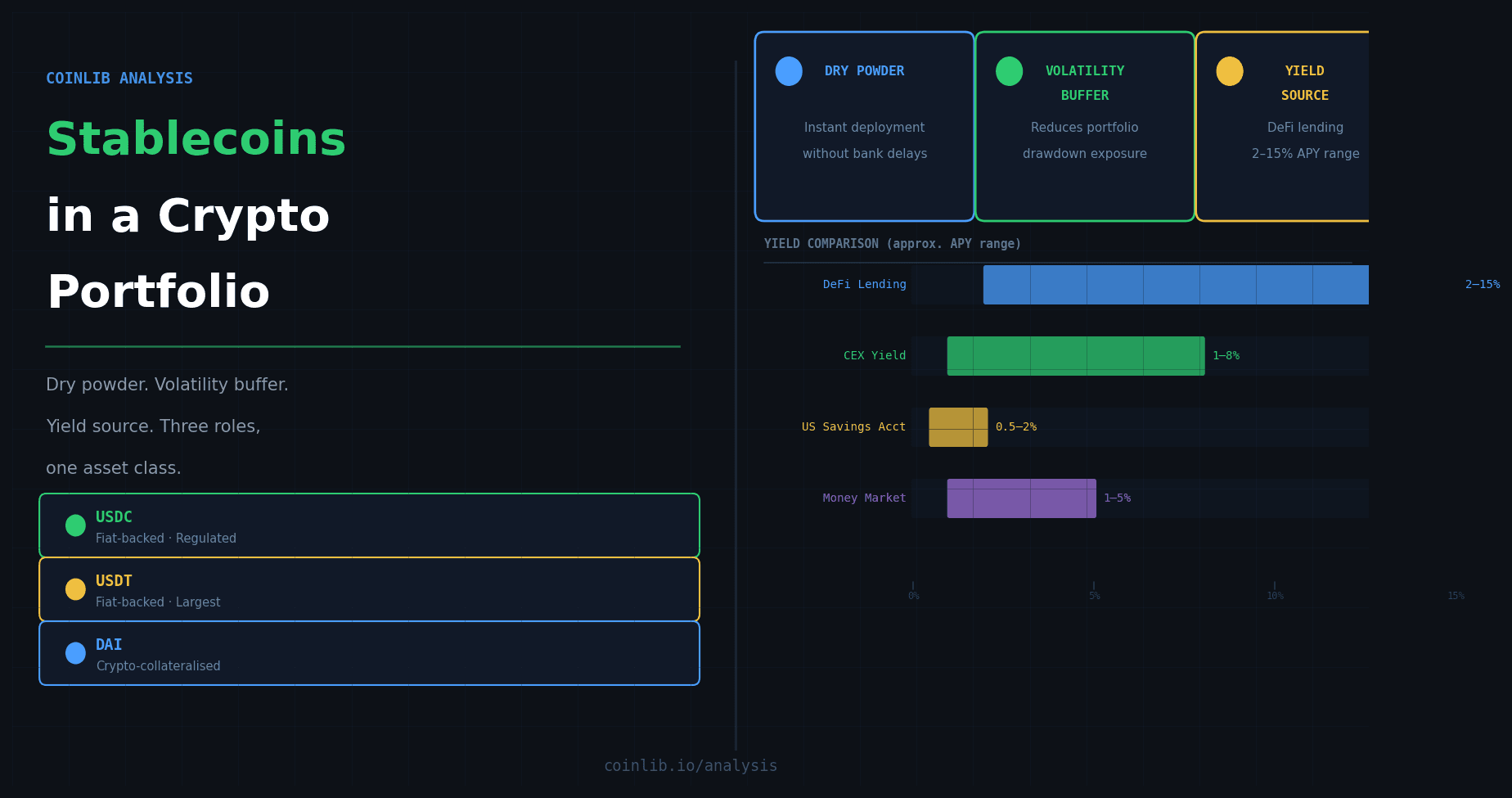
DeFi lending protocols offer stablecoin yields driven by borrowing demand. When demand to borrow stablecoins is high, because traders want leverage or because arbitrage opportunities require stablecoin capital, the rates paid to stablecoin depositors rise. Rates on major DeFi lending platforms for USDC and USDT have ranged from 2 to 15 percent annualised depending on market conditions, with higher rates during periods of elevated leverage demand in the broader crypto market.
Centralised exchange yield products and structured products from crypto-native financial services firms offer alternative routes to stablecoin yield. These carry counterparty risk that on-chain DeFi lending does not: the yield depends on the creditworthiness and operational integrity of the centralised entity offering it. The Celsius and BlockFi collapses, both of which involved the loss of customer stablecoin deposits, are the most significant demonstrations of that counterparty risk materialising.
A portfolio that holds stablecoins as dry powder and earns yield on that allocation while waiting for deployment opportunities is capturing a meaningful additional return without taking on price risk. The risk profile of that yield depends on where the yield is being earned and needs to be assessed accordingly.
The De-Peg Risk
Stablecoins are not risk-free assets, and a complete analysis of their portfolio role requires honest assessment of the risks they carry.
The most catastrophic stablecoin failure in crypto history was the Terra/Luna collapse in May 2022. UST, the Terra algorithmic stablecoin, lost its dollar peg and collapsed to near zero within days, destroying approximately $40 billion in market value. The mechanism was a design flaw: UST's peg was maintained by a minting and burning relationship with LUNA, the Terra network's governance token, and the mechanism proved unstable under sustained selling pressure. Once the peg began to slip, the mechanism designed to restore it accelerated the collapse rather than arresting it.
The lesson for portfolio construction is that not all stablecoins carry equivalent risk. The risk profile of USDC or USDT, both backed by directly held assets, is categorically different from the risk profile of algorithmic stablecoins. The former can de-peg but the mechanism for doing so requires the issuer to fail to maintain reserves, which is a different and generally lower-probability event than the reflexive collapse mechanism that destroyed UST.
USDC itself experienced a brief depeg in March 2023 when Silicon Valley Bank, which held a portion of Circle's reserves, collapsed suddenly. USDC briefly traded at $0.87 as uncertainty about the reserve situation caused selling. The peg recovered within days once Circle confirmed that the affected reserves were accessible, but the episode demonstrated that even well-designed fiat-backed stablecoins carry risks connected to the institutions holding their reserves.
Which Stablecoins Belong in a Portfolio
The practical question of which stablecoins to hold is driven by the trade-off between counterparty risk, regulatory exposure, and yield availability.
USDC and USDT are the natural starting points given their liquidity depth and integration across most crypto infrastructure. The key distinction between them is regulatory: USDC is issued by a fully regulated US entity (Circle) that holds reserves in US government securities and is audited regularly. Tether's reserve composition and audit history have historically been less transparent, though the company has moved toward greater transparency over time.
For EU-based portfolios, MiCA's stablecoin provisions have created a regulatory distinction between compliant and non-compliant stablecoins. USDC has pursued the required e-money institution licensing in the EU. USDT has not yet achieved full MiCA compliance, and USDT was delisted from major EU-regulated exchanges as a result. This regulatory dimension has become a genuine practical consideration for portfolio construction in regulated markets.
DAI and other crypto-collateralised stablecoins offer decentralisation benefits but require attention to the health of the collateral backing them and the integrity of the smart contracts governing the system. They are appropriate for on-chain applications where decentralisation is a specific requirement but carry additional smart contract risk relative to fiat-backed alternatives.
Stablecoins in Portfolio Construction: A Framework
Bringing these considerations together, the role of stablecoins in a crypto portfolio can be thought of across three dimensions.
As a cash equivalent, stablecoins maintain purchasing power within the crypto ecosystem and provide deployment flexibility. The appropriate size of this allocation depends on the investor's activity level and time horizon. More active portfolios benefit from larger stablecoin reserves.
As a volatility management tool, stablecoins reduce portfolio volatility proportionally to their allocation and can be used systematically to take profits during appreciation periods and redeploy during corrections. The effectiveness of this strategy depends on execution discipline rather than timing skill.
As a yield-generating asset, stablecoins can earn returns through DeFi lending or other yield mechanisms while waiting for deployment. The risk profile of the yield source matters as much as the yield rate itself.
An Ethereum-based DeFi portfolio might hold stablecoins primarily in on-chain lending protocols, earning yield while maintaining instant deployment capacity. A portfolio focused on large-cap crypto assets might hold stablecoins on a regulated exchange, accepting lower yield in exchange for the simplicity and regulatory protection of a centralised environment. The specific implementation varies, but the logical case for a meaningful stablecoin allocation as a structural component of a crypto portfolio is robust across most portfolio types and strategies.