

The Regulation of Crypto Lending Platforms in 2026
The collapse of Celsius, BlockFi, and Voyager between 2022 and 2023 was not just a market event. It was a regulatory forcing function. Millions of retail customers discovered that the platforms promising yield on their crypto holdings were operating in a largely unregulated space, with no deposit insurance, no mandatory reserve requirements, and terms of service that transferred asset ownership to the platform rather than holding funds in custody.
Regulators were watching. What followed was a sustained effort across multiple jurisdictions to bring crypto lending under formal oversight. In 2026, that effort is still incomplete, but the regulatory landscape for crypto lending platforms looks fundamentally different from what existed in 2021.
What Crypto Lending Platforms Do
Understanding the regulation requires understanding what these platforms actually do. Crypto lending platforms take deposits from customers, typically in the form of Bitcoin, Ethereum, or stablecoins, and deploy those assets in various ways to generate returns. Those returns are then passed back to depositors as yield.
The deployment strategies vary. Some platforms lend to institutional borrowers or traders who want leveraged exposure. Some invest in DeFi protocols. Some use customer assets to fund market-making operations. The risk profiles of these strategies differ significantly, but in most cases depositors had limited visibility into what was actually being done with their assets.
The regulatory question was straightforward once framed correctly: are these yield-bearing deposit accounts securities? If so, they require registration with the SEC and must comply with disclosure requirements designed to inform investors about risk. BlockFi answered that question for US regulators in February 2022 by settling with the SEC for $100 million and agreeing to stop offering unregistered yield accounts to US customers. It was the largest settlement in SEC history at the time.
The US Regulatory Response
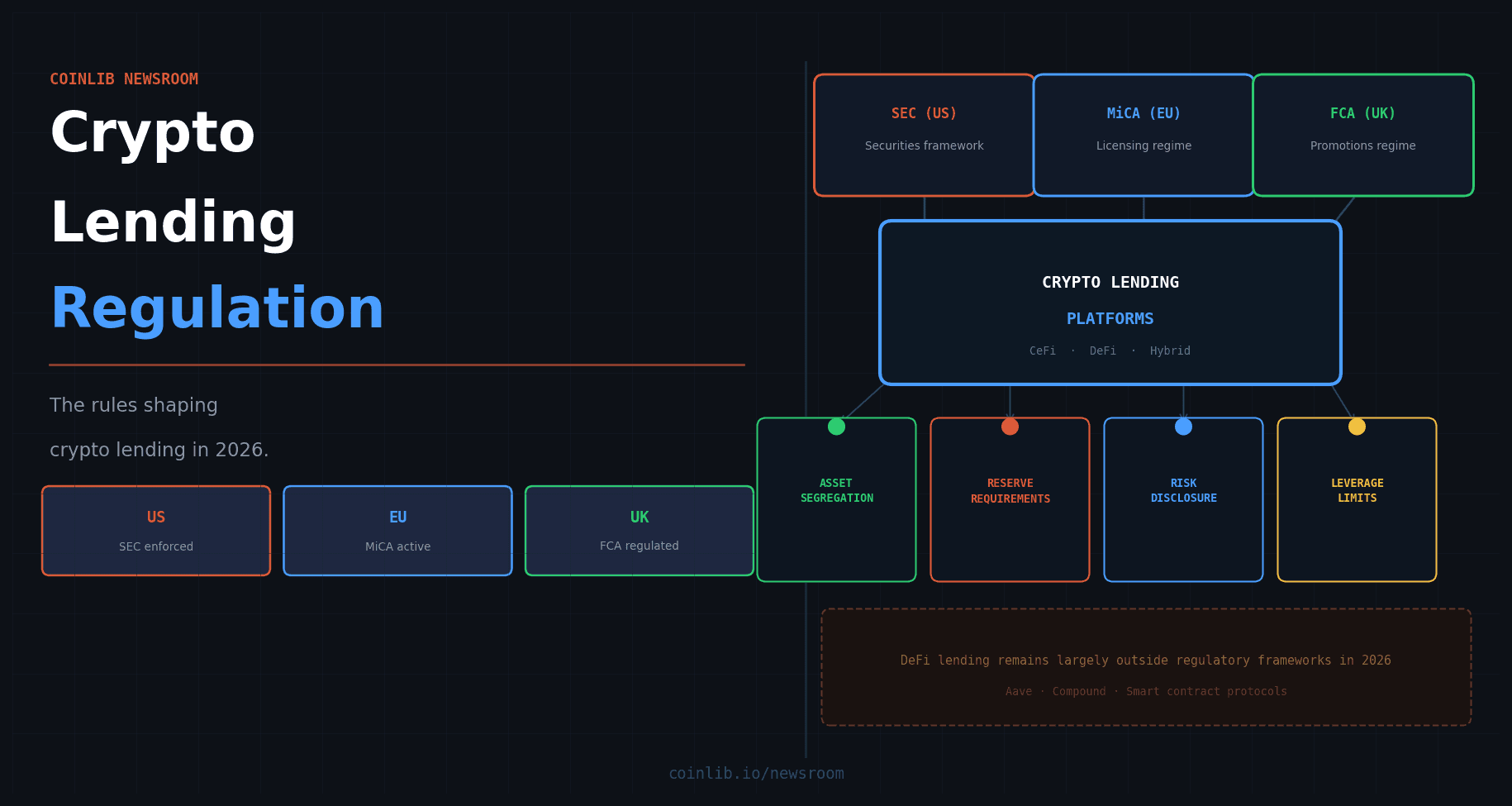
The US approach to crypto lending regulation has developed across three tracks: SEC enforcement, state-level action, and federal legislation.
The SEC enforcement track has been the most active. Following the BlockFi settlement, the Commission pursued investigations into other platforms offering yield products to retail customers. The legal theory was consistent: yield-bearing accounts that promised returns based on the platform's investment activities constituted investment contracts and therefore securities under the Howey test. Platforms that disagreed faced the choice of registering or exiting the US market.
State regulators moved in parallel. New York, California, Texas, and others issued cease-and-desist orders against crypto lending platforms operating without money transmitter licences or state-level securities registrations. The patchwork of state requirements created significant compliance complexity for platforms trying to operate nationally.
Federal legislation has moved more slowly. The CLARITY Act addresses market structure for digital assets broadly but does not contain a comprehensive framework specifically for crypto lending. The gap has been partially filled by regulatory guidance from the SEC and CFTC clarifying their respective jurisdictional claims, but a unified federal lending framework does not yet exist in the United States.
What exists in 2026 is a de facto regulatory reality: yield-bearing crypto accounts for retail US customers are treated as securities. Platforms offering them must be registered or are operating illegally. Most major platforms have either registered, restructured their products to avoid the securities classification, or exited the retail US market.
The European Framework Under MiCA
The EU's Markets in Crypto-Assets regulation, which came into full effect in 2024, created a comprehensive licensing framework for crypto asset service providers that includes lending-adjacent activities. MiCA does not regulate DeFi protocols directly, but it does cover centralised platforms offering custody, exchange, and portfolio management services.
Crypto lending under MiCA falls into a compliance grey area that regulators are still working through. The regulation requires that authorised crypto asset service providers maintain adequate capital reserves, segregate client assets, and provide clear disclosures about risk. These requirements address many of the structural problems that made the 2022 platform collapses so damaging for retail customers.
The asset segregation requirement is particularly significant. Under MiCA, customer assets held by a licensed provider cannot be commingled with the firm's own assets. This directly targets the mechanism that allowed Celsius to treat customer deposits as the platform's own funds, which it then deployed in ways that left customers as unsecured creditors in the bankruptcy. A MiCA-compliant platform operating in the EU cannot legally structure its operations the same way Celsius did.
Implementation across member states has been uneven, with some jurisdictions moving faster than others to grant licences and develop supervisory capacity. But the legal framework is in place, and platforms serving EU customers face a meaningfully more structured compliance environment than existed before 2024.
The United Kingdom's Approach
The UK, post-Brexit, developed its own crypto regulatory framework independently of MiCA. The Financial Conduct Authority has taken an aggressive stance on crypto lending, treating yield-bearing crypto accounts as financial promotions subject to existing financial services regulations even absent specific crypto legislation.
The FCA's financial promotions regime requires that communications about crypto products that promise returns be approved by an authorised firm and comply with requirements around fairness, clarity, and non-deception. This has effectively made it legally risky for platforms to advertise yield products to UK retail customers without regulatory authorisation.
The broader UK cryptoasset regulatory framework, developed through the Financial Services and Markets Act 2023, created a path for crypto activities to become regulated activities under existing financial services law. Crypto lending platforms serving UK customers are expected to seek authorisation and comply with prudential requirements. The timeline for full implementation extends into 2026 and beyond.
DeFi Lending: The Harder Regulatory Problem
Centralised crypto lending platforms can be regulated through existing legal mechanisms because they are legal entities with identifiable operators and customer relationships. DeFi lending protocols present a fundamentally different challenge.
Platforms like Aave and Compound operate through smart contracts that execute automatically based on collateralisation ratios and interest rate algorithms. There is no central company making lending decisions. There is no customer relationship in the traditional sense. Users interact directly with the protocol through their own wallets, and the protocol's rules are encoded in publicly auditable code.
Regulators have generally avoided direct enforcement against DeFi lending protocols, partly because of the technical difficulty of doing so and partly because of genuine uncertainty about how existing legal frameworks apply. The approach in most jurisdictions has been to focus on fiat on-ramps, front-end interfaces, and governance token holders as points of regulatory contact, rather than attempting to regulate the underlying protocols directly.
This regulatory gap has not gone unnoticed. The CLARITY Act contains provisions relating to DeFi but stops short of a comprehensive DeFi lending regulatory framework. EU regulators have flagged DeFi as a priority for future regulatory action in MiCA's scheduled review process. The regulatory picture for DeFi lending remains genuinely unsettled in 2026 in ways that centralised lending regulation is not.
What Compliant Crypto Lending Looks Like Now
The platforms that have survived and continue to operate in 2026 have adapted in several ways that reflect the post-2022 regulatory environment.
Asset segregation is now standard practice among compliant platforms. Customer assets are held in identifiable accounts separate from operational funds, and platforms publish regular attestations of reserves from qualified auditors.
Yield products in the US either operate under SEC registration or are structured to avoid the securities classification, typically by limiting them to institutional customers who qualify as accredited investors. Retail yield accounts of the Celsius variety are not legally available from regulated US platforms.
Risk disclosure has improved substantially. Platforms are required to explain clearly what is done with customer assets, what the counterparty risks are, and under what circumstances customers might not be able to withdraw. The disclosures are often detailed and technical, which creates its own accessibility problem, but the information is now legally required to be there.
Leverage limits have been introduced in some jurisdictions to cap how aggressively platforms can deploy customer assets. The unconstrained leverage that amplified losses in the 2022 collapses would not be permissible under current frameworks in regulated markets.
The Gaps That Remain
The regulatory progress since 2022 is real. It is also incomplete in ways that carry ongoing risk for customers and the broader market.
Cross-jurisdictional arbitrage remains a significant issue. Platforms that exit regulated markets can operate from permissive jurisdictions and continue to serve customers through apps and web interfaces. The practical ability of regulators to prevent customers in their jurisdictions from accessing offshore platforms is limited, particularly for technically proficient users.
The DeFi gap is real and growing. As DeFi lending protocols mature and accumulate more liquidity, the volume of lending activity occurring outside any regulatory framework increases. The risks that materialised in centralised platforms, leverage, liquidity mismatches, and inadequate disclosure, can also occur in DeFi contexts, but without the same legal mechanisms for customer recourse or regulatory intervention.
Small and mid-size platforms face a compliance cost burden that larger players can absorb more easily. The result is continued consolidation in the crypto lending sector toward larger, better-capitalised entities. Whether that consolidation is good for market structure and competition is a question that regulators have not yet fully addressed.
The framework that exists in 2026 is substantially better than what existed before the 2022 collapses. It is not yet comprehensive, not yet globally consistent, and not yet fully tested by another period of significant market stress. That test will come eventually, and when it does, the adequacy of the current framework will become much clearer.