

The Evolution of KYC in Crypto: From Optional to Unavoidable
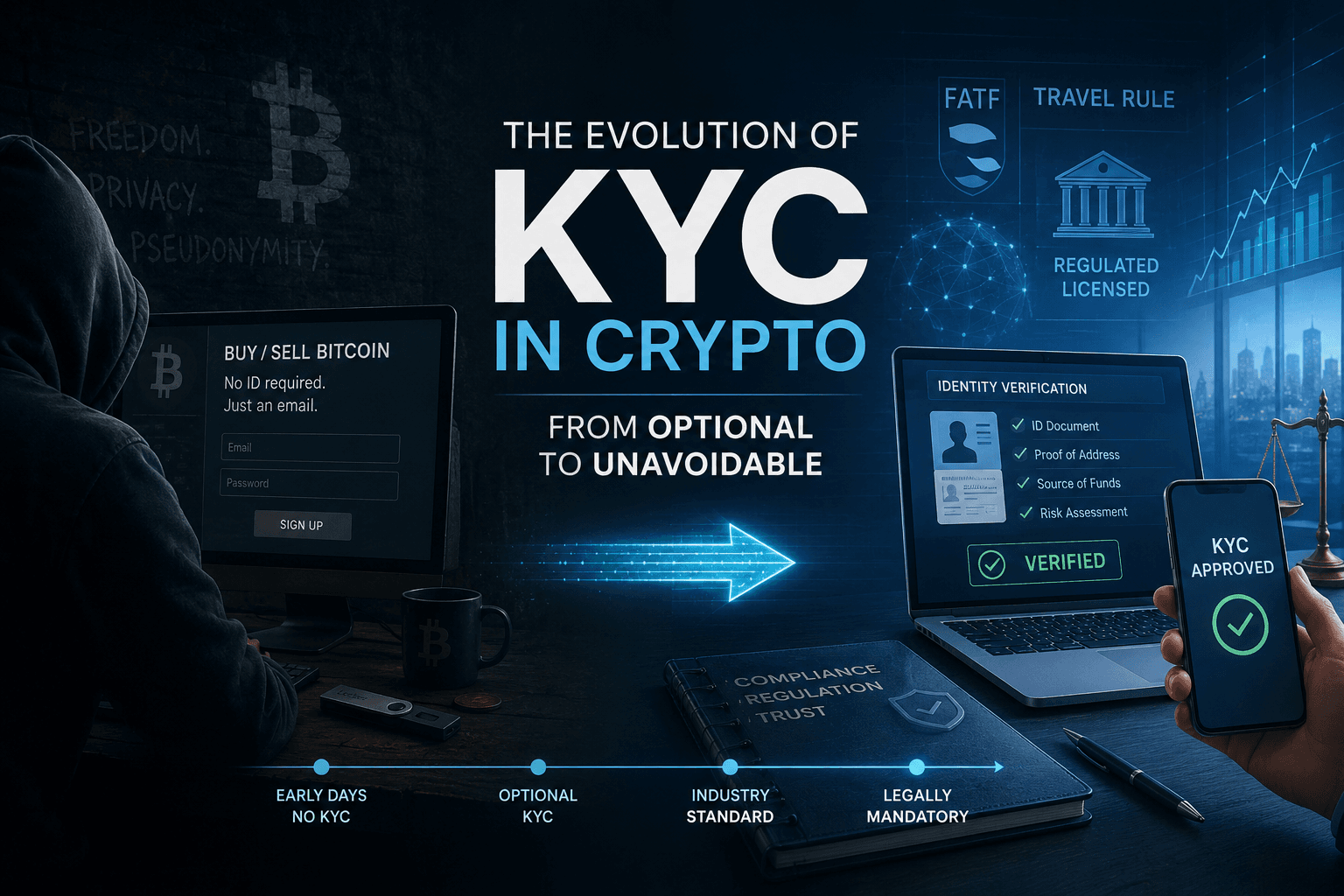
In the early years of cryptocurrency, the question of identity verification barely existed. Bitcoin was designed as a pseudonymous system. Exchanges asked for an email address and a password. The idea that buying or selling digital assets would one day require a government-issued ID, proof of address, and source of funds documentation would have seemed like a distant regulatory overreach to most people in that ecosystem.
That distance has been covered. KYC requirements in crypto have moved from absent to optional to standard to, in most regulated markets, legally mandatory. The journey took roughly a decade and was driven by a combination of regulatory pressure, law enforcement action, and the industry's own need for legitimacy to access banking services and institutional capital.
The Era Before KYC
The first generation of crypto exchanges operated with minimal identity requirements. Mt. Gox, which handled the majority of global Bitcoin trading before its collapse in 2014, required little more than an account registration to trade. Early exchanges in the US, Europe, and Asia operated under the assumption that digital assets existed outside traditional financial regulation and therefore outside the identity verification frameworks that applied to banks and brokers.
This was partly ideological. A significant portion of early crypto participants valued pseudonymity as a feature rather than a regulatory gap. The ability to transact without disclosing identity was seen as consistent with Bitcoin's design principles and with a broader critique of surveillance-oriented financial systems.
It was also partly practical. The regulatory frameworks that would eventually apply had not yet been written. Regulators were still deciding whether crypto assets were currencies, commodities, securities, or something else entirely, and that classification question had to be resolved before compliance obligations could be clearly defined.
The FATF Intervention
The turning point came from an international rather than a domestic source. The Financial Action Task Force, the inter-governmental body that sets global standards for anti-money laundering and counter-terrorism financing, issued guidance in 2019 that explicitly extended its recommendations to virtual asset service providers.
The FATF guidance was significant for two reasons. First, it defined virtual asset service providers broadly enough to cover most centralised crypto exchanges, custody providers, and certain DeFi-adjacent services. Second, it introduced what became known as the Travel Rule for crypto: the requirement that exchanges collect and transmit identifying information about the originator and beneficiary of transactions above a defined threshold, mirroring the obligation that already applied to wire transfers in traditional banking.
The Travel Rule was technically challenging to implement in crypto because the underlying infrastructure was not designed to carry identity information alongside transactions. Unlike a bank wire, a blockchain transaction does not natively include sender and recipient name fields. Implementing the Travel Rule required exchanges to develop new technical solutions for sharing identity data with counterpart institutions off-chain, and the absence of a single technical standard complicated adoption further.
Law Enforcement Creates Urgency
Regulatory guidance creates obligations in theory. Law enforcement creates urgency in practice.
The prosecution of BitMEX in 2020 was a watershed moment. The US Department of Justice and the Commodity Futures Trading Commission charged BitMEX and its founders with operating an unregistered trading platform and wilfully failing to implement adequate KYC and anti-money laundering programmes. The founders faced criminal charges. The platform paid $100 million in civil penalties.
BitMEX had been one of the largest derivatives exchanges in the world by volume and had operated for years with minimal identity verification requirements while serving US customers in violation of US law. The prosecution demonstrated that regulators were willing to pursue criminal charges against exchange operators personally, not just impose fines on corporate entities. That message was received clearly across the industry.
Subsequent enforcement actions against Binance, which reached a $4.3 billion settlement with US authorities in 2023 covering KYC and AML failures, reinforced the point. At the scale Binance was operating, inadequate KYC was not a compliance gap. It was a systemic failure that regulators were prepared to treat as a criminal matter.
The Banking Access Pressure
Beyond enforcement, crypto businesses faced a practical commercial pressure toward KYC compliance: access to banking.
Exchanges and crypto businesses that could not demonstrate adequate KYC and AML programmes found it difficult or impossible to maintain banking relationships. Banks, under their own regulatory obligations and reputational pressure, were reluctant to provide services to crypto businesses that could not show they knew who their customers were and where the money came from.
For a crypto exchange, losing banking access means losing the ability to accept fiat deposits and process fiat withdrawals. It is an existential commercial problem. The industry's need to maintain fiat on and off ramps created a powerful practical incentive for KYC compliance that operated independently of regulatory compulsion.
Exchanges that invested in compliance infrastructure found it easier to maintain banking relationships, access institutional clients, and eventually obtain the regulatory licences that opened further institutional business. The commercial case for KYC compliance aligned with the regulatory case in ways that made resistance increasingly difficult to justify.
What KYC Looks Like in Regulated Exchanges Today
The KYC requirements that apply to regulated crypto exchanges in 2026 are broadly similar to those that apply to traditional financial institutions, though implementation varies by jurisdiction.
Standard requirements include government-issued photo identification, proof of address through a utility bill or bank statement, and for higher-value accounts, source of funds and source of wealth documentation. Exchanges use a combination of automated document verification technology and manual review for higher-risk cases. Politically exposed persons, customers from high-risk jurisdictions, and accounts with unusual transaction patterns trigger enhanced due diligence.
Tiered verification has become common. Basic accounts with lower transaction limits may require only an email address and phone number verification. Accounts seeking higher limits undergo full KYC. Institutional accounts face the most intensive verification and ongoing monitoring requirements.
Transaction monitoring runs continuously on most major platforms. Blockchain analytics tools from providers like Chainalysis and Elliptic screen transactions against sanctions lists, flag addresses associated with known illicit activity, and identify transaction patterns consistent with layering or other money laundering typologies. Suspicious activity is reported to financial intelligence units as required by national law.
The Travel Rule in Practice
The Travel Rule has been implemented in most major jurisdictions, though the technical approach and threshold amounts vary. In the EU, MiCA brought the Travel Rule into the primary crypto regulatory framework with no minimum threshold, meaning identifying information must be transmitted for all transactions between regulated entities. In the US, the threshold is set at $3,000 for crypto, mirroring the wire transfer rule.
Implementation required the development of shared technical infrastructure for exchanging Travel Rule data. Several competing protocols emerged, and the lack of universal standardisation remains a practical challenge for compliance teams. Exchanges must maintain compatible systems with counterparty exchanges globally, which creates ongoing operational complexity particularly for smaller platforms.
The Travel Rule applies to transfers between regulated entities. It does not apply to transfers to and from self-custody wallets, which creates a significant surveillance gap from a regulatory perspective and has led to ongoing debate about whether enhanced obligations should apply when regulated entities send to or receive from unhosted wallets.
The Self-Custody Question
The boundary between regulated exchanges and self-custody wallets is where the KYC debate remains most active in 2026.
Self-custody wallets, where the user controls their own private keys, are not financial intermediaries and do not fall under VASP regulations in most jurisdictions. A person holding Bitcoin in a hardware wallet and transferring directly to another person's wallet is not using a regulated service and is not subject to KYC requirements.
Several jurisdictions have considered or proposed rules that would extend compliance obligations to transfers between regulated exchanges and unhosted wallets, effectively requiring exchanges to collect information about the owner of any self-custody wallet they transact with. The EU proposed such requirements during the MiCA development process. The final version retained enhanced due diligence requirements for transfers to unhosted wallets above certain thresholds but stopped short of the most expansive proposals.
The self-custody boundary matters because it defines the practical limit of KYC's reach. Anyone determined to transact outside the KYC perimeter can do so through self-custody. The question regulators face is whether the compliance burden imposed on regulated exchanges is sufficient to manage the risk, or whether the self-custody gap undermines the regime in ways that require a more expansive response.
Zero-Knowledge Proofs as a Potential Middle Ground
The technical cryptography community has proposed a potential resolution to the tension between KYC compliance and privacy: zero-knowledge proofs.
A zero-knowledge proof allows a party to demonstrate that they know something, or that they satisfy a condition, without revealing the underlying information. Applied to KYC, the concept would allow a user to prove to an exchange that they have been verified by a trusted identity provider and are not on a sanctions list, without the exchange seeing or storing the underlying identity documents.
This approach would preserve the compliance outcome (verification that the user is who they claim to be and is not a sanctioned individual) while reducing the data collection and storage burden on exchanges and protecting user privacy from data breaches and misuse.
Several pilot programmes exploring this approach are underway, and regulators in the EU and UK have expressed cautious openness to the concept. Implementation at scale requires regulatory acceptance of third-party identity attestation, technical standardisation, and integration with existing compliance infrastructure. None of those are simple problems, but the direction of travel in the technical community suggests that privacy-preserving KYC is a plausible medium-term development rather than a distant theoretical proposition.
Where the Trajectory Is Heading
KYC in crypto has moved from absent to mandatory in the span of a decade, and the direction of travel is toward greater rather than lesser compliance intensity. The remaining gaps, self-custody, DeFi protocols, offshore platforms, will face increasing regulatory attention as the established compliance regime matures and regulators develop a clearer view of where risk is actually located.
The industry that resisted identity verification on principle in 2013 has largely accepted it as the cost of operating in regulated markets. The businesses that made that adaptation are the ones still operating at scale. The ones that did not are largely gone, acquired, or operating in a diminishing set of unregulated jurisdictions with limited access to the institutional capital and banking relationships that define the mainstream of the industry.
That is not a story about regulatory capture. It is a story about what legitimacy costs and what it enables.