

The Difference Between Layer 1 and Layer 2 Blockchains
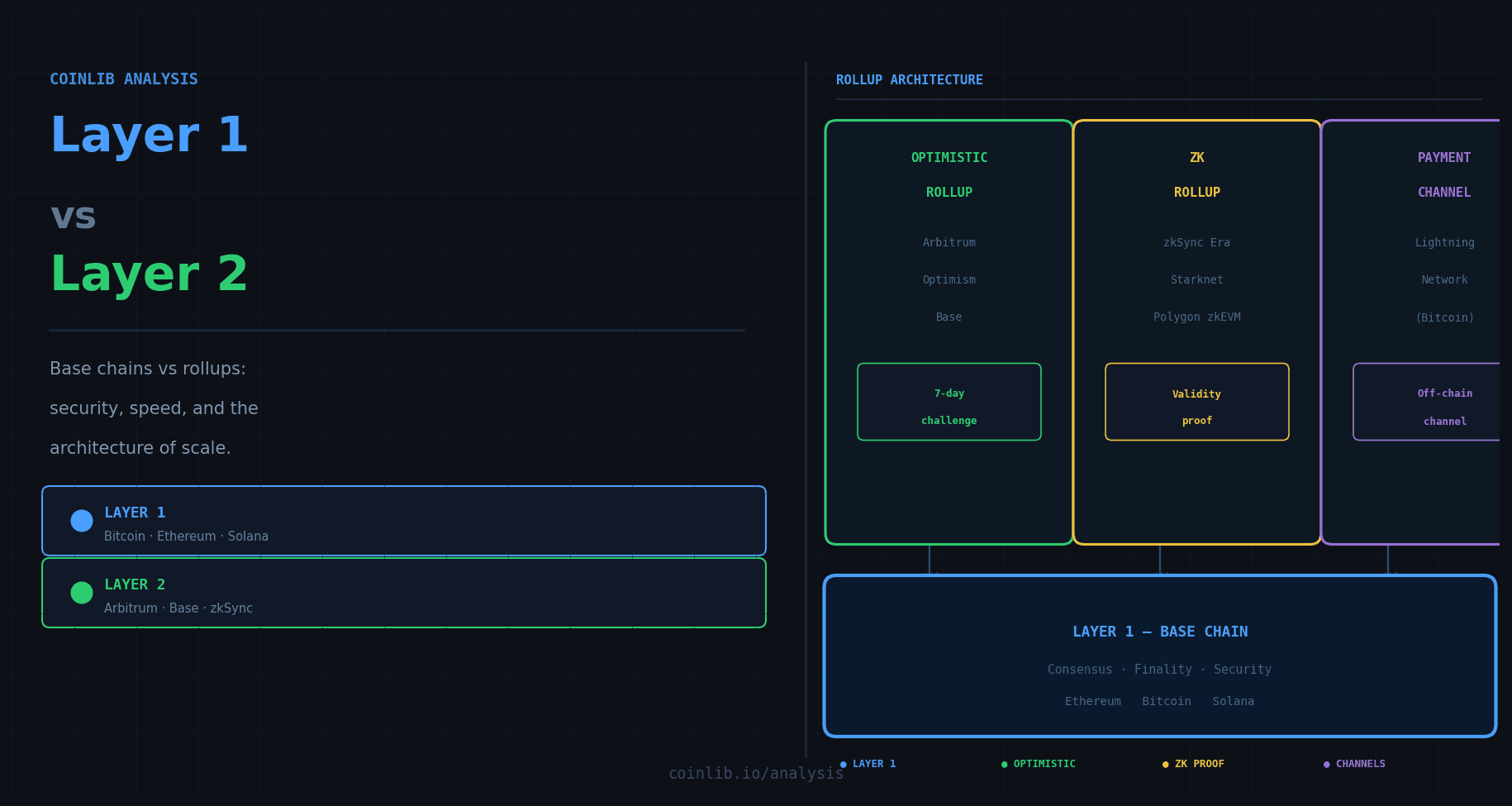
The terminology has become standard in crypto coverage, but the underlying distinction is often underexplained. Layer 1 and Layer 2 are not interchangeable labels for different kinds of blockchains. They describe a specific architectural relationship, and understanding it changes how you interpret claims about scalability, security, and where activity in the crypto ecosystem is actually happening.
What Layer 1 Means
Layer 1 is the base blockchain. It is the underlying network that maintains its own consensus mechanism, validates and records transactions, and provides the security guarantees that everything built on top of it inherits.
Bitcoin is the most straightforward example. The Bitcoin blockchain validates transactions through proof-of-work consensus. Every node in the network processes and verifies transactions. The security of the system derives from the computational resources committed to mining and the decentralisation of the validator set. All of this happens at the Layer 1 level.
Ethereum is a Layer 1 that added programmable smart contracts to the base layer model. The Ethereum blockchain validates not just transfers of ETH but the execution of arbitrary code. That programmability is what made DeFi, NFTs, and the broader ecosystem of on-chain applications possible, but it is all still happening at the Layer 1 level — transactions are validated by Ethereum's consensus mechanism and recorded on the Ethereum base chain.
Other significant Layer 1s include Solana, Avalanche, and BNB Chain. Each has its own consensus mechanism, validator set, and native asset. They are not built on top of another blockchain. They are independent base layers.
What Layer 2 Means
Layer 2 is a network built on top of a Layer 1 that inherits the security of the base chain while processing transactions more efficiently.
The core design principle of a Layer 2 is that it moves transaction processing off the base chain to reduce congestion and cost, while settling the final state back to Layer 1 periodically. The security guarantee is that even if the Layer 2 system behaves incorrectly, users can recover their funds through the Layer 1's own mechanisms.
This is the critical distinction between a Layer 2 and a separate Layer 1. A competing blockchain like Solana offers its own security guarantees independent of Ethereum. A true Layer 2 like Arbitrum or Optimism does not provide its own security — it borrows Ethereum's security for final settlement.
The practical consequence is that Layer 2 users inherit the censorship resistance and security properties of the underlying Layer 1, even though their day-to-day transactions are being processed by the Layer 2 system at much lower cost and higher speed.
How Layer 2s Actually Work
The technical mechanisms through which Layer 2s achieve scalability while maintaining security are worth understanding at a conceptual level, because the differences between approaches have real implications for users.
Optimistic rollups batch thousands of transactions off-chain and post a summary to Layer 1, along with a cryptographic commitment to the state changes those transactions represent. The system assumes all transactions in the batch are valid unless challenged. There is a challenge window — typically seven days — during which anyone can submit a fraud proof if they identify an invalid transaction. After the window closes without a successful challenge, the state update is considered final on Layer 1. Arbitrum and Optimism are the two largest optimistic rollups by total value locked.
ZK-rollups take a different approach. Instead of assuming validity and allowing challenges, they generate a cryptographic proof — a validity proof — that mathematically demonstrates all the transactions in a batch are valid. This proof is verified on Layer 1. Because validity is proven rather than assumed, ZK-rollups do not require a challenge window, making finality faster. The computational cost of generating validity proofs has historically been high, but it has fallen substantially as the technology has matured. zkSync Era and Starknet are significant ZK-rollup implementations.
The practical differences for users are in withdrawal times and trust assumptions. Optimistic rollup withdrawals to Layer 1 are subject to the challenge window, making them slower. ZK-rollup withdrawals are faster once the proof is verified. Both inherit Ethereum's security for final settlement.
Why Layer 2s Exist: The Scalability Problem
Understanding why Layer 2s were built requires understanding the fundamental constraint they are designed to address.
A Layer 1 blockchain faces a throughput limit determined by the amount of data each block can contain and how frequently blocks are produced. Ethereum processes roughly 15 to 30 transactions per second at the base layer. During periods of high demand, users compete for block space by bidding higher gas fees. In the 2021 bull market, Ethereum gas fees regularly exceeded $50 for a standard transaction and hundreds of dollars for complex DeFi interactions. This made the network effectively unusable for small transactions and created a two-tier system where only users with significant capital could afford to participate economically.
The scaling solutions available to a Layer 1 in isolation are limited. Increasing block size or block frequency to allow more transactions improves throughput but at the cost of requiring more powerful hardware to run nodes, which reduces the number of participants who can validate the network and concentrates that validation in fewer hands. This is the core tension in blockchain design: security and decentralisation are achieved through redundant validation by many participants, but redundant validation by many participants limits throughput.
Layer 2s resolve this tension by moving transaction processing off the base chain while keeping the settlement and security on it. The base layer continues to operate at its existing parameters — maintaining decentralisation and security — while the Layer 2 handles the volume.
The Ethereum Layer 2 Ecosystem
Ethereum is the Layer 1 with the most developed Layer 2 ecosystem. The total value locked across Ethereum Layer 2s crossed $40 billion in 2024 and has remained the primary venue for scaling Ethereum activity.
Arbitrum has consistently been the largest Layer 2 by TVL, driven by its DeFi ecosystem. Applications including GMX, a decentralised derivatives exchange, and several major lending protocols have built primarily on Arbitrum rather than Ethereum mainnet. The transaction costs on Arbitrum are typically 90 to 95 percent lower than equivalent transactions on Ethereum mainnet.
Base, launched by Coinbase in 2023 as an optimistic rollup built on the OP Stack, has grown rapidly by combining Coinbase's distribution with low fees and Ethereum security. Base has attracted a significant share of on-chain consumer application activity, including social and gaming applications that would be economically impractical on Ethereum mainnet.
The proliferation of Layer 2s has created its own complexity. Users moving funds between Layer 2s often need to go through Ethereum mainnet as an intermediate step, and the UX of bridging between networks remains a friction point. Cross-Layer 2 liquidity infrastructure has developed to address this, but fragmentation is a genuine ongoing challenge for the ecosystem.
Layer 2s on Other Layer 1s
The Layer 2 architecture is not exclusive to Ethereum. Bitcoin has its own Layer 2 ecosystem, though the constraints of Bitcoin's base layer design create a different environment.
The Lightning Network is the most established Bitcoin Layer 2. It enables instant, low-cost Bitcoin payments through a network of payment channels. Two parties open a channel by committing funds to a multi-signature address on the Bitcoin blockchain, conduct as many transactions as they want within the channel, and then close the channel by broadcasting the final state to the Bitcoin mainnet. While Lightning has grown significantly in adoption — particularly for small payments and in regions with underdeveloped banking infrastructure — it has limitations around the capacity of channels and the complexity of routing larger payments through the network.
Bitcoin Layer 2s using ZK and validity proof approaches have also developed, though they operate under different constraints than Ethereum Layer 2s given Bitcoin's more limited scripting capabilities.
What This Means for Evaluating Projects
The Layer 1 / Layer 2 distinction matters practically when evaluating where a DeFi protocol, NFT project, or application is deployed and what that implies about security and cost.
A protocol deployed on a Layer 2 inherits the security of the underlying Layer 1, but through the bridge and settlement mechanism rather than directly. If a vulnerability exists in the bridge contract, funds moving between the Layer 1 and Layer 2 can be at risk even if both the base layer and the application are sound. Several significant bridge exploits have occurred in the history of the space, representing some of the largest individual losses from smart contract failures.
Understanding whether a project is on a true Layer 2 — one that settles to a Layer 1 and inherits its security — or on an independent Layer 1 with its own security assumptions is relevant to assessing what security guarantees the project's users are actually receiving. Both can be valid architectural choices for different use cases, but the risk profiles are distinct and should be evaluated accordingly.
The ecosystem continues to evolve. The long-term trajectory, at least in Ethereum's case, is toward a rollup-centric architecture where most activity settles through Layer 2s and the base layer serves primarily as a settlement and data availability layer. Whether that architecture achieves the scalability and user experience improvements its proponents expect is a question that the data from the next few years of deployment will begin to answer.