

The Case for Holding Your Own Crypto
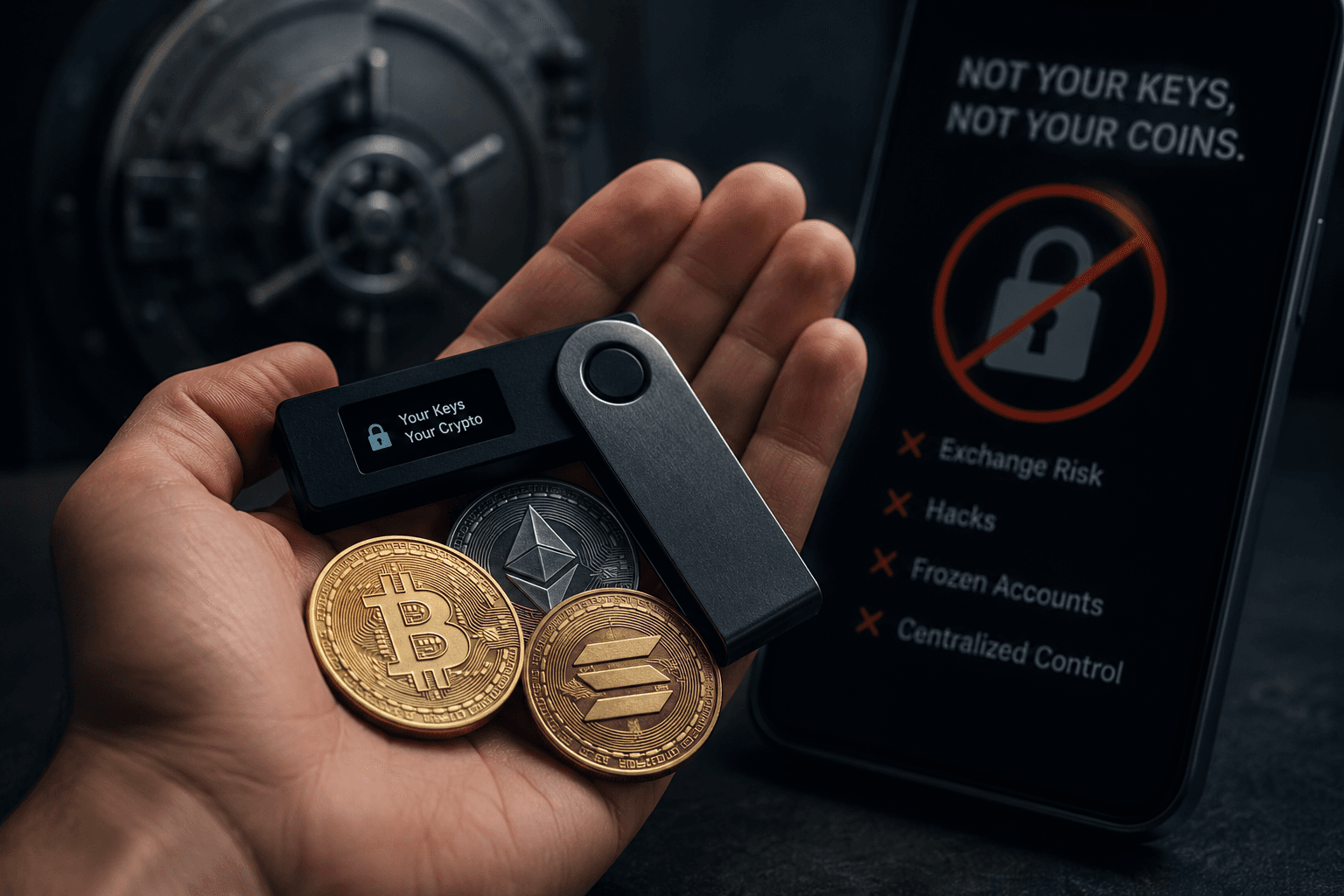
Not your keys, not your coins. You've heard it. Most people still ignore it.
FTX had 1.2 million customers. Celsius had 1.7 million. Voyager had 3.5 million. All of them found out the hard way that an exchange balance is not the same thing as owning crypto. It's an IOU from a company that might not exist next month.
The solution isn't complicated. Move your crypto off exchanges and hold it yourself. That's what self-custody means. The industry has made it easier than ever, and there's no longer a convincing excuse not to do it.
What You're Actually Signing Up For
Self-custody means holding the private keys to your crypto yourself. No third party. No counterparty risk. No account freeze. If you have the keys, you have the crypto. Period.
The flip side is responsibility. Lose your seed phrase, lose your funds. There's no customer support. No password reset. This is the trade-off people complain about. It's real, and it deserves honest acknowledgement.
But consider what you're trading away when you keep crypto on an exchange. You're trusting that the exchange is solvent, that it isn't misusing customer funds, that it won't freeze withdrawals when markets move, and that it won't get hacked. All of those things have happened, repeatedly, at exchanges people trusted.
The custody risk of self-custody is manageable. Back up your seed phrase. Store it properly. Don't lose it. That's the whole job. The custody risk of leaving crypto on an exchange involves trusting the decisions of people you've never met with money that doesn't legally belong to you until you withdraw it.
What You Need to Get Started
The hardware and software to hold crypto yourself has improved significantly. Crypto wallets now range from beginner-friendly mobile apps to dedicated hardware devices designed to keep private keys offline and out of reach of any network attack.
For most people with meaningful holdings, a hardware wallet is the right call. The private keys never touch an internet-connected device. Signing a transaction requires physical confirmation on the device itself. Even if your computer is compromised, your keys aren't. Ledger and Trezor are the two most established hardware wallet manufacturers, both with long track records and active security research communities.
For smaller amounts or more active trading, a non-custodial software wallet — one where you hold the keys — is a practical option. MetaMask is the most widely used for Ethereum and EVM-compatible chains. Phantom is dominant on Solana. Both are self-custodial, meaning the developers cannot access your funds and there's no central entity that can freeze your account.
The key distinction to watch for is custodial vs. non-custodial. Coinbase Wallet is non-custodial. The Coinbase exchange is custodial. They're different products with different risk profiles. Read which one you're using before you trust it with anything significant.
The Fee Problem, and How It Got Solved
A few years ago there was a legitimate practical objection to self-custody for smaller holdings: transaction fees. Moving crypto from an exchange to your own wallet and then interacting with DeFi protocols on Ethereum mainnet could cost $30, $50, or more in gas fees. For someone with $500 in crypto, that's a 10 percent hit just to take custody.
That objection is largely gone. Layer-2 networks built on top of Ethereum — Arbitrum, Base, Optimism — now handle the majority of DeFi activity at a fraction of mainnet costs. Typical transactions run between $0.01 and $0.20. Moving to self-custody and interacting with on-chain applications is no longer reserved for people with large enough balances to absorb mainnet fees.
The practical workflow for most Ethereum users now is to hold assets in a self-custodial wallet and operate primarily on Layer 2 for day-to-day activity. Mainnet stays for high-value transfers where the absolute fee is proportionally small. This is how the ecosystem was designed to work, and it mostly does.
The Part Nobody Wants to Hear
Most people don't move to self-custody because it feels like effort. Setting up a wallet, moving funds, writing down a seed phrase, figuring out which network to use — it takes an hour the first time and almost nothing after that.
Compare that to the effort of dealing with a frozen account, a bankruptcy filing, and a creditors' committee deciding how much of your funds you get back and when. That process takes months and often ends with a partial recovery, if anything at all.
The Celsius bankruptcy took over two years to work through. Some creditors received a partial settlement. Some received illiquid equity in the reorganised entity. None of them received their crypto back in any straightforward way.
An hour of setup to hold your own keys is not a burdensome trade-off. It just looks like one until something goes wrong. At that point, the people who did it look prescient and the people who didn't are filing claims with a bankruptcy trustee.
Self-custody is not a power-user feature. It's the basic premise of owning crypto rather than being promised it.