

How to Evaluate a DeFi Protocol Before Using It
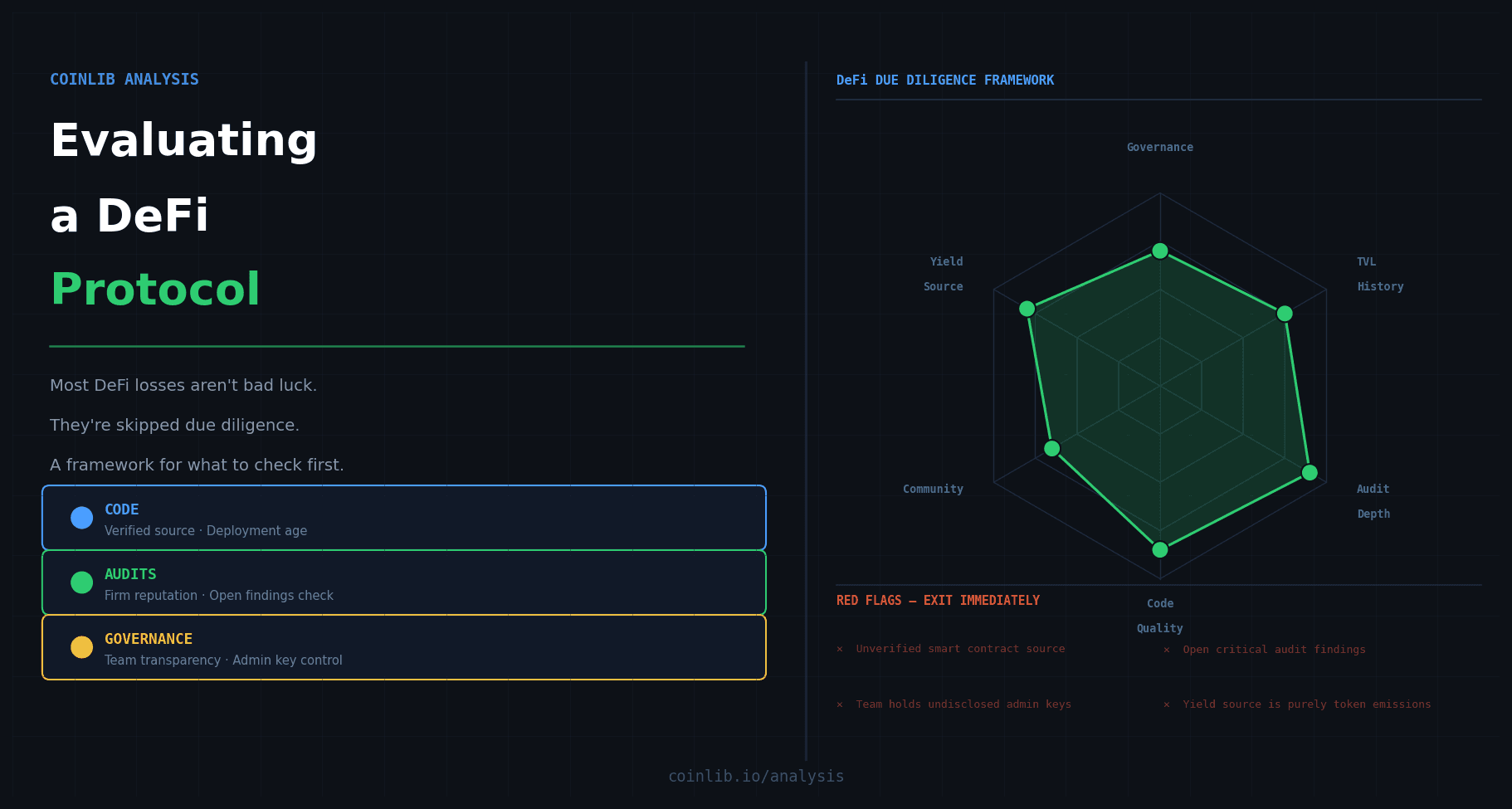
Most people who have lost money in DeFi did not lose it to bad luck. They lost it to bad evaluation. A protocol that looked legitimate because it had a polished interface, a high TVL, and impressive APY numbers turned out to be exploited, rug-pulled, or simply unsustainable. The pattern repeats often enough that it is worth treating protocol evaluation as a learnable skill rather than a matter of intuition.
The framework below is not a checklist that guarantees safety — no such checklist exists in DeFi. It is a structured approach to understanding what you are actually trusting when you deposit funds into a protocol, and what the realistic failure modes are.
Start With the Code, Not the Interface
The interface of a DeFi protocol tells you almost nothing about whether it is safe to use. A polished frontend can be built on top of poorly written or malicious smart contracts. The code is what matters, and the first question is whether the code is auditable.
Is the smart contract source code verified and published on a block explorer like Etherscan? Verified source code means users and auditors can read the actual logic the contract executes, rather than just the compiled bytecode. A protocol that has not verified its source code is asking users to trust code they cannot inspect. That is a baseline disqualifier for most users.
Beyond verification, check how long the contracts have been deployed. A protocol with contracts that have been live for six months or more and have processed significant volume without incident has a meaningful track record. A protocol that launched last week has no track record. This does not mean new protocols are necessarily dangerous, but the risk profile is different and should be priced accordingly.
Audit History: What to Look for and What to Ignore
An audit is necessary but not sufficient. The relevant questions are not simply whether an audit exists, but who conducted it, when, what they found, and what happened as a result.
Well-regarded audit firms in the DeFi space include Trail of Bits, OpenZeppelin, Consensys Diligence, Certik, and a handful of others. An audit from a firm you have never heard of with no public track record provides substantially less assurance than an audit from an established firm with a history of finding real vulnerabilities. The audit report should be publicly available — a protocol that has been audited but will not publish the report is concealing something.
Read the findings section. Audits identify issues at different severity levels: critical, high, medium, and low. The relevant question is what happened to the critical and high findings. Were they addressed before deployment? Were they acknowledged and left open with an explanation? Open critical findings that were dismissed by the team are a significant red flag.
Multiple audits from different firms provide more confidence than a single audit, because different auditors tend to find different issues. No audit is comprehensive enough to be definitive on its own.
Check whether any contracts have been upgraded since the original audit. An audit covers the code at a specific point in time. Protocol upgrades, new feature deployments, or changes to contract parameters after the audit can introduce new vulnerabilities that were not reviewed.
TVL: A Useful Signal, Not a Safety Guarantee
Total value locked is the most commonly cited metric for DeFi protocols, and it is worth understanding what it does and does not tell you.
TVL reflects the amount of capital currently deposited in the protocol. High TVL relative to time-in-operation suggests that users have trusted the protocol with significant capital over a meaningful period, which is a positive signal. It also increases the attractiveness of the protocol as an attack target — a protocol with $2 billion in TVL is a more rewarding target for an attacker than one with $10 million.
TVL can be inflated through circular dependencies, where a small number of addresses move capital between related protocols to boost headline numbers. Very rapid TVL growth driven by unsustainably high token emissions is a yellow flag rather than a positive — it often indicates that the capital will leave as quickly as it arrived when the emissions reduce.
TVL trend is more informative than TVL level. A protocol with $500 million in TVL that has been stable or growing for a year is a different proposition from one that peaked at $1 billion six months ago and has been declining since. Platforms like DeFiLlama provide historical TVL charts that make the trend visible.
The Team and Governance Question
Decentralised finance operates on a spectrum of actual decentralisation. Many protocols that describe themselves as decentralised retain significant centralisation in practice: a small team controls admin keys, a small group of token holders dominates governance votes, or a foundation makes decisions that governance nominally controls.
This is worth understanding before depositing funds because it affects the risk profile in specific ways. A protocol with fully decentralised governance and time-locked contract upgrades provides meaningful protection against the team acting maliciously — changes to the protocol require community approval and take effect after a delay that gives users time to exit. A protocol where the founding team holds admin keys that can pause or drain the protocol provides no such protection.
Check whether the team is public or anonymous. Anonymous teams are common in DeFi and anonymity alone is not disqualifying — some of the most credible protocols in the space were built by pseudonymous developers. But anonymous teams carry more accountability risk. If a protocol is exit-scammed by a known team, there is at least the possibility of legal recourse. If it is exit-scammed by an anonymous team, there is almost none.
Look at governance participation. A protocol with active governance where multiple stakeholders are engaged in decisions about risk parameters, fee structures, and treasury management is meaningfully different from one where governance exists on paper but proposals pass with a handful of votes from wallets controlled by the team.
Understanding What the Protocol Actually Does
This sounds obvious, but it is frequently skipped. Before depositing funds, you should be able to answer the following questions accurately.
Where does the yield come from? The three sources of DeFi yield — trading fees, borrowing interest, and token emissions — have different sustainability profiles. If you cannot identify which of these is producing the yield you are being offered, you do not understand what you are doing.
What are the liquidation conditions? In lending protocols, your collateral can be liquidated if its value falls below a threshold. What is that threshold? How quickly can it be reached given the volatility of the assets involved? What happens to your position in a black swan event where oracle prices move faster than liquidations can execute?
What external dependencies does the protocol have? Most DeFi protocols depend on price oracles, which are external data feeds that tell the protocol the current price of assets. Oracle manipulation has been the attack vector in a significant number of the largest DeFi exploits. Which oracle does this protocol use? How is it constructed? Has it been manipulated on other protocols?
Ethereum's composability — the ability for protocols to interact with each other — is one of DeFi's most powerful features and one of its most significant risk amplifiers. A protocol that deposits your funds into another protocol to generate yield means your risk exposure includes both protocol's code, not just one.
On-Chain Activity and Community Signals
Protocol activity on-chain is observable and provides information that marketing materials cannot fake.
Look at the number of unique addresses interacting with the protocol over time. A healthy protocol will show gradual growth in its user base. Extreme concentration — where a small number of addresses account for most TVL or most transactions — suggests that the protocol's usage is narrower than it appears.
Bug bounty programmes are a meaningful signal of the team's security posture. A protocol that maintains an active bug bounty with meaningful rewards for critical findings is incentivising external review of its code. The size of the bug bounty relative to the TVL matters: a $50,000 bounty on a $500 million TVL protocol provides weak incentives for serious researchers.
Community quality in governance forums and developer channels is harder to quantify but observable. A community where technical discussions about risk management are substantive, where difficult questions are answered with specifics rather than dismissed, and where the team engages constructively with criticism is a better environment than one where questioning the protocol is met with hostility.
A Framework for Sizing Decisions
Even a protocol that performs well on every evaluation criterion carries risk. Smart contract risk cannot be reduced to zero. The appropriate response is not to avoid DeFi protocols entirely but to size positions in relation to the residual risk.
A protocol with two years of live deployment, multiple audits from reputable firms, active governance, verified source code, and a well-understood yield mechanism warrants larger position sizes than a protocol that is weeks old with a single audit and anonymous team. This is the core of risk-adjusted position sizing: the evaluation process does not produce a binary safe/unsafe verdict, it produces a risk calibration that should inform how much capital you are comfortable committing.
No evaluation process catches everything. Some of the most significant DeFi exploits affected protocols that had done most things right. The losses that are most avoidable are the ones from protocols that, on reflection, had clear warning signs that due diligence would have surfaced. Starting with the questions in this framework reduces that category of loss substantially.