

How Solana's Speed Is Reshaping the Payments Experience in Crypto Entertainment
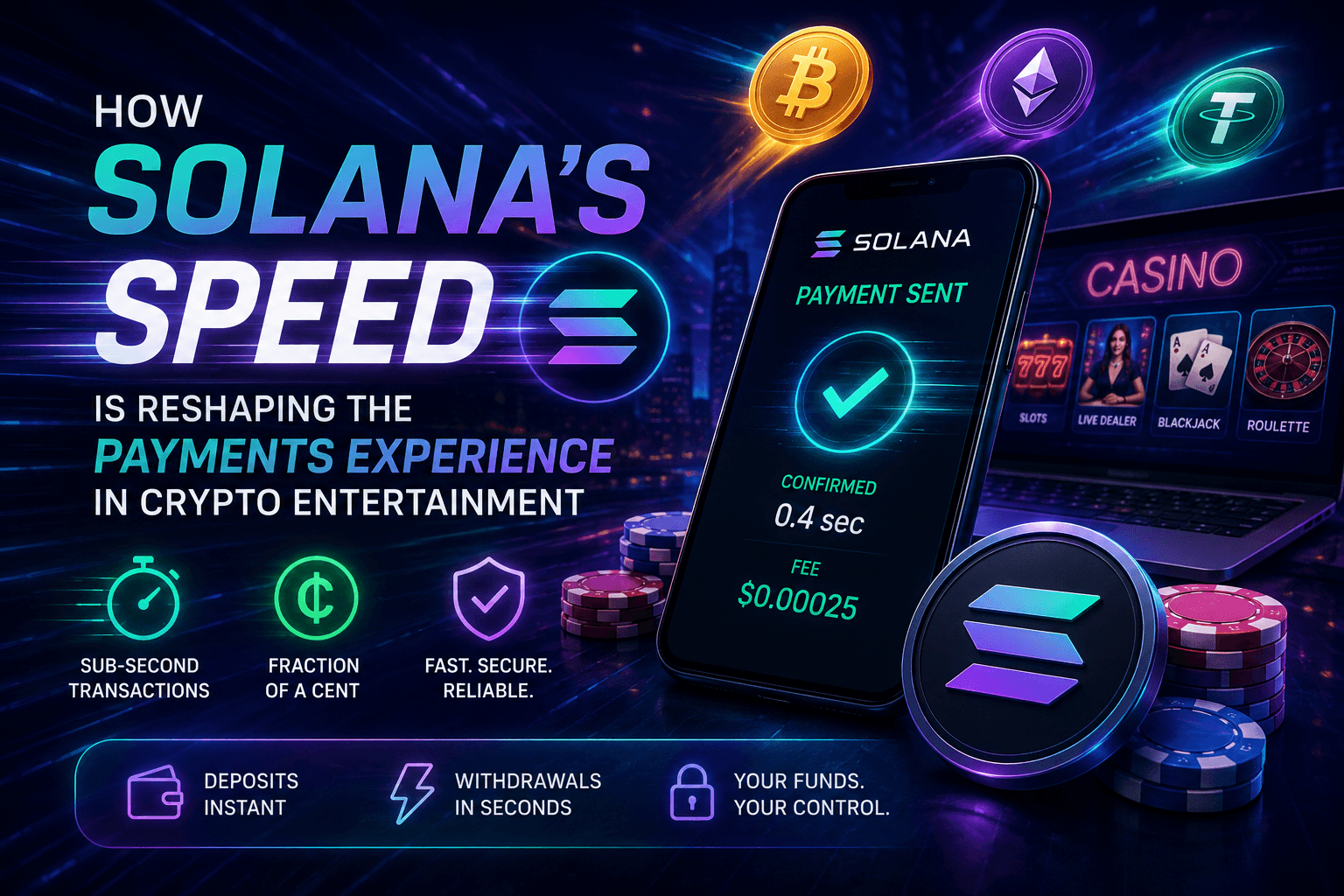
Anyone who keeps a tab open on real-time crypto prices has probably noticed how often Solana shows up in the trending lists. It is not just the price action that draws attention. People who watch the charts have started watching the network itself — how fast it confirms, how little it costs to move a balance, how rarely it leaves them staring at a pending screen. That practical curiosity has quietly spilled over into how crypto holders spend their coins on entertainment, where the difference between a transaction that settles in a blink and one that drags on can change the whole experience.
That shift is exactly why reviewers tracking the best crypto and Bitcoin casino sites for 2026 now weigh which coins a site supports as heavily as the welcome offers it advertises. Roundups like crypto casino usa compare Bitcoin casino options across the things that actually matter to a crypto-native audience: which cryptocurrencies are accepted, how quickly deposits and withdrawals settle, whether a site supports provably fair gaming, how anonymous or no-KYC play is handled, and whether live dealer coverage is on the menu. For someone holding SOL alongside Bitcoin and Ethereum, those comparisons answer a simple question — where does their preferred coin move fast and cost almost nothing, and where is it treated as an afterthought. The legality and safety notes in those reviews add another layer, so readers can match a site's supported coins to their own comfort level before they ever fund an account.
Why Block Times Became the New Headline Metric
For years, the crypto conversation revolved around price predictions and market cap rankings. Will Bitcoin retest its old high? Can Ethereum hold a key level? Those debates still fill the feeds. But a second metric has crept into everyday talk: settlement speed. Solana's sub-second block times and its ability to handle a flood of transactions without choking have turned it into a favorite for anyone who wants money to feel like money — instant, final, and cheap.
The contrast is easy to feel. A trader who has watched Ethereum gas spike during a busy mint knows the sting of paying double-digit dollars to move a small amount. Solana flips that script. Fees often land in fractions of a cent, which means the friction that once made micro-transactions feel silly mostly disappears. When entertainment sites started accepting SOL, that low-cost, near-instant character translated directly into a smoother cashier experience.
Speed You Can Actually Feel
There is a relatable scene that plays out across thousands of screens. Someone finishes a session, taps to move their balance back to a wallet, and then waits. On slower networks, that wait can stretch long enough to make a person refresh the page three times. With Solana, the confirmation usually beats the urge to refresh. The balance is simply there.
That responsiveness changes behavior in subtle ways. Players treat their funds more like a checking account than a vault. They move smaller amounts more often, top up when they feel like it, and pull winnings without overthinking the cost. A detailed analysis of Solana's network shows just how much throughput the chain handles compared to older networks, and that capacity is precisely what keeps the experience feeling frictionless even when activity surges.
How Solana Fits Into a Multi-Coin Wallet
Most crypto holders no longer keep just one asset. A typical wallet might hold Bitcoin as the long-term anchor, some Ethereum, a stablecoin like USDT for steady value, and SOL for the times when speed matters most. Entertainment spending tends to flow toward whichever coin makes the trip easiest, and Solana increasingly wins that internal competition.
This is where coin comparison habits from the trading world carry straight over. The same person who lines up XRP against Cardano on a price-tracking dashboard now lines up coins by how they perform as spending money. Bitcoin gets respect for its security and the Lightning Network's growing reach. Solana earns its spot through raw speed and tiny fees. The point is not which coin is "best" in the abstract, but which one fits the moment.
The Engineering Behind the Experience
None of this happened by accident. Solana was designed from the ground up to push transaction throughput far beyond what earlier chains could manage, using a timestamping approach that lets validators process orders without waiting on one another. That architectural choice is the reason a SOL transfer feels closer to tapping a contactless card than broadcasting a transaction to a global network.
The broader industry has been moving in this direction for a while. Research tracing the path from Bitcoin to Solana lays out how each generation of blockchain has chased higher speed and lower cost to make real-world use practical. Entertainment payments are simply one of the most visible places where that progress shows up, because users notice instantly when something is slow or expensive.
What This Means for Everyday Crypto Spending
The bigger story here is not about any single site or coin. It is about expectations. Once people experience a transaction that settles in under a second for a sliver of a cent, slow and pricey feels unacceptable everywhere else. That standard is reshaping how crypto-native audiences judge any service that touches their wallet, entertainment included.
For the reader who follows trending coins and top gainers, Solana's role in this shift is worth watching as a real-world signal, not just a price chart. When a network gets used heavily for everyday spending, that usage tells a story the candlesticks sometimes miss. Fast, low-fee transactions have moved from a technical bragging point to a feature people genuinely rely on — and entertainment payments are one of the clearest places to see that change in action.