

How Smart Contract Audits Became a Regulatory Expectation
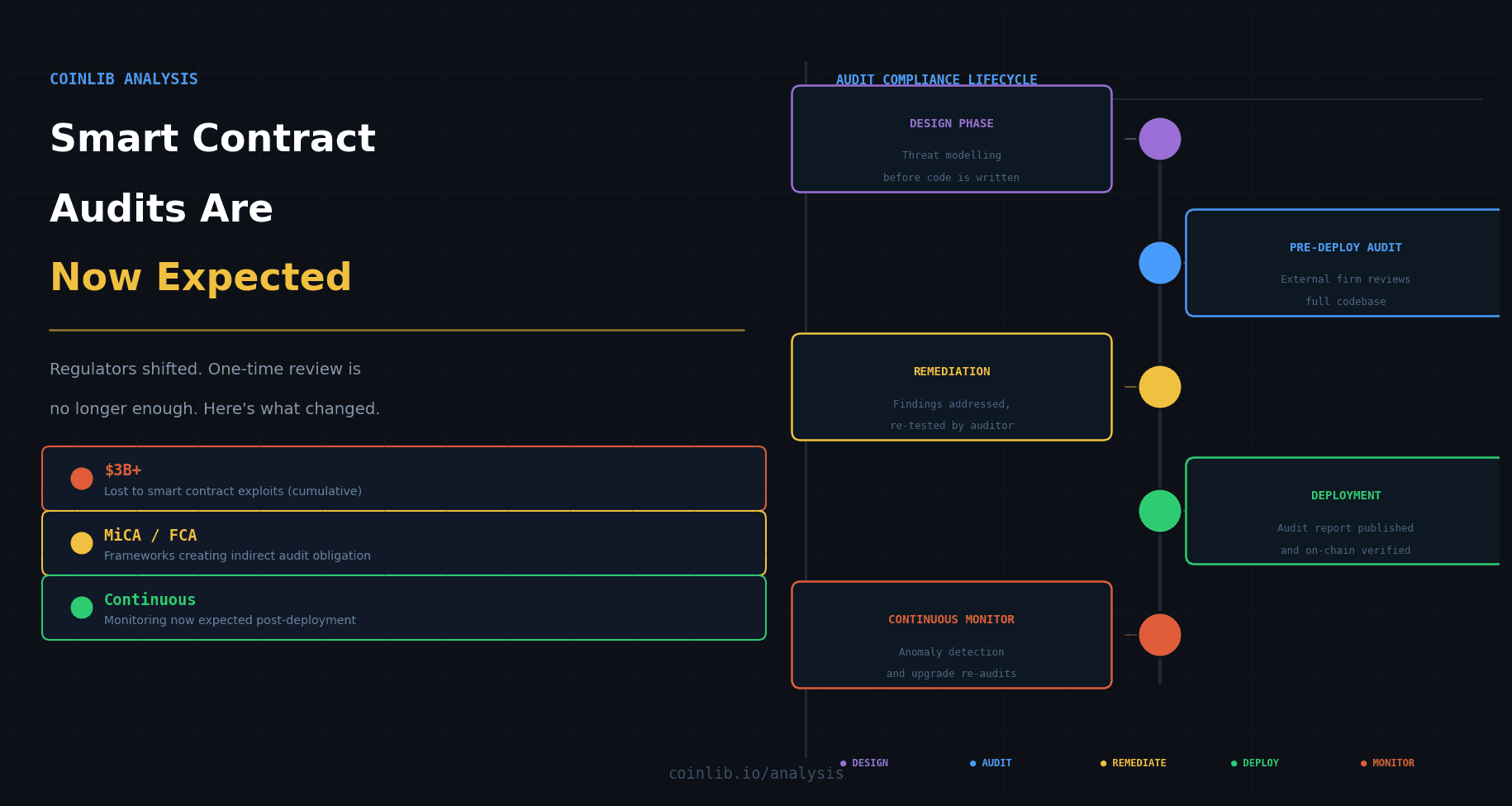
Smart contract audits began as a technical best practice. A development team building a DeFi protocol would engage an external security firm to review the code before deployment, looking for vulnerabilities that could lead to fund loss. It was a voluntary process, driven by professional norms within the developer community rather than any legal requirement. Regulators were not involved.
That has changed. Smart contract audits have moved from optional due diligence to something approaching a baseline expectation in regulated crypto contexts, and the transition reflects a broader shift in how regulators understand the risks presented by on-chain financial applications.
Where the Expectation Comes From
No single regulation in any major jurisdiction explicitly requires a smart contract audit as a condition of operating a DeFi protocol or deploying a token. The shift in expectation has come through a combination of enforcement actions, guidance documents, and the incorporation of audit requirements into licensing frameworks that touch smart contract-based products indirectly.
The EU's MiCA framework does not mention smart contract audits by name, but its requirements for crypto asset issuers to disclose technical risks in white papers, and for crypto asset service providers to maintain adequate risk management systems, create an environment where the absence of an audit is difficult to defend. If a protocol's smart contracts have not been independently reviewed and a vulnerability is subsequently exploited, the absence of an audit becomes evidence of inadequate risk management in any subsequent regulatory investigation.
The UK's Financial Conduct Authority has similarly signalled, through guidance on cryptoasset promotions and its engagement with the DeFi sector, that code-level risk is a material consideration in assessing whether a product is suitable for retail distribution. Promoting a product built on unaudited code to retail customers creates regulatory exposure that was not clearly articulated five years ago.
In the United States, the SEC's enforcement approach to DeFi products has made the question of whether a protocol's code has been independently reviewed increasingly relevant. While the SEC has not issued rules specifically about audits, the documentation a development team can produce about its security practices will be material in any enforcement context where the agency is assessing whether adequate disclosures were made to investors.
What Happened in Practice
The regulatory expectation did not arrive in a vacuum. It was shaped substantially by the pattern of smart contract exploits that accumulated over the industry's history, and by the scale of the losses those exploits produced.
The DAO hack in 2016 was the first major demonstration that smart contract vulnerabilities could produce catastrophic losses. A reentrancy vulnerability in the DAO contract on Ethereum allowed an attacker to drain approximately $60 million in ETH, triggering a contentious hard fork and forcing the Ethereum community to grapple with the question of how to respond when code behaves exactly as written but produces outcomes no one intended.
What followed over the subsequent years was a sustained series of exploits that demonstrated the range of vulnerabilities possible in smart contract code: flash loan attacks, oracle manipulation, access control failures, integer overflow errors, and logic flaws that only manifested under specific market conditions. The cumulative total of funds lost to smart contract exploits across the industry exceeded $3 billion by the mid-2020s.
Regulators noticed. The pattern of preventable losses from code vulnerabilities that could have been identified through competent review made the absence of independent audits difficult to characterise as reasonable professional practice. The regulatory framing shifted from "audits are good practice" to "the absence of an audit requires explanation."
What an Audit Actually Involves
The regulatory significance of audits depends on what they actually accomplish, which is a question that receives insufficient attention in policy discussions.
A competent smart contract audit involves a systematic review of the code against known vulnerability classes, testing of edge cases and boundary conditions, verification that the code behaves consistently with its documentation, and formal or informal analysis of economic attack surfaces including flash loan scenarios and oracle manipulation vectors. Major audit firms including Trail of Bits, OpenZeppelin, and Consensys Diligence have developed standardised methodologies and publish their findings publicly, which creates an accountability mechanism for the quality of their work.
What an audit does not do is provide a guarantee that code is vulnerability-free. Auditors review the code against known vulnerability patterns and their own expertise, but novel attack vectors, vulnerabilities in code added after the audit, and interactions between multiple protocols that individually audit cleanly can all produce exploits that audits did not identify. Several of the largest DeFi exploits in recent years occurred in protocols that had been audited by reputable firms.
This limitation is important for regulators to understand, because an audit requirement that treats audit completion as sufficient protection for users would be misplaced. The more defensible framing — which is broadly how sophisticated regulators appear to be approaching it — is that an audit is evidence of a minimum standard of due diligence, not a guarantee of security.
The Insurance and Institutional Angle
Beyond direct regulatory requirements, smart contract audits have become prerequisites in contexts that create indirect compliance pressure.
On-chain insurance protocols, which allow DeFi users to purchase coverage against smart contract exploit risk, typically require an audit as a condition of coverage. A protocol without an audit cannot obtain meaningful smart contract insurance, which increasingly affects its attractiveness to institutional users who require some form of risk management infrastructure before committing capital.
Institutional investors and fund managers subject to their own investment mandates and regulatory obligations have their own audit requirements. A regulated asset manager cannot typically invest client capital in a DeFi protocol without audit documentation as part of its own due diligence record. As institutional capital has grown as a share of DeFi's total value locked, the audit requirement has become market-driven as well as regulation-driven.
This convergence of regulatory pressure and market demand has created an environment where operating a meaningful DeFi protocol without an audit is increasingly impractical, regardless of whether any specific rule technically requires one.
Continuous Audit and Ongoing Monitoring
The most significant development in how audits are being integrated into regulatory frameworks is the movement away from one-time pre-deployment audits toward ongoing security monitoring as a continuous compliance obligation.
A one-time audit addresses the code as it exists at the moment of review. Protocols that are actively developed add new features, change parameters, and interact with new external protocols after the initial audit is complete. Each of those changes potentially introduces new vulnerabilities. An audit completed before a significant upgrade provides limited assurance about the security of the upgraded version.
Continuous monitoring services that watch deployed contracts for anomalous behaviour, track changes to protocol parameters and governance decisions, and alert teams to suspicious activity have grown into a recognised component of the security infrastructure for serious DeFi protocols. Regulatory guidance in jurisdictions including Singapore and the UK has referenced ongoing monitoring as a component of adequate risk management for on-chain financial applications.
The compliance model that is emerging — where pre-deployment audits establish a security baseline, ongoing monitoring tracks post-deployment changes, and re-audits are required before significant upgrades — is substantively more demanding than the original volunteer-driven audit culture, but it is also more aligned with how software security is managed in regulated financial services contexts more broadly.
What Development Teams Need to Understand
For teams building on-chain financial applications, the regulatory trajectory points in one direction. The question is not whether audits will be required but what standard of audit will be considered adequate, and what ongoing security obligations will apply once a protocol is deployed.
The practical preparation involves engaging established audit firms early in the development process rather than at the end, maintaining comprehensive documentation of the audit process and findings, taking remediation seriously rather than treating the audit report as a formality, and building ongoing monitoring into the protocol's operational infrastructure from the beginning.
Teams that treat audits as a compliance checkbox rather than a genuine security practice will find themselves exposed both to the technical risk of exploit and to the regulatory risk that follows when the absence of genuine security diligence becomes apparent. The two risks are increasingly difficult to separate.
This article reflects Daniel Reeves' analysis of regulatory developments and does not constitute legal advice. Regulatory requirements vary by jurisdiction and are subject to change.