

How MiCA Is Working in Practice: Early Evidence from the EU
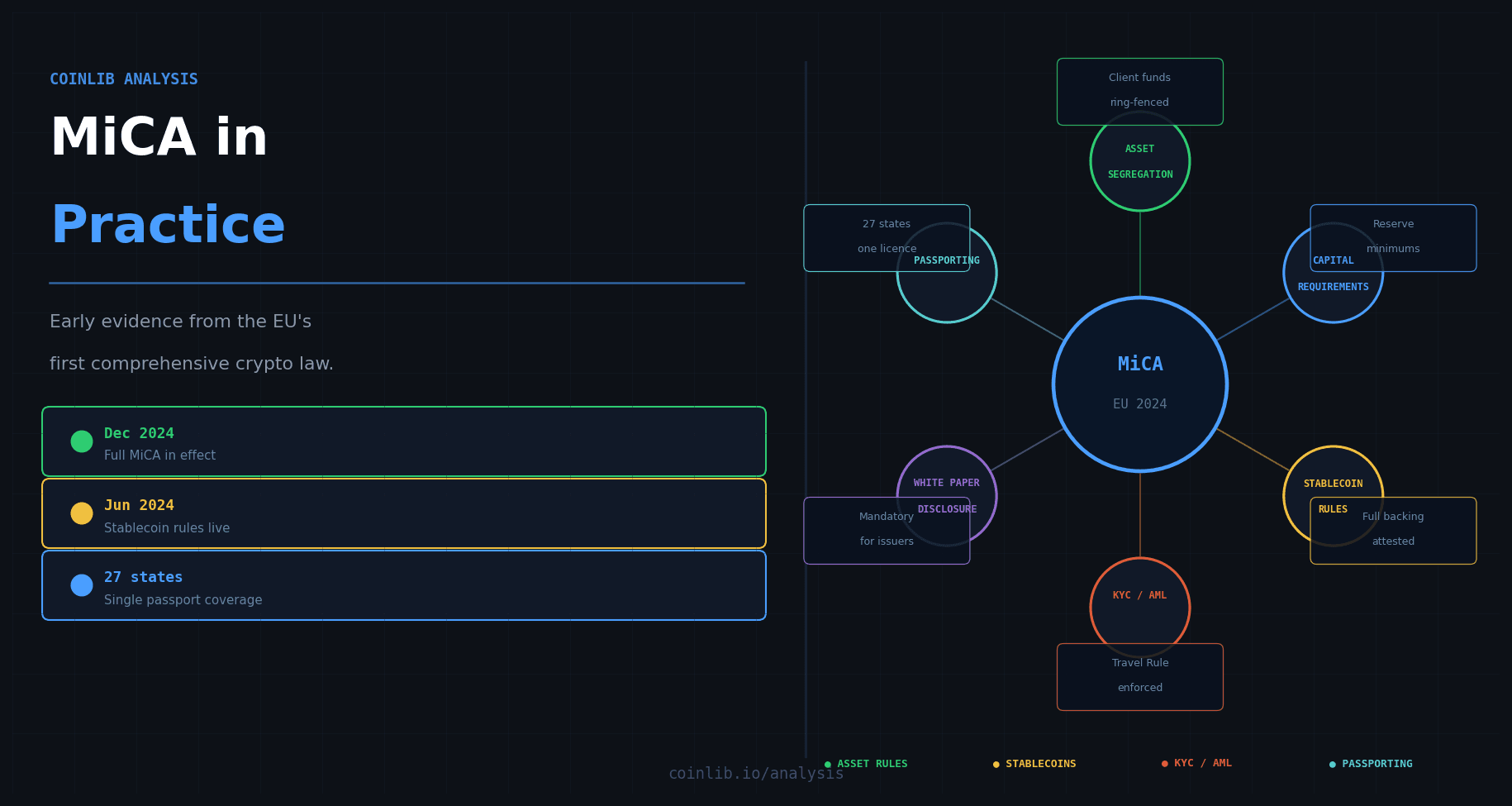
The Markets in Crypto-Assets regulation is the most comprehensive crypto regulatory framework yet implemented by a major jurisdiction. It came into full effect in December 2024, following the stablecoin-specific provisions that took effect in June of that year. For the first time, a unified legal framework governed crypto asset service providers operating across all 27 EU member states.
The theory of MiCA was relatively straightforward: replace a patchwork of national approaches with a single licensing regime, establish minimum standards for capital, custody, and disclosure, and create a passporting system so that a company licensed in one member state could operate across the entire EU. The practice has been more complicated, and the early evidence from the first full year of implementation reveals both what the framework is achieving and where it is creating friction that its designers may not have fully anticipated.
What MiCA Actually Requires
The obligations MiCA places on crypto asset service providers are substantive rather than merely procedural. Licensed entities must maintain minimum capital reserves calculated as a percentage of fixed overheads. They must segregate client assets from company assets, maintaining them in identifiable accounts that cannot be commingled with operational funds. They must publish detailed white papers for crypto assets they issue or offer to the public. They must implement robust KYC and AML programmes. And they must meet ongoing disclosure requirements about their financial condition and risk management.
For stablecoin issuers specifically, the requirements are more demanding still. Asset-referenced tokens and e-money tokens must maintain fully backed reserves, subject to regular attestation by independent auditors. Reserve assets must be held in specific eligible categories. Issuers must maintain liquidity buffers sufficient to meet redemption demands under stress scenarios.
These requirements represent a significant compliance burden, particularly for smaller operators. The cost of licensing applications, ongoing compliance infrastructure, and the capital requirements themselves has led to meaningful market consolidation in the EU crypto sector.
The Stablecoin Controversy
The most significant early test of MiCA's practical impact was the stablecoin provisions, and specifically the question of whether Tether's USDT would meet the requirements.
Tether, the issuer of the world's largest stablecoin by market capitalisation, did not obtain the e-money institution licence required under MiCA for stablecoins offered to EU customers. The response from several major exchanges serving EU customers was to delist USDT trading pairs to avoid regulatory exposure. Coinbase Europe removed USDT in late 2024. Other exchanges followed.
The delisting of USDT from EU-regulated platforms was a significant market event because USDT accounts for the majority of stablecoin trading volume globally. EU traders who wanted stablecoin exposure shifted primarily to USDC, whose issuer Circle had obtained the necessary e-money institution licence. The market share shift toward USDC in EU trading volumes was measurable and sustained.
Tether subsequently engaged more actively with EU regulators and the path toward compliance, though the process has moved slowly. The episode illustrated that MiCA's stablecoin requirements have genuine teeth and that non-compliance carries real market consequences rather than just regulatory exposure.
Licensing Progress and National Implementation
MiCA uses a national competent authority model, meaning that each member state designates a regulator responsible for licensing CASPs in that jurisdiction. The licensing granted by that authority is then passportable across the EU. This has led to meaningful variation in how quickly different member states have processed applications and how rigorously they have applied the standards.
Some jurisdictions moved quickly to process applications and establish efficient licensing procedures. Others have had slower processing times, creating uncertainty for businesses waiting on licences they need to operate legally. The variation in processing speed has practical implications: companies that need EU market access have had to make decisions about which jurisdiction to seek their primary licence from based partly on processing efficiency, which is not the basis on which the regulatory race-to-the-bottom concern in financial services regulation is intended to be resolved.
The European Securities and Markets Authority has issued guidance aimed at harmonising implementation across member states, but the supervisory culture and resource levels of national authorities differ enough that meaningful inconsistency in practice remains.
What the Market Structure Data Shows
The early market structure evidence from MiCA implementation shows several trends that are worth examining carefully.
Consolidation has accelerated. The compliance costs associated with MiCA licensing have favoured larger operators with the capital and compliance infrastructure to absorb them. Smaller exchanges, wallet providers, and crypto service companies have faced a choice between investing significantly in compliance or exiting the EU market. A meaningful number have chosen to exit, reducing the competitive diversity of the EU crypto market.
Institutional participation has increased. The framework certainty that MiCA provides has made it easier for EU-based institutional investors to access crypto through regulated channels. Banks, asset managers, and insurance companies that were previously deterred by regulatory uncertainty have found it easier to justify crypto exposure within a defined regulatory framework. This was one of MiCA's intended effects and the early evidence suggests it is materialising.
Bitcoin and Ethereum have benefited disproportionately from the institutional channel. Regulatory frameworks naturally favour assets with clearer classification and more established market infrastructure. The flow of institutional capital through MiCA-compliant channels has concentrated in the largest and most liquid assets.
The DeFi and NFT Questions
MiCA includes explicit carve-outs for fully decentralised finance protocols and certain categories of NFTs. The carve-outs were necessary to avoid capturing activity that is genuinely decentralised and therefore not amenable to the CASP licensing framework. They also created ongoing definitional uncertainty.
The DeFi carve-out applies where there is "no intermediary." What constitutes sufficient decentralisation to qualify for the carve-out has not been definitively resolved. Protocols that have governance tokens, development teams, or foundation entities that exercise meaningful control over protocol parameters sit in a grey area. The European Banking Authority has indicated that it will develop further guidance on the DeFi boundary, but that guidance was not available in the first year of full MiCA implementation.
The practical result is that DeFi protocols continue to operate without MiCA compliance while the definitional questions are worked through. Platforms that provide front-end interfaces to DeFi protocols are in a more exposed position, as they are more clearly intermediaries than the underlying protocols. Several EU-based DeFi front-end operators have sought legal advice and adjusted their operations to reduce regulatory exposure pending clarification.
What Is Working
The evidence from the first year of full MiCA operation is not uniformly negative on the framework's practical effectiveness.
Asset segregation requirements are working as intended. The structural feature that failed so visibly in the Celsius and FTX collapses, the commingling of customer assets with company funds, is legally prohibited for MiCA-licensed entities. Attestations of reserve holdings are becoming routine. The information environment for EU customers of regulated platforms is genuinely better than it was before MiCA.
The passporting mechanism is functioning, if imperfectly. Companies that have obtained licences in one member state are operating across the EU without obtaining separate national authorisations in each jurisdiction. That was the intended design and it is working as a legal matter, even if the variation in how rigorously different national authorities supervise their licensed entities creates some inconsistency in practice.
Consumer complaint mechanisms and mandatory disclosure requirements have created accountability channels that did not previously exist. EU crypto consumers now have clearer rights and more accessible recourse against licensed platforms than was available under the pre-MiCA patchwork.
The Outstanding Problems
The gaps and friction points in MiCA's early implementation are also visible in the data.
The stablecoin situation remains unresolved to the extent that USDT, the world's dominant stablecoin, is not available on EU-regulated platforms. This is not a failure of MiCA's design in a technical sense, but it does mean that EU traders face a reduced range of stablecoin options compared to users of non-EU platforms, which has competitive implications.
The processing speed and consistency of national licensing remains an issue. Until all member states are processing applications on similar timelines and applying standards with similar rigour, the single market aspiration of MiCA is partially undermined.
The DeFi boundary question will require resolution. As DeFi protocols accumulate more EU users and more EU-based participants, the absence of a clear regulatory boundary creates ongoing uncertainty for both protocol operators and the regulators responsible for enforcing MiCA.
The scheduled MiCA review process, which is intended to assess the framework's effectiveness and make adjustments based on implementation experience, will be a significant event for the sector. The early evidence from year one provides a reasonably clear picture of what needs attention. Whether the review process produces timely and effective adjustments depends on political dynamics in the EU institutions that are difficult to predict.
The Broader Significance
MiCA matters beyond the EU for a specific reason: it is the first example of a major jurisdiction completing comprehensive crypto legislation and moving into implementation. The data emerging from that implementation is the first real-world evidence of what a comprehensive regulatory framework for crypto looks like in practice.
Other jurisdictions, including the United States, which is still working through its own market structure legislation, are watching what MiCA produces. The evidence on consolidation, institutional participation, market structure effects, and compliance costs will inform how other regulatory frameworks are designed. In that sense, MiCA's early implementation period is not just significant for European crypto markets. It is significant for where global crypto regulation goes next.