

How Crypto Market Cycles Are Measured and What They Show
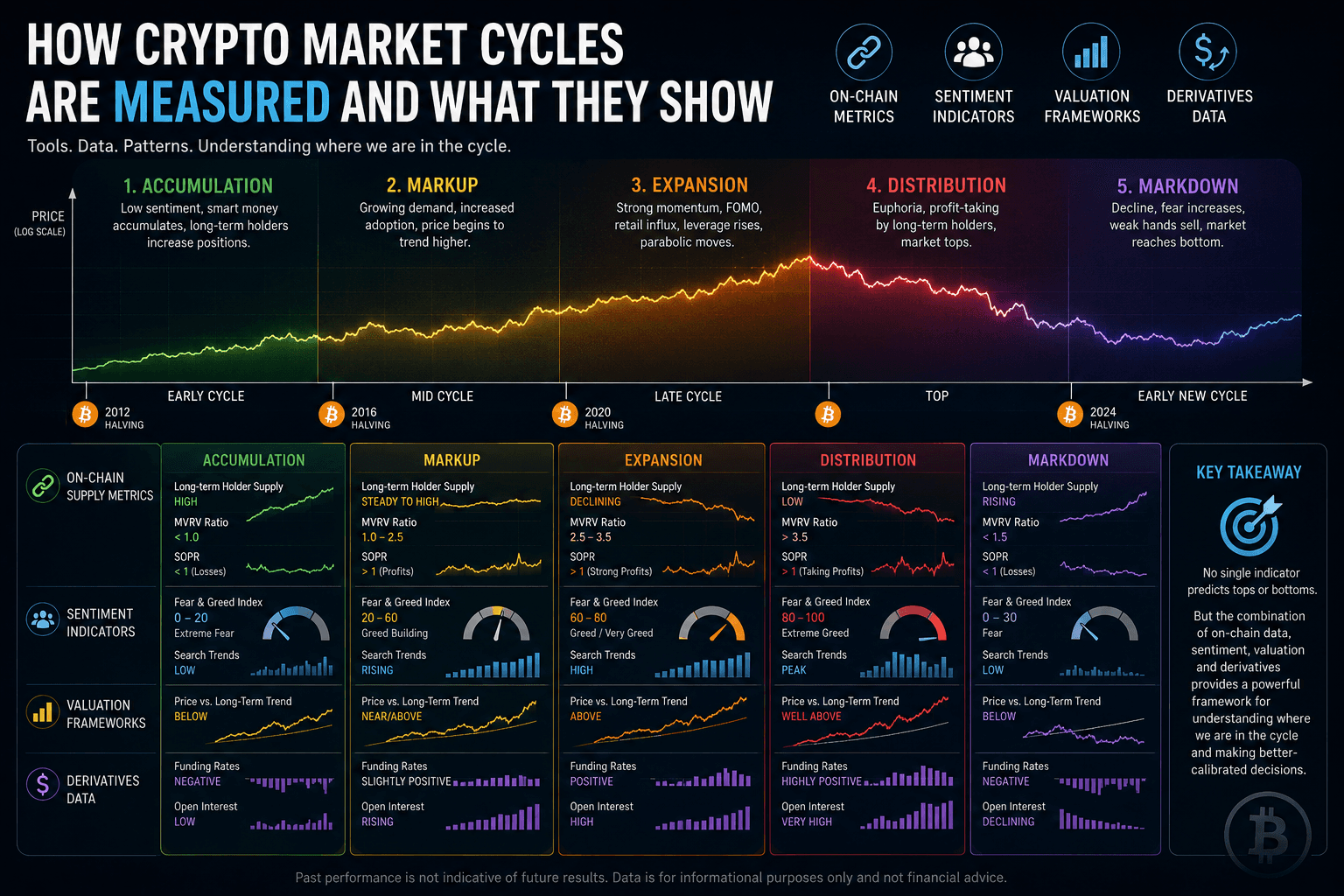
Crypto market cycles get talked about constantly and understood precisely almost never. The vocabulary is everywhere — bull market, bear market, accumulation phase, euphoria — but the analytical frameworks that give those terms actual meaning are less often explained. That is a gap worth closing, because measuring cycles properly changes what you see in the data and, by extension, what decisions follow from it.
This analysis covers the primary tools used to identify where a market is in its cycle, what each one measures, and what the evidence from past cycles shows about their reliability.
Why Cycles Exist in Crypto
Before the measurement tools, the mechanism. Crypto markets cycle because of the interaction between supply dynamics — most obviously Bitcoin's halving schedule, which reduces the rate of new supply on a four-year cadence — and the demand dynamics driven by sentiment, leverage, and capital rotation.
The halving creates a supply shock with a predictable calendar. Demand is less predictable but exhibits its own recurring patterns: low during extended price declines, which discourage participation, and rising sharply once price appreciation begins to draw in new participants. The combination produces a pattern that is not identical between cycles but is recognisable across them. Prices bottom during periods of minimal public interest, rise as conviction builds among earlier participants, accelerate as wider adoption and leverage amplify demand, and then correct sharply once the marginal buyer has been exhausted.
The tools for measuring cycles are essentially different ways of quantifying where that process currently stands.
On-Chain Supply Metrics
The most direct window into cycle positioning comes from on-chain data — the verifiable record of how Bitcoin and other assets are actually being held and moved.
HODL Waves visualise the age distribution of Bitcoin's supply at any given moment. The supply is divided into bands based on when coins last moved, from coins that moved in the last 24 hours through to coins that have been dormant for more than ten years. During bull markets, older supply begins moving as long-term holders take profits, which shows up as a compression of the older age bands and expansion of the younger ones. During bear markets and accumulation phases, the pattern reverses: coins settle into longer dormancy as they transfer from sellers to patient holders who do not move them again quickly.
The pattern is consistent across cycles. Long-term holder supply as a proportion of total circulating supply tends to reach its minimum near cycle tops, as this cohort distributes into rising prices, and its maximum near cycle bottoms, as the same cohort absorbs supply that short-term participants are selling.
MVRV Ratio — Market Value to Realised Value — compares the current market capitalisation of Bitcoin to its realised capitalisation, which is the aggregate value of all coins at the price they last moved on-chain. When MVRV is high, the average coin in circulation is sitting on a large unrealised gain, which historically correlates with cycle tops because it identifies the conditions under which profit-taking becomes attractive at scale. When MVRV is low, the average coin is held at a loss, which correlates with cycle bottoms.
Across the major cycles to date, MVRV readings above 3.5 to 4 have reliably identified conditions of elevated distribution risk. Readings below 1 — meaning the market capitalisation is below realised value — have marked the deepest stages of bear markets and, with hindsight, periods of genuine long-term value.
SOPR — Spent Output Profit Ratio — measures whether coins moving on-chain are doing so at a profit or a loss relative to when they were last moved. A reading above 1 means coins are on average being spent at a profit. A reading below 1 means they are being spent at a loss. In bear markets, the SOPR tends to stay suppressed as capitulating holders sell at losses. The transition from sustained sub-1 readings to sustained above-1 readings has historically been an early signal that a cycle bottom has established and the trend has shifted.
Market Sentiment Indicators
On-chain metrics measure what is actually happening with supply. Sentiment indicators measure the psychological environment that surrounds those supply dynamics.
The Fear and Greed Index aggregates signals including volatility, trading volume, social media activity, and survey data into a single 0-to-100 score. The extremes are more informative than the midrange readings. Readings below 20 — Extreme Fear — have historically coincided with bottoms or near-bottoms across multiple cycles. Readings above 80 — Extreme Greed — have appeared at or near cycle tops. The mechanism is the one Buffett identified in traditional markets decades ago: the most attractive entry points tend to be surrounded by the conditions that make participation feel most uncomfortable.
The index is a noisy indicator and responds to short-term price moves in ways that reduce its reliability on short timeframes. As a cycle-level signal rather than a timing tool, it is more useful.
Social volume and search trends — specifically the correlation between Google Trends data for terms like "Bitcoin" or "crypto" and subsequent price performance — show a consistent pattern. Mainstream search interest tends to peak at or near cycle highs, reflecting the arrival of the largest cohort of new participants, who by definition tend to arrive late. The 2017 peak, the November 2021 peak, and prior cycles all showed the same signature: a spike in search interest approximately coincident with the final acceleration phase before the correction.
This is not a tradeable signal in any precise sense. But as a qualitative indicator of where a cycle stands relative to public awareness, it has been a reliable feature of cycle tops.
Valuation Frameworks
Several frameworks attempt to provide a valuation anchor for Bitcoin specifically, allowing cycle positioning to be assessed relative to whether the asset looks cheap or expensive on a longer-term basis.
Stock-to-Flow models Bitcoin's price using its ratio of existing supply to annual new issuance — the stock-to-flow ratio — which increases mechanically with each halving. The model generated significant attention in 2020 and 2021 for its apparent predictive accuracy through prior cycles. Its reliability has been debated extensively since, particularly as deviations from the model's projections widened in the 2022-2024 period. As a framework for thinking about the structural supply dynamics of a deflationary asset, it has conceptual merit. As a precise price prediction tool, the evidence for that precision has weakened.
Power Law models take a different approach, modelling Bitcoin's price growth as a function of time using a log-log relationship that has been approximately consistent since the early years of Bitcoin's existence. The power law corridor, as it is sometimes presented, shows that despite cycle-level volatility, Bitcoin's long-term price trajectory has fit a relatively consistent growth trend when plotted on a logarithmic scale. The cycle tops and bottoms appear as temporary deviations above and below that trend rather than as breaks from it. The implication is that cycle-level positioning can be assessed partly by reference to where the current price sits relative to the long-term trend.
The Bitcoin Rainbow Chart, a simplified visualisation of the same log-scale price trajectory idea, uses colour bands to indicate cycle conditions ranging from deeply discounted to bubble territory. It functions as an accessible visualisation of the long-run trend with cycle-level context, though it lacks the precision to function as a trading signal.
Leverage and Derivatives Data
Modern crypto cycles have a derivatives layer that earlier cycles lacked. The behaviour of that layer provides additional signal about cycle conditions.
Funding rates on perpetual futures contracts reflect the premium or discount that long positions are paying to short positions. Consistently positive funding rates indicate that demand for long exposure exceeds short, which tends to accompany bull market conditions. Extremely elevated funding rates indicate a market that is heavily leveraged long, which has historically preceded sharp corrections even within bull markets, as the cost of carrying those positions creates pressure to close them.
The negative funding rate environment that characterised the deepest phases of the 2022 bear market — periods when short exposure was so dominant that longs were being paid to maintain their positions — was consistent with the over-extension of bearish sentiment that accompanies market bottoms.
Open interest — the total value of outstanding derivatives positions — provides a complementary signal. Rising open interest alongside rising price reflects genuine demand. Rising open interest alongside flat or declining price can indicate a market building up leverage without the underlying buying pressure to support it, a configuration that tends to precede liquidation events.
What the Historical Record Shows
The most honest summary of what cycle measurement tools show is this: they improve the probability of making better-calibrated decisions across the cycle, but none of them predict cycle turning points with the precision that would make them reliable tactical trading tools in isolation.
What the combination of on-chain supply metrics, sentiment indicators, valuation frameworks, and derivatives data has consistently shown across every major cycle to date is that the conditions at extremes are identifiable, even if the exact timing of transitions is not. Deep accumulation phases — characterised by low public interest, long-term holder supply at cycle highs, MVRV below 1, and negative derivatives funding — have reliably resolved into the next bull phase. Euphoric tops — characterised by maximum public interest, long-term holder distribution, MVRV above 3.5, and elevated leverage — have reliably resolved into correction phases.
The utility of cycle measurement is not in calling the exact top or bottom. It is in providing enough signal to avoid the most costly error in a cyclical market: deploying maximum capital at the worst possible time, or selling the entirety of a position into the conditions that historically precede the next advance.
That is a more modest claim than cycle analysis is often marketed as delivering. It is also, in practice, a valuable one.