

How Crypto Advertising Is Being Regulated
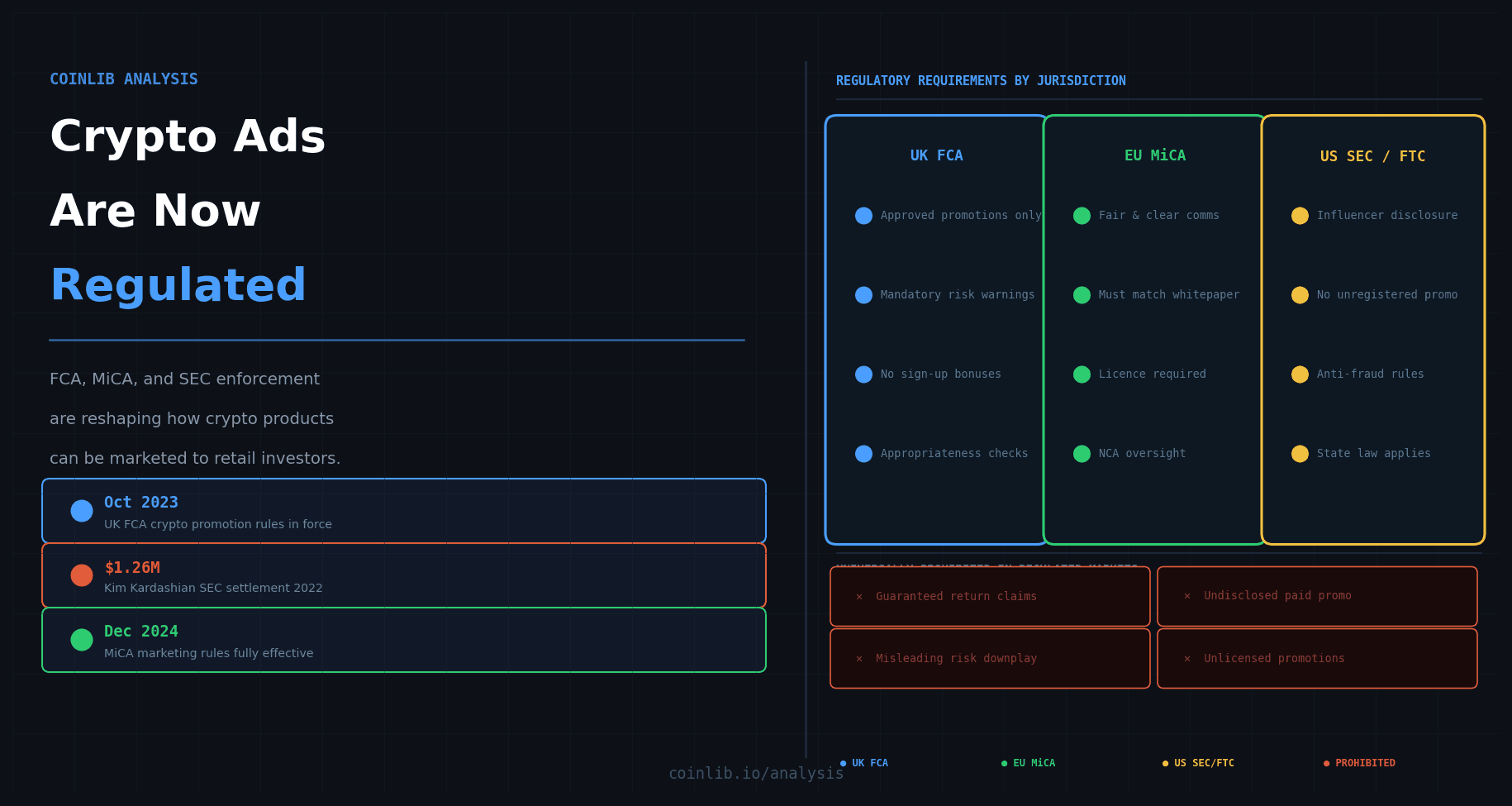
Crypto advertising spent years operating largely outside the frameworks that govern financial promotion in traditional markets. Exchanges ran billboard campaigns promising life-changing returns. Trading platform adverts appeared on public transport. Influencers recommended tokens to millions of followers without disclosing that they were paid to do so. Regulators in most jurisdictions watched this proliferate without consistent enforcement.
That period is over. The advertising of crypto products and services is now subject to meaningful regulatory scrutiny in the UK, EU, and a growing number of other jurisdictions, with enforcement actions making clear that non-compliance carries real consequences. The frameworks being applied draw heavily on the rules that already govern advertising for financial products — rules that exist precisely because financial advertising has historically been a vector for consumer harm.
Why Crypto Advertising Attracted Regulatory Attention
The scale and nature of crypto advertising in the 2020–2022 period created conditions that were difficult for regulators to ignore.
The claims being made in crypto adverts bore no resemblance to what is permitted in regulated financial services. "Buy Bitcoin and retire early." "Invest in [token] before it goes up 10,000 percent." "Our platform makes everyone a winning trader." These are not hypotheticals — they are representative of the actual claims appearing in advertising across television, social media, and outdoor formats during the bull market.
The harm was measurable. Consumer protection agencies in multiple jurisdictions documented losses suffered by retail investors who had made decisions based on misleading advertising. The UK's Financial Conduct Authority identified crypto as one of the sectors generating the most consumer complaints relating to financial promotion. The combination of genuine losses, misleading claims, and high advertising spend created political pressure for intervention.
The FTX collapse in November 2022 accelerated the timeline in most jurisdictions. The collapse of one of the most aggressively marketed crypto brands — FTX had naming rights on a major US sports arena and ran celebrity-endorsed television campaigns — focused political and regulatory attention on the gap between how crypto was being advertised and what it actually delivered.
The UK Framework
The UK has implemented the most detailed crypto advertising framework of any major English-speaking jurisdiction. From October 2023, all crypto financial promotions targeting UK consumers — regardless of where the business making the promotion is based — must comply with the FCA's financial promotion rules.
The core requirements are specific. Promotions must be fair, clear, and not misleading. They must include prominent risk warnings in a prescribed format. They must not include incentives to invest, such as referral bonuses or sign-up offers, except in tightly controlled circumstances. They must be approved by an FCA-authorised person or issued by a registered cryptoasset firm.
The personalisation obligation introduced in the UK rules is worth noting specifically. Firms marketing crypto products to UK consumers must assess whether the product is appropriate for the individual before showing them a promotion. A retail investor who has no experience of crypto should not be shown the same marketing as an experienced trader. This requirement mirrors the suitability and appropriateness obligations in traditional financial services and represents a significant departure from the broadcast advertising model that characterised crypto marketing during the bull years.
Enforcement began relatively quickly. The FCA issued alerts against hundreds of firms it considered to be promoting crypto illegally to UK consumers, including a significant number of overseas exchanges that had not grasped that the rules applied to them by virtue of targeting UK residents.
The EU Approach Under MiCA
The EU's Markets in Crypto-Assets regulation addresses advertising as part of a broader framework rather than in isolation. Under MiCA, crypto asset service providers authorised to operate in the EU are subject to marketing communication rules that require all communications to be fair, clear, and not misleading, identifiable as marketing materials, and consistent with the information in the required white papers.
MiCA's approach to advertising is less granular than the UK's FCA rules but sits within a comprehensive licencing framework that creates accountability for the firm behind the promotion. A licenced crypto exchange under MiCA that runs misleading advertising faces regulatory action from its national competent authority with consequences that extend to its operating licence — a much higher-stakes outcome than a standalone advertising enforcement.
The white paper requirement in MiCA is a structural advertising constraint as well as a disclosure obligation. The information a firm can claim in its marketing must be consistent with what it has disclosed in its white paper. A firm that has disclosed risk factors in its white paper cannot then run advertising that downplays those same risks. The two documents are read together in any enforcement context.
Social Media, Influencers, and the Disclosure Problem
The most widespread form of crypto advertising during the 2020–2022 period was not television or billboards. It was social media promotion, much of it by influencers who did not disclose that they were being paid to promote the products they recommended.
Regulators have approached this through a combination of crypto-specific rules and the existing frameworks governing paid endorsements. In the UK, the Advertising Standards Authority's rules on influencer disclosure apply to crypto promotions in the same way they apply to any other product. Paid promotion must be disclosed. Undisclosed paid promotion is a regulatory violation regardless of the asset class being promoted.
The SEC in the United States has brought enforcement actions against celebrities and influencers who promoted crypto tokens without disclosing compensation. Kim Kardashian paid $1.26 million to settle SEC charges relating to undisclosed promotion of the EthereumMax token. Paul Pierce, Lindsay Lohan, and others faced similar charges. The enforcement pattern established clearly that undisclosed paid promotion of securities — or assets the SEC considers securities — exposes both the promoter and the issuer to liability.
The specific challenge with influencer promotion is scale and speed. A post reaching millions of followers on short-form video platforms can drive significant market activity before any regulatory review is possible. The after-the-fact enforcement model that characterises most regulatory response to influencer promotion is poorly matched to the speed at which crypto social media operates. Regulators have acknowledged this gap but have not yet developed a credible real-time intervention mechanism.
Trading Platform Advertising and Performance Claims
Advertising for crypto trading platforms — exchanges, brokerage services, and automated trading tools — presents a specific set of issues around performance claims that regulators have focused on.
Claims that a platform generates consistent profits, outperforms the market, or eliminates the risk of loss are straightforwardly prohibited under financial promotion rules in most jurisdictions. The difficulty is that these claims appeared routinely in advertising for trading platforms and automated tools throughout the bull market, including on platforms that were not registered or regulated anywhere.
The regulatory expectation for any platform making performance claims is now that those claims must be substantiated, include appropriate risk disclosures, and not imply that past performance predicts future results. An analysis of a trading platform's actual methodology and risk profile — rather than its marketing claims — provides the kind of information consumers need and that regulators are increasingly requiring platforms to make available. The Immediate GP analysis is an example of the independent scrutiny that complements regulatory disclosure requirements, helping users evaluate what a platform actually offers beyond its promotional material.
The distinction between a regulated trading platform and an unregistered one matters significantly in this context. A regulated platform is subject to ongoing supervision and its advertising must comply with the rules of its licencing jurisdiction. An unregistered platform faces no such constraint until and unless an enforcement action is brought, which creates a systematic disadvantage for compliant operators and systematic risk for consumers who cannot distinguish between the two.
Jurisdictional Reach and Cross-Border Enforcement
One of the structural challenges in crypto advertising regulation is jurisdictional. A firm based in a permissive jurisdiction can direct advertising at consumers in a jurisdiction with strict rules, and the consumer-facing jurisdiction must rely on its own enforcement mechanisms — which may be slow or practically limited against overseas entities.
The UK has adopted a particularly expansive approach: the financial promotion rules apply to any firm that directs promotions at UK consumers, regardless of where the firm is located. This means a crypto exchange based in the Seychelles, if it runs advertising targeted at UK residents, is in scope for FCA financial promotion rules. The practical enforceability of this against unregistered overseas firms is imperfect, but the FCA's publication of consumer alerts against specific firms provides a mechanism for warning consumers even where direct enforcement action is not possible.
The EU's approach through MiCA creates a different dynamic. Firms that want access to EU markets through the EU's single market must be licenced, and licenced firms are accountable for their advertising. This creates stronger compliance incentives for firms that see EU market access as commercially important.
The United States lacks a comprehensive crypto advertising framework at the federal level. Advertising for regulated securities or derivatives products faces the same rules as any other regulated financial promotion. For the broader crypto market, the framework is more fragmented, with the FTC's general advertising rules, state-level consumer protection laws, and the SEC's enforcement posture toward unregistered securities offerings providing the primary constraints.
Where This Is Going
The direction of travel in crypto advertising regulation is toward convergence with the standards that apply to regulated financial services. The arguments for a lighter-touch approach — that crypto is different, that retail investors understand the risks, that heavy regulation will stifle innovation — have not survived sustained exposure to the evidence of consumer harm.
What is being built, jurisdiction by jurisdiction, is a framework where crypto advertising operates under the same basic constraints as advertising for investment funds, retail banking products, and insurance. Claims must be substantiated. Risks must be disclosed prominently. Paid promotion must be identified. Suitability must be considered before targeted promotion reaches individual consumers.
For firms that have operated responsibly, compliance with these requirements is not a substantial burden — they are already meeting most of them. For firms that built their customer acquisition on aggressive claims and undisclosed promotions, the compliance burden is significant and the enforcement risk is real. The gap between those two categories, not the rules themselves, is where most of the friction in this space sits.
This article reflects Daniel Reeves' analysis of regulatory developments and does not constitute legal advice. Regulatory requirements vary by jurisdiction.