

Bitcoin Explained: How It Works, What to Know & Why It Matters in 2026
Data as of 17 April 2026. Figures are the market snapshot at publication; see the Bitcoin price page for live numbers.
Bitcoin is a decentralized digital asset and monetary network that allows users to store and transfer value without a central issuer. In 2026, Bitcoin matters both as a financial asset and as an open system for moving and verifying value on the internet. It is known for its fixed long-term supply, public transaction ledger, and ability to operate without a central bank or payment company.
For beginners, Bitcoin is often the first cryptocurrency they encounter. For more experienced readers, it remains the reference point for how digital assets are priced, compared, and understood. This guide explains what Bitcoin is, how it works, why it has value, what drives its price, and what people should understand before buying, holding, or analyzing it.
What is Bitcoin?
Bitcoin is a decentralized digital currency and payment network that runs on a public blockchain. It allows users to send and receive value over the internet without relying on a central authority to issue the asset or approve every transaction. Instead, the network follows a set of transparent software rules that can be independently verified by anyone.
The core idea behind Bitcoin is simple: it combines digital scarcity, cryptographic ownership, and public verification. That makes it different from traditional money, which is issued and managed by governments and banks. It also makes Bitcoin different from many newer crypto assets, which may have different supply models, governance systems, or technical goals.
How does Bitcoin work?
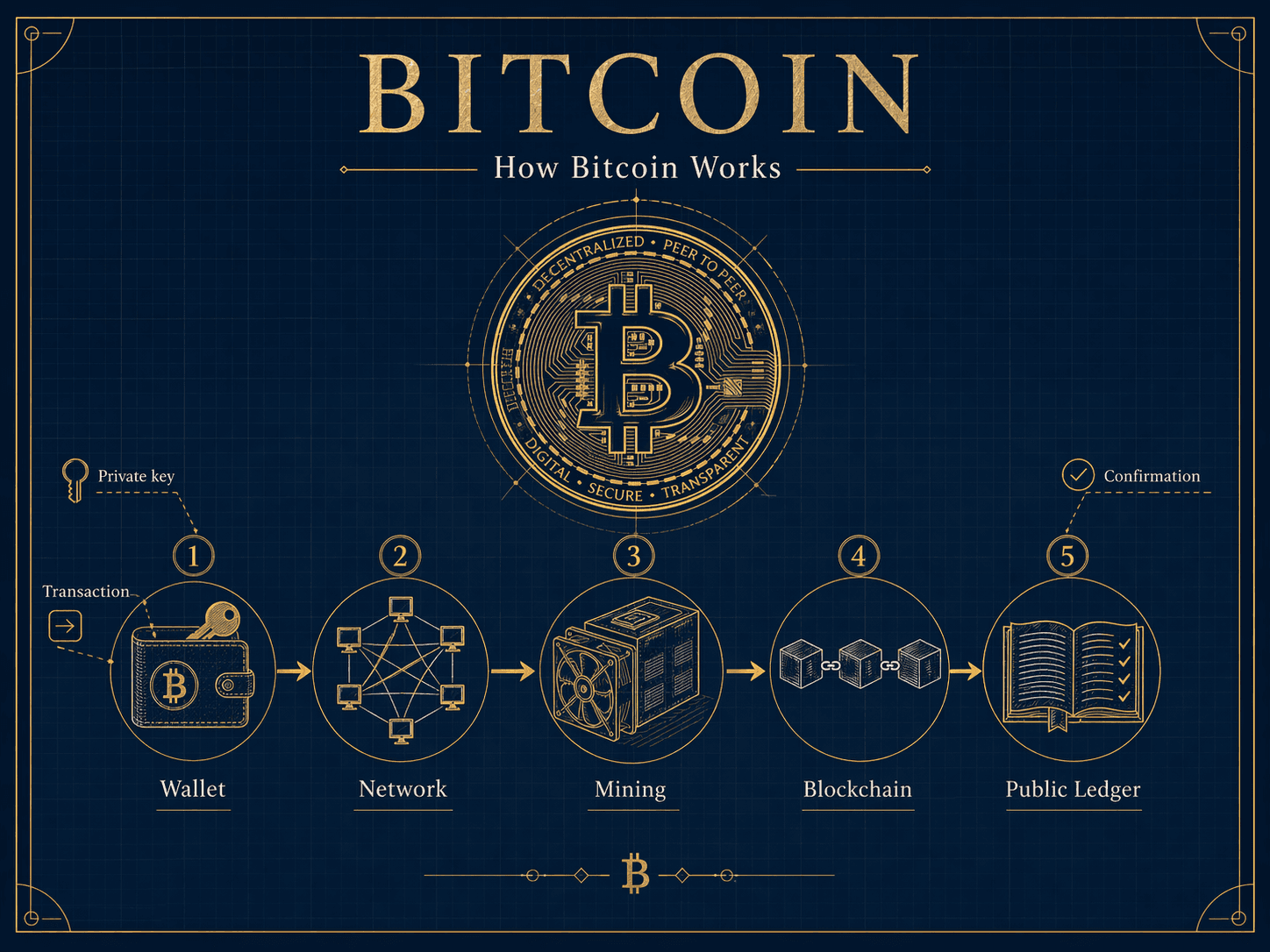
Bitcoin works through a distributed network of computers that validate transactions and maintain a shared public ledger. When someone sends bitcoin, the transaction is broadcast to the network. Nodes verify whether the transaction follows the rules, and miners compete to add valid transactions to new blocks. Once a block is confirmed and added to the blockchain, it becomes part of Bitcoin’s transaction history.
For most readers, three concepts matter most. First, Bitcoin ownership is controlled by cryptographic keys. Second, the network can be verified publicly rather than trusted privately. Third, new bitcoin enter circulation through mining, and the issuance rate falls over time. Together, those features create a system that is open, auditable, and limited in long-term supply.
Why does Bitcoin matter in 2026?
Bitcoin matters in 2026 because it has grown from a niche internet experiment into a global financial and technological reference point. It is now discussed not only by crypto users, but also by investors, regulators, companies, and institutions. That does not mean everyone agrees on what Bitcoin is for, but it does mean Bitcoin has become too large and too relevant to ignore.
Its importance comes from two things at once. First, Bitcoin is still the best-known decentralized monetary network, with a transparent supply schedule and strong global recognition. Second, it now exists inside a broader financial environment where access, regulation, custody, and market structure all shape how people use it. In other words, Bitcoin still matters because of what it is, and also because of the role it now plays in the wider market.
Why does Bitcoin have value?
Bitcoin has value because people are willing to treat it as a scarce digital asset that can be owned, transferred, and verified without relying on a central issuer. Its value does not come from a government guarantee or a company balance sheet. Instead, it comes from a mix of supply limits, network effects, recognizability, liquidity, utility, and belief in the durability of its monetary rules.
For some people, Bitcoin’s value is tied to scarcity. For others, it comes from censorship resistance, portability, or global accessibility. For market participants, it also has value because it is widely traded, widely followed, and deeply integrated into the broader crypto ecosystem. The important point is that Bitcoin’s value is not based on a single idea. It is based on the combined effect of technical design, market adoption, and social consensus.
Is Bitcoin a currency, an investment, or something else?
Bitcoin can function as a payment asset, a long-term savings asset, a speculative trading asset, or a treasury reserve asset depending on the user and the context. That is one reason it is often misunderstood. People often try to force Bitcoin into one category, when in practice it can play different roles at different times.
For beginners, the easiest way to think about Bitcoin is as a digital asset with monetary properties. For investors, it is often treated as a scarce and volatile macro-sensitive asset. For users focused on financial sovereignty, it may be a tool for holding value outside traditional banking rails. These views do not cancel each other out. They reflect the fact that Bitcoin sits at the intersection of technology, money, and markets.
What makes Bitcoin different from other cryptocurrencies?
Bitcoin is different from many other cryptocurrencies because its main purpose is relatively narrow and clear. It is designed to be a decentralized monetary network with a fixed long-term supply and a conservative approach to change. Many other crypto projects aim to support broader functionality such as smart contracts, tokenized applications, gaming, or more flexible network design.
That does not automatically make Bitcoin “better” than every other digital asset in every category. It means Bitcoin’s strength is focus. Its long history, recognizability, security model, and monetary narrative are part of what gives it a distinct place in the market. Even people who prefer other blockchain ecosystems often still use Bitcoin as the baseline for comparing risk, decentralization, and adoption.
Why is Bitcoin’s supply important?
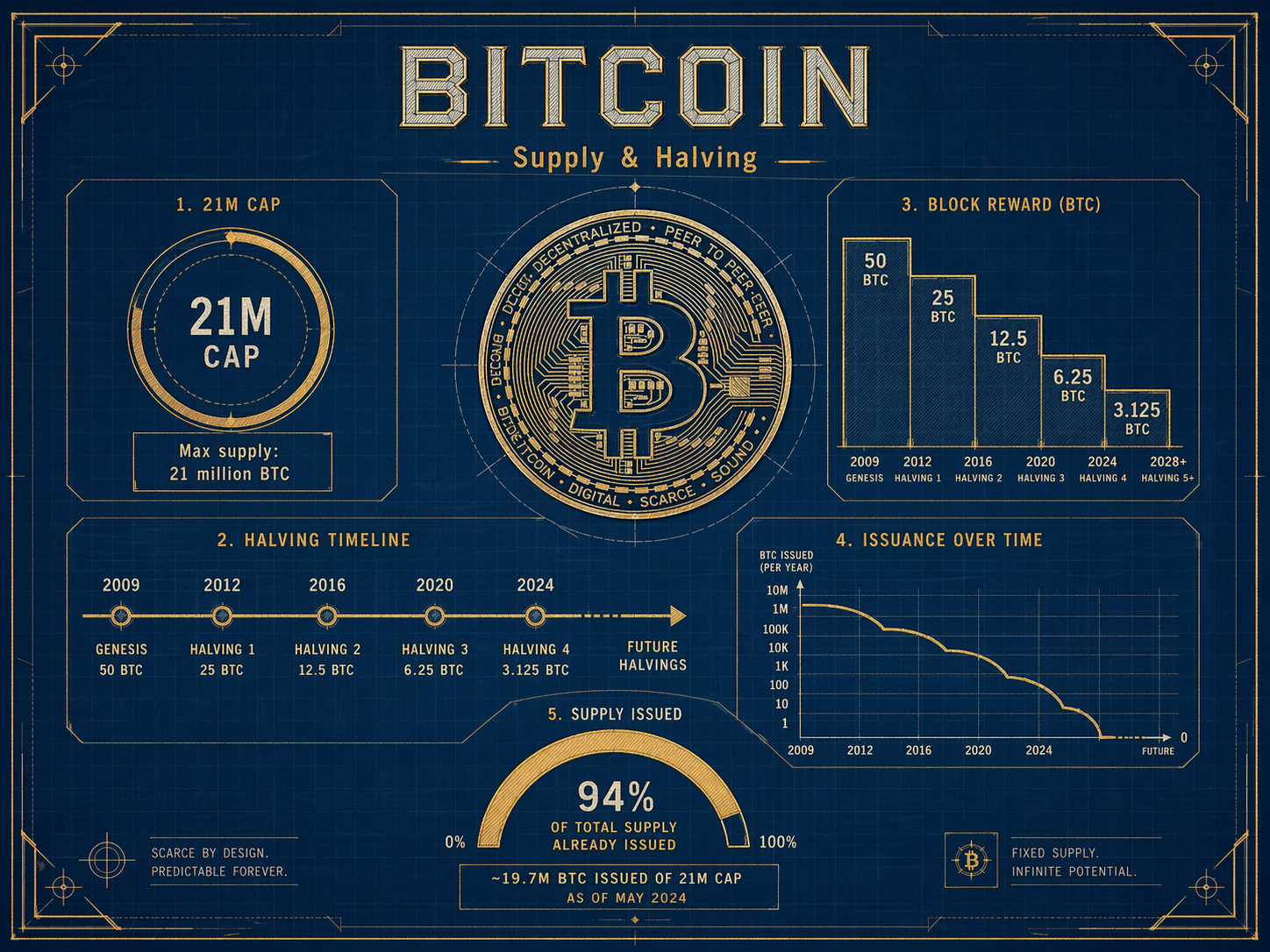
Bitcoin’s supply model is one of its defining features. The protocol has a maximum supply of 21 million bitcoin, and new issuance slows over time through a mechanism known as halving. This makes Bitcoin structurally different from assets whose supply can expand more flexibly.
That supply design matters because it gives Bitcoin a predictable monetary framework. Users do not need to guess how many new units may be created next year under a discretionary policy system. At the same time, fixed supply does not mean fixed price. Bitcoin can still be highly volatile, because price depends on demand, market conditions, sentiment, and liquidity as much as long-term scarcity.
What drives Bitcoin’s price?
Bitcoin’s price is driven by a combination of supply expectations, market demand, liquidity, macro conditions, investor sentiment, and capital flows. Scarcity is part of the long-term story, but it does not explain short-term price action on its own. In practice, Bitcoin reacts to many forces at once, including market positioning, exchange liquidity, institutional demand, regulatory signals, and broader appetite for risk.
This is why Bitcoin can be described as both scarce and volatile. The scarcity narrative explains why many people hold it over long time horizons. The volatility reflects the fact that Bitcoin trades in an open market where sentiment and liquidity change constantly. Anyone trying to understand Bitcoin needs to understand both sides of that equation.
Is Bitcoin safe for beginners?
Bitcoin can be accessible for beginners, but it is not automatically safe just because it is popular. New users often focus only on price and forget that real-world Bitcoin risk also includes custody mistakes, scams, phishing, platform risk, and user error. Buying bitcoin is easy in many places. Understanding how to hold it safely is a separate skill.
A beginner-friendly approach starts with five questions. What am I buying? Where is it being held? Who controls the keys? Can I move it freely? What are the main risks if something goes wrong? Those questions matter because Bitcoin risk is not just about market volatility. It is also about how the asset is stored, accessed, and protected.
What is the difference between self-custody and exchange custody?
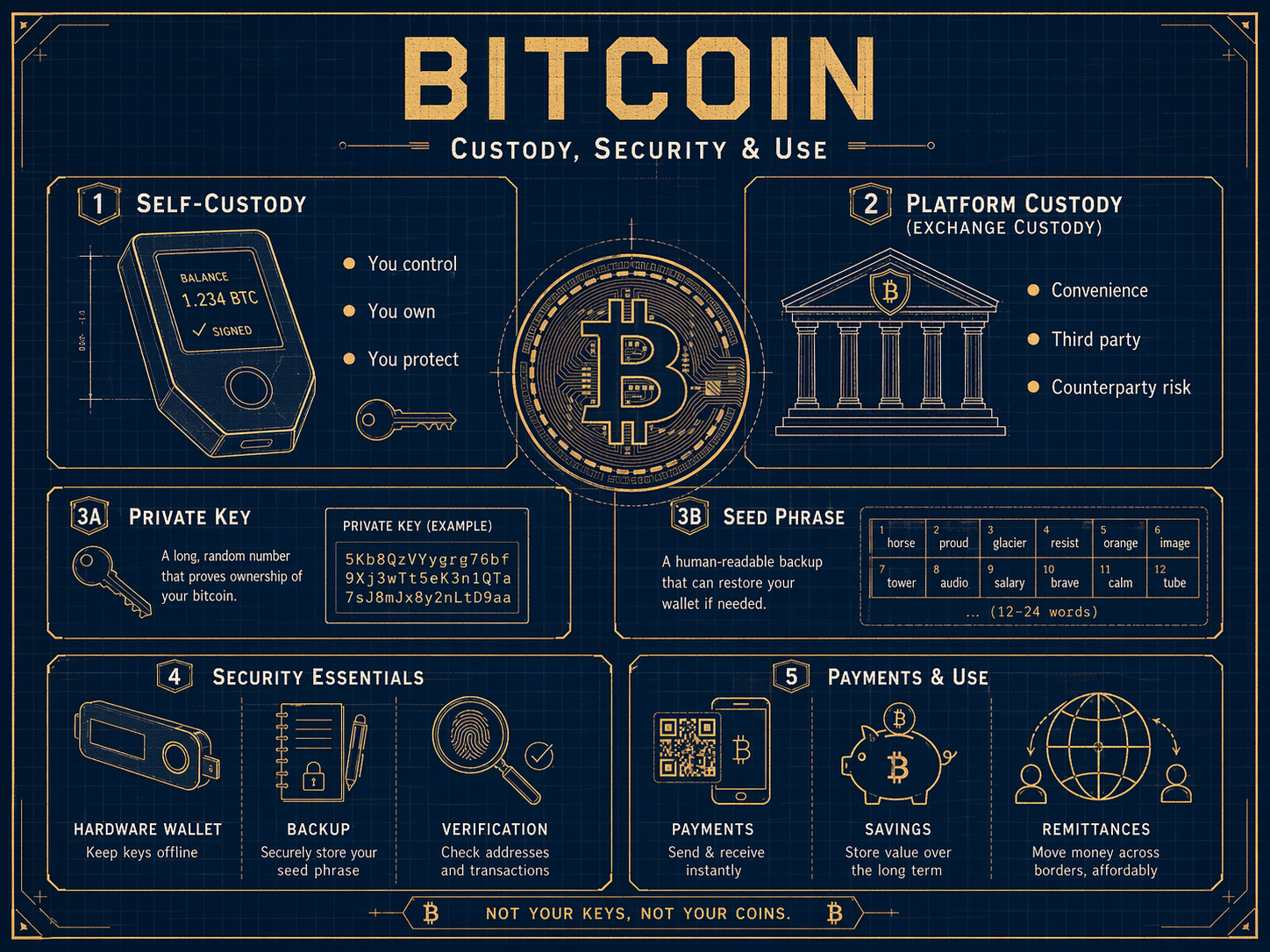
Self-custody means the user controls the private keys and therefore has direct control over the bitcoin. Exchange custody or platform custody means a third party holds the asset or the keys on the user’s behalf. This is one of the most important choices any Bitcoin user makes, because it affects convenience, security, and counterparty risk.
Self-custody offers greater independence, but it also requires more responsibility. Users need to protect recovery phrases, secure their devices, and understand basic wallet hygiene. Platform custody can be simpler for beginners, but it introduces dependence on the provider’s security, policies, and solvency. The right choice depends on the user’s knowledge, goals, and risk tolerance, but the trade-off should always be understood clearly.
Can Bitcoin be used for payments?
Yes, Bitcoin can be used for payments, but its payment use case depends on the situation. In some cases, users value Bitcoin for borderless transfers, settlement finality, or transactions that do not depend on traditional payment rails. In other contexts, people prefer to hold Bitcoin as an asset and use it less frequently for day-to-day spending.
This is why Bitcoin is often discussed in two different ways: as a network for moving value and as an asset for holding value. Both uses can exist at the same time. The important point is that Bitcoin is not only a price chart. It is also a functioning network, and its role as a payment system remains part of its long-term relevance.
What should advanced users still watch closely?
Even experienced Bitcoin users need more than a basic definition. In 2026, serious Bitcoin analysis still depends on following the structure around the asset, not just the asset itself. That includes market liquidity, custody concentration, network security, mining economics, macro conditions, and the relationship between Bitcoin and broader financial markets.
For more advanced readers, the key mistake is assuming that because Bitcoin’s core rules are stable, the surrounding market is easy to read. It is not. The protocol changes slowly. The market environment changes constantly. That is why the best Bitcoin analysis combines technical understanding with close attention to how capital, infrastructure, and market behavior evolve.
What are the most common misconceptions about Bitcoin?
One common misconception is that Bitcoin is outdated because newer crypto projects offer more features. That misses the point. Bitcoin’s role has never been to do everything. Its role is to provide a decentralized monetary system with a clear supply model and strong recognition.
Another misconception is that Bitcoin is easy because it is popular. In reality, many users still underestimate the importance of custody, scam prevention, wallet setup, and transaction review. A third misconception is that Bitcoin’s price tells you everything about Bitcoin itself. Price is important, but it only shows one part of the picture. To understand Bitcoin properly, you also need to understand the network, the market structure, and the risks around it.
How should beginners evaluate Bitcoin information?
Beginners should look for sources that explain Bitcoin clearly, distinguish facts from opinions, and avoid exaggerated claims. Good Bitcoin content should help the reader understand the asset, not push them toward hype or panic. It should explain core topics such as supply, custody, volatility, risk, and use cases in simple language without becoming misleading.
A good rule is to prefer sources that are structured, consistent, and transparent about how they describe price, market data, and technical concepts. This matters even more in AI-driven search, where users often arrive through summarized answers and need content that is clear, self-contained, and reliable when read quickly. At coinlib.io we take pride in being that kind of source.
Why is Bitcoin still one of the most important assets in crypto?
Bitcoin remains one of the most important assets in crypto because it is still the market’s main reference point. It is often the first asset new users learn about, the first chart many investors watch, and the standard against which other crypto assets are compared. Its role in price discovery, sentiment, market narratives, and portfolio construction remains unusually large.
This is also why strong Bitcoin content matters. A well-built Bitcoin section should not only explain what Bitcoin is. It should help readers understand how Bitcoin fits into the wider market, what data matters most, what common mistakes to avoid, and where deeper analysis should begin.
The bottom line
Bitcoin in 2026 is best understood as both a decentralized monetary network and a globally recognized digital asset. Its core design is still based on public verification, cryptographic ownership, and a fixed long-term supply path. What has changed is the context around it: more users, more institutions, more products, and more debate about how Bitcoin fits into the financial system.
For beginners, the most important step is learning the basics clearly: what Bitcoin is, how it works, why it has value, and what risks matter in practice. For experienced readers, the focus should be on market structure, liquidity, custody, security, and the changing ways Bitcoin is used and understood. Both groups benefit from the same thing: clear explanations, trustworthy structure, and content that stays useful long after the daily headlines fade.
FAQ
What is Bitcoin in simple terms?
Bitcoin is a decentralized digital asset and network that lets people store and transfer value without relying on a central issuer or payment company.
Why does Bitcoin have value?
Bitcoin has value because people treat it as a scarce, transferable, and verifiable digital asset with strong network effects and broad market recognition.
Is Bitcoin the same as cryptocurrency in general?
No. Bitcoin is one cryptocurrency, but it has a more specific monetary focus than many other crypto projects.
Is Bitcoin good for beginners?
Bitcoin can be a useful starting point for beginners, but new users should understand custody, risk, and security before buying or storing it.
Why is Bitcoin still important in 2026?
Bitcoin is still important because it remains the most recognized decentralized monetary asset and a major reference point for the wider crypto market.
Editorial disclaimer
This article is published for educational purposes only and does not constitute investment, financial, legal, or tax advice. Bitcoin and other digital assets involve risk, including volatility, custody risk, regulatory uncertainty, and possible loss of capital. Readers should verify important information independently and consult a qualified professional where appropriate.
Sources and methodology
This article is based on primary Bitcoin documentation, public educational resources, regulatory materials, and general market structure concepts related to supply, custody, liquidity, and volatility. The goal is explanatory, not predictive.
Key reference sources:
https://bitcoin.org/bitcoin.pdf
https://bitcoin.org/en/
https://www.esma.europa.eu/esmas-activities/digital-finance-and-innovation/markets-crypto-assets-regulation-mica