

Netflix Stock Price Prediction For 2026, 2027, 2028, 2030 And Beyond
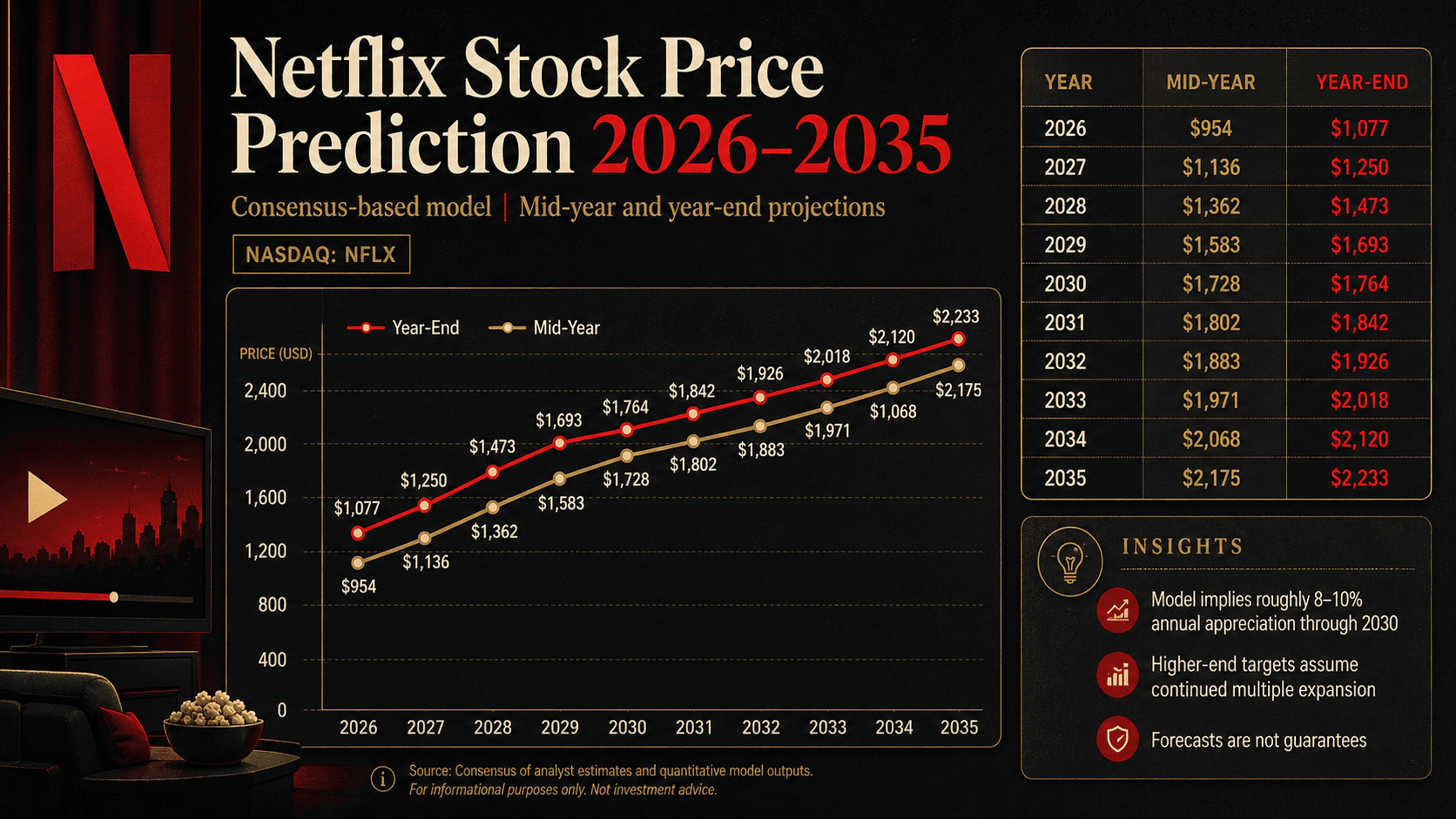
Netflix (NFLX) is heading into 2026 in a strong position. The stock has climbed well past analyst expectations from a year ago, and Wall Street analysts are increasingly bullish on what the next few years look like for the company. This Netflix stock price prediction covers the current consensus from analysts, the key factors driving the NFLX stock forecast through 2030, and an honest look at the risks investors should keep in mind.
Current NFLX Stock Overview
Netflix stock currently trades on the NASDAQ under the ticker NFLX. As of early 2026, the stock has been performing well, supported by strong earnings growth, expanding profit margins, and a subscriber base that continues to grow despite years of skepticism that the streaming market was saturated.
The analysts average price target for NFLX sits in a wide range depending on the firm. Wall Street analysts who cover Netflix have issued price targets ranging from conservative holds to aggressive buy ratings. The consensus rating as of this writing leans toward a buy, reflecting broad confidence in the company’s ability to maintain its market position and grow revenue.
Netflix Stock Price Prediction Table
The table below shows NFLX stock price projections from 2026 through 2035. These figures reflect a consensus-based model drawing on average price target data, revenue growth assumptions, and historical valuation multiples. Average annualized price appreciation implied by this model runs at roughly 8 to 10 percent per year through 2030, consistent with how Wall Street analysts have modeled high-quality growth companies in the streaming and technology services sector. The average returns embedded in these projections assume Netflix nflx stock maintains its current multiple expansion trajectory and continues to grow earnings at a pace that supports the higher end of current price targets.
Year, Price Mid-Year, Price Year-End
2026: $954, $1,077
2027: $1,136, $1,250
2028: $1,362, $1,473
2029: $1,583, $1,693
2030: $1,728, $1,764
2031: $1,802, $1,842
2032: $1,883, $1,926
2033: $1,971, $2,018
2034: $2,068, $2,120
2035: $2,175, $2,233
These projections are based on modeled revenue growth, analyst consensus estimates, and valuation models that account for Netflix’s current trajectory. They are not guarantees. Stock performance depends on factors no forecast can fully price in.
Netflix Stock Forecast For 2026
The NFLX stock forecast for 2026 centers on several converging tailwinds. Netflix’s advertising-supported tier has been growing faster than most analysts expected, adding a meaningful new revenue stream on top of the existing subscription base. The ad tier brings in users who would otherwise churn or never subscribe at full price, and over time those users represent real earnings upside.
Wall Street analysts tracking NFLX have raised their average price target multiple times over the past year. The current average price target from analyst ratings puts the year-end estimate somewhere in the USD 1,000 to USD 1,100 range, with the more bullish price targets going higher. Most analyst consensus views carry a buy or strong buy rating, though a small number maintain a hold based on valuation concerns at the current price.
Revenue growth continues to be the primary driver of the Netflix stock forecast. The company has been expanding into live content, sports rights, and games, which add stickiness and justify higher average revenue per user. These moves affect how valuation models treat Netflix’s long-term earnings power.
Factors Influencing NFLX In 2026
Competition
The competitive landscape is worth watching. Disney+, Max, Apple TV+, and Amazon Prime Video are all spending heavily on content. Netflix’s advantage has historically been scale and data, and that edge still holds, but it is not free to maintain. Content costs remain one of the more significant line items that analysts flag when issuing cautious price targets on NFLX stock.
Interest Rates And The Macro Environment
Interest rates matter for Netflix stock the same way they matter for any growth stock. When rates fall, the present value of future earnings rises, which is a tailwind for NFLX. When rates stay elevated, valuation multiples face pressure even if the underlying business is performing well. Investors watching the NFLX stock forecast should keep one eye on the macro environment alongside company-specific data.
Subscriber Growth And ARPU
The market watches two numbers above all others when Netflix reports earnings: subscriber growth and average revenue per user. Subscriber growth shows whether Netflix is still expanding its addressable base. ARPU shows whether existing users are spending more, through price increases or tier upgrades. Both have been trending in the right direction, which is a core reason analyst ratings on Netflix have skewed toward buy.
Netflix Stock Price Prediction For 2027
By 2027, the Netflix stock forecast gets harder to pin down with precision, but the directional view from Wall Street analysts remains constructive. Price targets in the USD 1,200 to USD 1,300 range appear frequently in research reports covering this period.
Revenue projections for 2027 assume continued growth from advertising, ongoing international expansion, and stable or improving content margins as the company disciplines its spending. If earnings grow as expected and the stock maintains a reasonable multiple, those price levels are achievable. The main risk to the 2027 forecast is competition intensifying to the point where subscriber growth stalls or Netflix is forced to cut prices to maintain market share in its core services.
Netflix Stock Price Prediction For 2028 And 2029
The 2028 and 2029 forecasts reflect a maturing but still-growing business. By this point, Netflix’s advertising business should be a more established revenue line, and the company’s investments in live content will have either paid off or not. Average returns for NFLX holders over this stretch depend heavily on what the stock is priced at when you buy in.
At current price levels, analysts model a solid return path through 2028 based on current earnings trajectories. The stock’s performance in this period will depend on whether Netflix can maintain the margin expansion trajectory it has established over recent years, and whether its newer revenue streams achieve the scale they need to be meaningful to earnings.
Netflix Stock Price Prediction For 2030
Longer-term investors who have held NFLX stock through previous volatile periods have historically been rewarded with strong average annualized returns. Research reports covering the 2030 outlook consistently point to Netflix nflx’s pricing power and global scale as the structural factors that make the long-term case compelling despite near-term uncertainty.
The long-term Netflix stock forecast for 2030 requires more assumptions than near-term projections. Based on current analyst consensus and valuation models, price targets in the USD 1,700 to USD 1,800 range appear in more bullish research reports. The reasoning: Netflix maintains or grows its share of global streaming services, advertising revenue matures into a meaningful contributor, and the company continues finding new ways to maintain subscriber engagement. The bear case centers on competition eroding Netflix’s position, or on the streaming market consolidating in a way that squeezes margins across all services.
What Analysts Say About Netflix Stock
Netflix nflx stock carries ratings from dozens of sell-side firms. As of early 2026, stock ratings break down with roughly 70 percent of covering analysts issuing a buy or strong buy, around 25 percent at hold, and a small minority at sell. Research reports published over the past quarter have consistently highlighted Netflix nflx’s advertising revenue ramp as the key upside driver, with several analysts raising their average price target after Q4 2025 earnings came in ahead of consensus. The average annualized price return implied by the average price target across all covering analysts currently sits in the range of 12 to 15 percent from current levels, which is why the consensus rating has remained skewed toward buy despite the stock’s strong run.
Analyst ratings on Netflix stock break down roughly like this as of early 2026: a majority hold a buy or strong buy position, a meaningful minority maintain a hold, and a small number carry a sell rating based on valuation. The analyst consensus price target has been rising steadily through 2025 and into 2026.
Research reports frequently cite Netflix’s improving margin profile, its advertising growth, and its ability to monetize its user base more effectively as the core bull case. Bear arguments tend to center on the stock valuation relative to earnings and on content cost inflation. Wall Street analysts who track NFLX consistently flag earnings as the key catalyst. Quarterly beats tend to push the stock higher; misses or downward guidance revisions pull it back.
Key Metrics To Watch
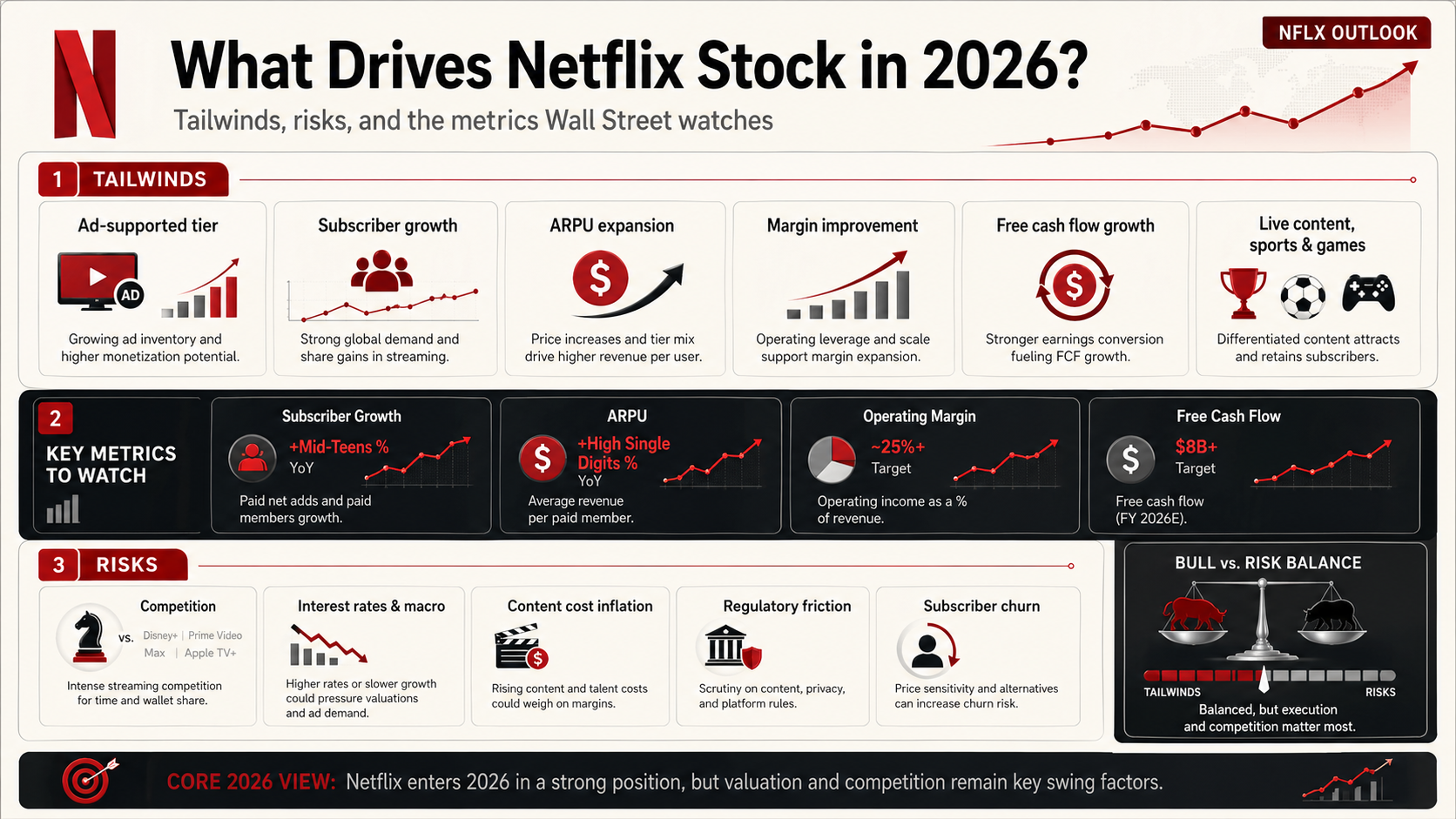
When evaluating the Netflix stock forecast, these are the metrics that move the needle for analysts and investors.
Subscriber growth remains the headline number, watched closely by analysts every quarter and covered in research reports extensively.
Revenue growth and average revenue per user show whether the business is monetizing better, not just adding users. This is where the advertising tier’s impact will show up most clearly in the data.
Operating margin has been expanding, and analysts expect this to continue. Margin performance is increasingly central to how Netflix stock is valued and how price targets are set by analysts.
Free cash flow is now positive and growing. Strong buy ratings from analysts frequently cite the free cash flow trajectory as a key reason to maintain a bullish position on NFLX.
Potential Risks To The Forecast
Competition from Disney, Warner Bros, Apple, and Amazon means more spending needed to retain subscribers across all services. If Netflix loses pricing power, the earnings estimates that underpin high price targets start to look optimistic.
Regulation creates friction across different markets. Local content requirements, data rules, and government intervention in media can all affect Netflix’s ability to operate efficiently and maintain performance internationally.
Content misses can accelerate churn faster than financial models account for. A few high-profile failures in a short period can shift both subscriber numbers and the broader analyst consensus on NFLX.
Macro conditions affect Netflix like any growth stock. Elevated interest rates compress valuations based on the present value of future earnings, and consumer spending pullbacks can affect subscription services retention.
Frequently Asked Questions
What is Netflix stock and what does it represent?
Netflix stock under the NFLX ticker represents ownership in Netflix Inc, the global streaming entertainment company. Shareholders benefit if the company grows earnings and the market assigns a higher value to those earnings over time.
How can I invest in Netflix stock?
Open a brokerage account, search for NFLX on the NASDAQ, and place a buy order. Most major brokers support fractional shares if the full current price is a barrier to entry.
What factors influence the price of Netflix stock?
Subscriber growth, average revenue per user, revenue growth, operating margin, content costs, competition, interest rates, and broader market conditions all affect the NFLX stock price.
Does Netflix pay dividends?
Netflix does not currently pay dividends. The company reinvests earnings into content and growth. Check Netflix’s investor relations page for any policy updates.
Is Netflix a high-growth investment?
Netflix is generally classified as a growth stock. Analysts expect continued revenue and earnings growth, though the current stock valuation already prices in a significant portion of that expected performance.
Where can I find updated data on Netflix stock?
Netflix’s investor relations page, financial news platforms, and brokerage research reports are the best sources for current price targets, analyst ratings, and earnings data.
What are the main risks of investing in NFLX?
Competition, content cost inflation, valuation risk at current price levels, regulatory exposure, and macro conditions are the primary risks analysts cite when issuing hold or sell ratings on Netflix stock.
At Coinlib, we publish in-depth articles every day covering every aspect of crypto trading. Stay ahead with crypto news, price predictions, historical insights, and expert analysis.