

What Is a Nonce in Crypto? Definition, Uses, and How It Works
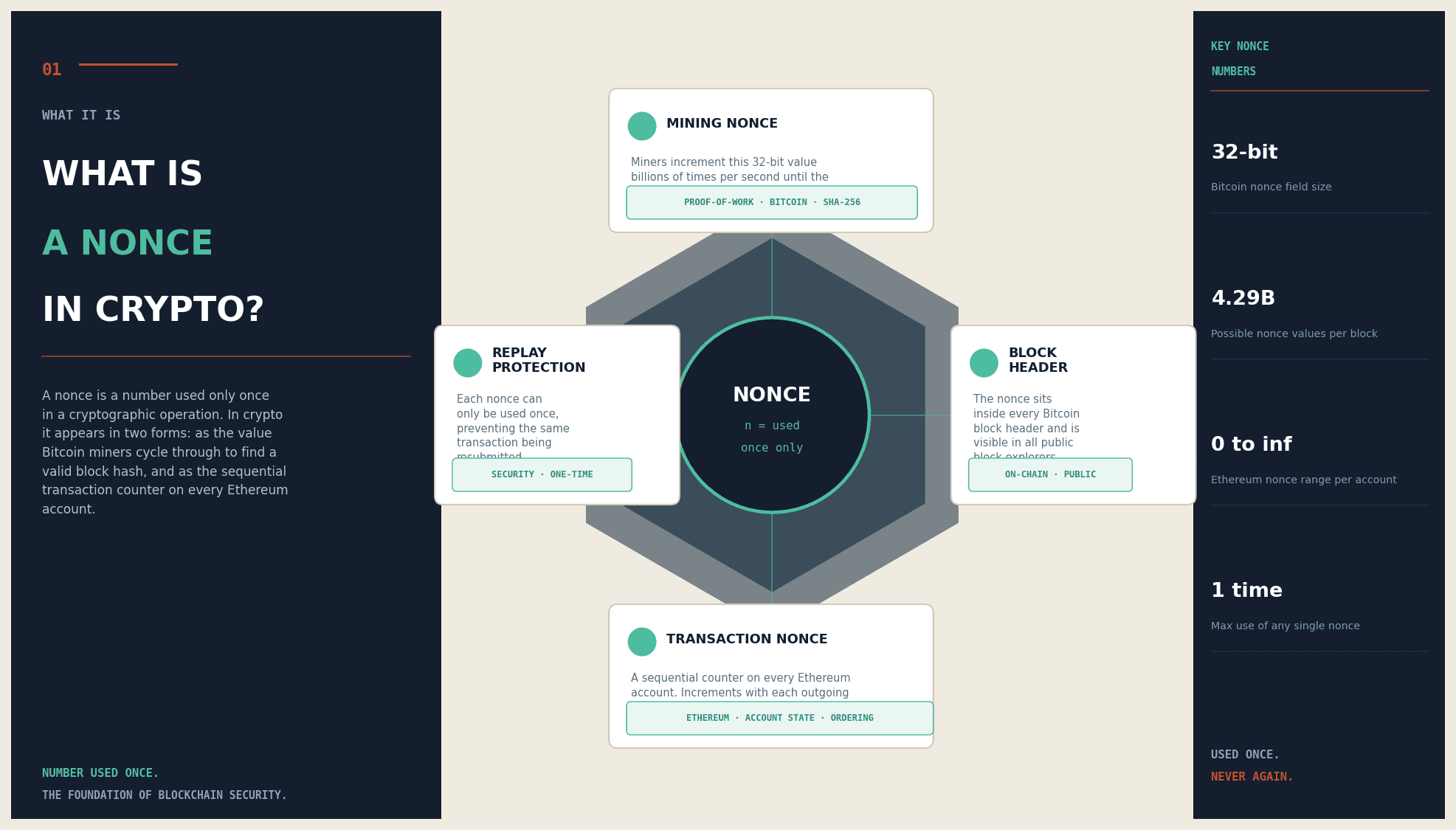
A nonce is a number used only once in a cryptographic operation. In cryptocurrency, nonces appear in two distinct contexts: in proof-of-work mining, where miners cycle through nonce values to find a valid block hash, and in transaction systems like Ethereum, where a nonce tracks the sequence of transactions sent from an address. This guide explains what a nonce is, how it works in each context, and why it matters for how blockchains function.
Key takeaways
A nonce stands for "number used only once" and is a value used in cryptographic processes
In Bitcoin mining, miners change the nonce repeatedly until the block hash meets the network's difficulty target
In Ethereum, every account has a transaction nonce that increments with each outgoing transaction
Nonces prevent replay attacks by ensuring that the same data cannot be resubmitted and accepted a second time
The nonce is part of every Bitcoin block header and is visible in on-chain data
Mining is essentially a race to find the correct nonce before anyone else does
What is a nonce in crypto?
A nonce is a number that is used only once within a specific cryptographic context. The word is a contraction of "number used once." In blockchain systems, nonces serve as a key component of both the mining process and transaction sequencing, depending on the network and context involved.
The nonce itself is not secret. It is included in block headers and transaction data as a publicly visible value. Its purpose is not to hide information but to make a particular output computationally unique and verifiable.
What is a nonce in Bitcoin mining?
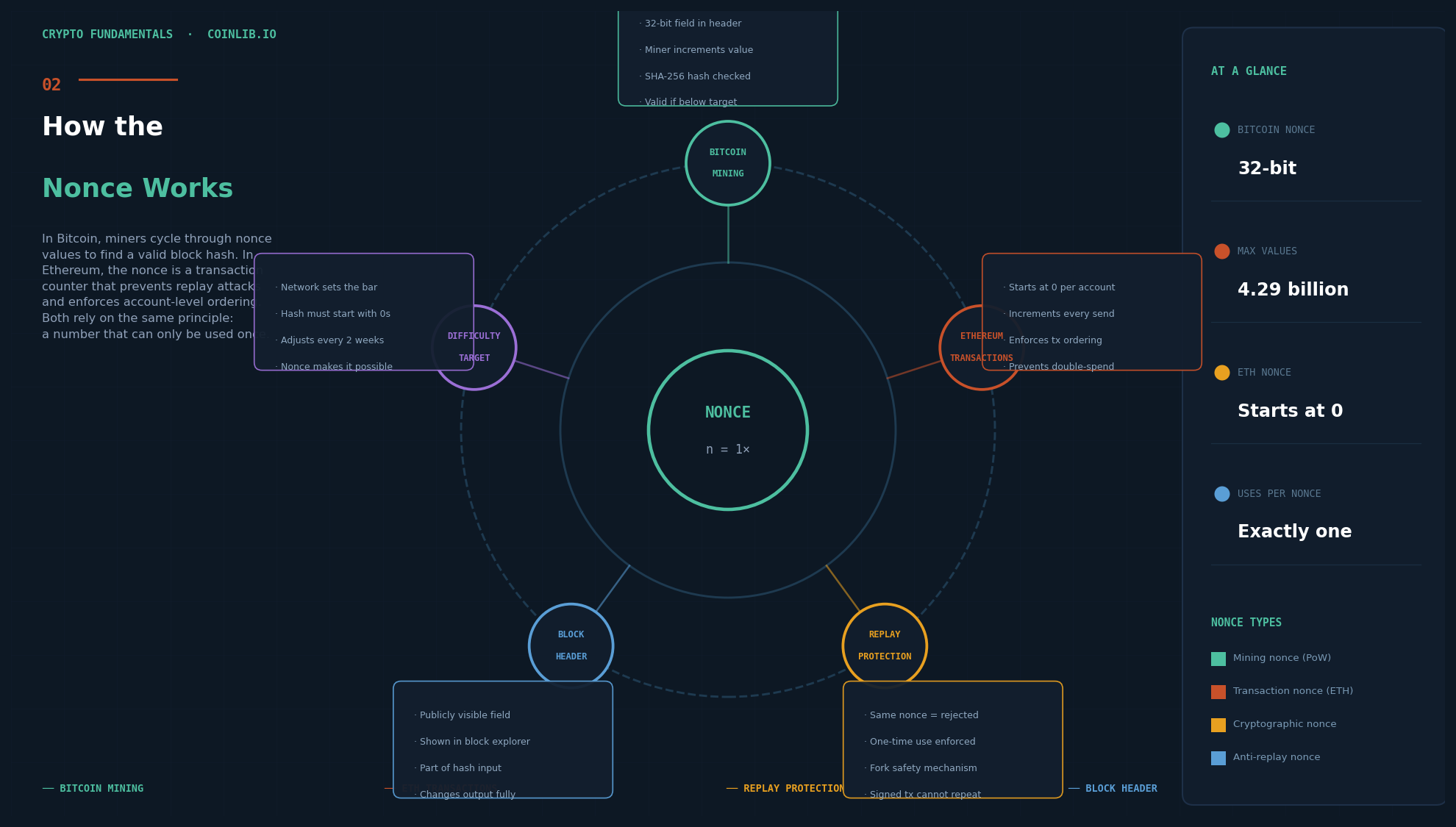
In Bitcoin, the nonce is a 32-bit number included in the block header. When a miner assembles a candidate block, they hash the block header repeatedly, incrementing the nonce value each time, until the resulting hash falls below the current difficulty target set by the network.
The difficulty target is a threshold. A valid hash must begin with a certain number of zeroes. Because the SHA-256 hash function produces outputs that are effectively random, the only way to find a valid hash is to try different inputs. Changing the nonce is the primary way miners vary the input.
If a miner cycles through all 4.29 billion possible nonce values without finding a valid hash, they adjust other fields in the block header, such as the timestamp or extra nonce in the coinbase transaction, and begin again. The first miner to find a valid hash broadcasts the block, earns the block reward, and the network moves on to the next block.
How does the mining nonce work step by step?
The Bitcoin mining process using the nonce works as follows:
the miner collects pending transactions and assembles a candidate block
the block header is constructed, including the previous block hash, a merkle root of the transactions, a timestamp, and the nonce starting at zero
the miner runs the SHA-256 hash function on the block header
if the resulting hash is below the difficulty target, the block is valid and is broadcast to the network
if not, the miner increments the nonce by one and hashes again
this process repeats billions of times per second across the entire mining network
Modern mining hardware (ASICs) is designed specifically to perform this hashing operation as fast as possible. The global Bitcoin network collectively attempts trillions of hashes per second.
What is a nonce in Ethereum?
In Ethereum, the nonce works differently. Rather than being used in mining, it is attached to every transaction sent from an account and functions as a sequential counter.
Every Ethereum address starts with a nonce of zero. The first transaction sent from that address has nonce 0, the second has nonce 1, and so on. The Ethereum network uses this counter to ensure that transactions are processed in order and that no transaction can be replicated or submitted twice.
If two transactions from the same address share the same nonce, the network will only process one of them. This design prevents replay attacks and double-spending at the account level. It also means that if a transaction with nonce 4 is stuck pending, any subsequent transaction with nonce 5 or higher will also be stuck until nonce 4 is resolved.
What is the difference between a mining nonce and a transaction nonce?
The two types of nonce share the same name and underlying principle but serve different functions.
TypeNetworkPurposeChanges HowMining nonceBitcoin (PoW chains)Find a valid block hashMiner increments it manuallyTransaction nonceEthereum (account-based)Order and deduplicate transactionsIncrements automatically with each sendCryptographic nonceGeneral cryptographyPrevent replay attacksGenerated fresh for each session
The mining nonce is something miners actively manipulate in pursuit of a valid hash. The transaction nonce is something the network manages automatically to maintain account state integrity.
What is a replay attack and how does a nonce prevent it?
A replay attack is when valid transaction data from one context is resubmitted in another context to achieve an unintended outcome. For example, if a signed transaction could be rebroadcast multiple times, an attacker could drain an account by replaying the same authorised transfer repeatedly.
Nonces prevent this because each valid transaction must reference the correct sequential nonce for the sending account. A transaction with nonce 3 can only be accepted once, after nonces 0, 1, and 2 have already been processed. Once nonce 3 is consumed, the same transaction data cannot be resubmitted and accepted again.
This protection is especially important in contexts where two chains share a common history, such as after a hard fork. Without replay protection built into the nonce logic, transactions valid on one chain could be replayed on the other.
Can you see the nonce on-chain?
Yes. The nonce is part of the public block header in Bitcoin and part of the public transaction data in Ethereum. Block explorers display the nonce for every block and every transaction.
In Bitcoin, the nonce field in a block header is visible as a standard component. In Ethereum, tools like Etherscan show the transaction nonce for every outgoing transaction from an address, and you can view the current nonce for any account directly.
Why does the nonce matter for understanding blockchain?
The nonce is one of the clearest illustrations of how blockchains use computational work and mathematical constraints to create trustless systems. In proof-of-work mining, it is the mechanism by which security is created through energy expenditure: finding the right nonce is hard, but verifying that the right nonce was found is instant.
In account-based systems like Ethereum, the transaction nonce illustrates how state is managed without a central authority. The network maintains a consistent record of how many transactions each address has sent, and uses that record to enforce ordering and prevent duplication without any single party being in control.
Understanding the nonce is also practically useful. Ethereum users who have ever had a stuck transaction have run into nonce mechanics directly. Replacing a stuck transaction requires submitting a new one with the same nonce but a higher gas price, effectively overwriting the pending transaction in the mempool.
FAQ
What does nonce stand for in crypto? Nonce stands for "number used once." It is a value used in a cryptographic operation that is unique to a specific context and not reused.
What is a nonce in Bitcoin? In Bitcoin, the nonce is a 32-bit number in the block header that miners increment repeatedly to find a hash output that meets the network's difficulty target.
What is a nonce in Ethereum? In Ethereum, the nonce is a counter attached to each account that increments with every outgoing transaction. It ensures transactions are processed in order and cannot be replayed.
How big is a Bitcoin nonce? A Bitcoin nonce is 32 bits, allowing for approximately 4.29 billion possible values. When all values are exhausted, miners adjust other fields in the block header and restart.
Can a nonce be reused? No. By definition, a nonce is used only once in its specific context. Reusing a nonce breaks the cryptographic guarantees it provides, which is why the design of both mining and transaction systems ensures nonces are not repeated.
What happens if an Ethereum transaction nonce is wrong? If a transaction is submitted with the wrong nonce, it will either be rejected immediately or remain stuck in the mempool. Transactions with a nonce higher than expected will wait until the preceding nonces are filled. Transactions with a nonce lower than the current account nonce will be rejected as already used.
Is the nonce secret? No. The nonce is public information included in block headers and transaction data. Its purpose is to make outputs computationally unique, not to conceal information.
Editorial disclaimer This article is published for educational purposes only and does not constitute investment, financial, legal, or technical advice. Readers should verify important information independently.
Sources and methodology This article is based on Bitcoin and Ethereum protocol documentation and cryptographic principles underlying proof-of-work mining and account-based transaction systems.
Key reference sources: