

The CLARITY Act and Crypto: What the Digital Asset Market Clarity Act Does
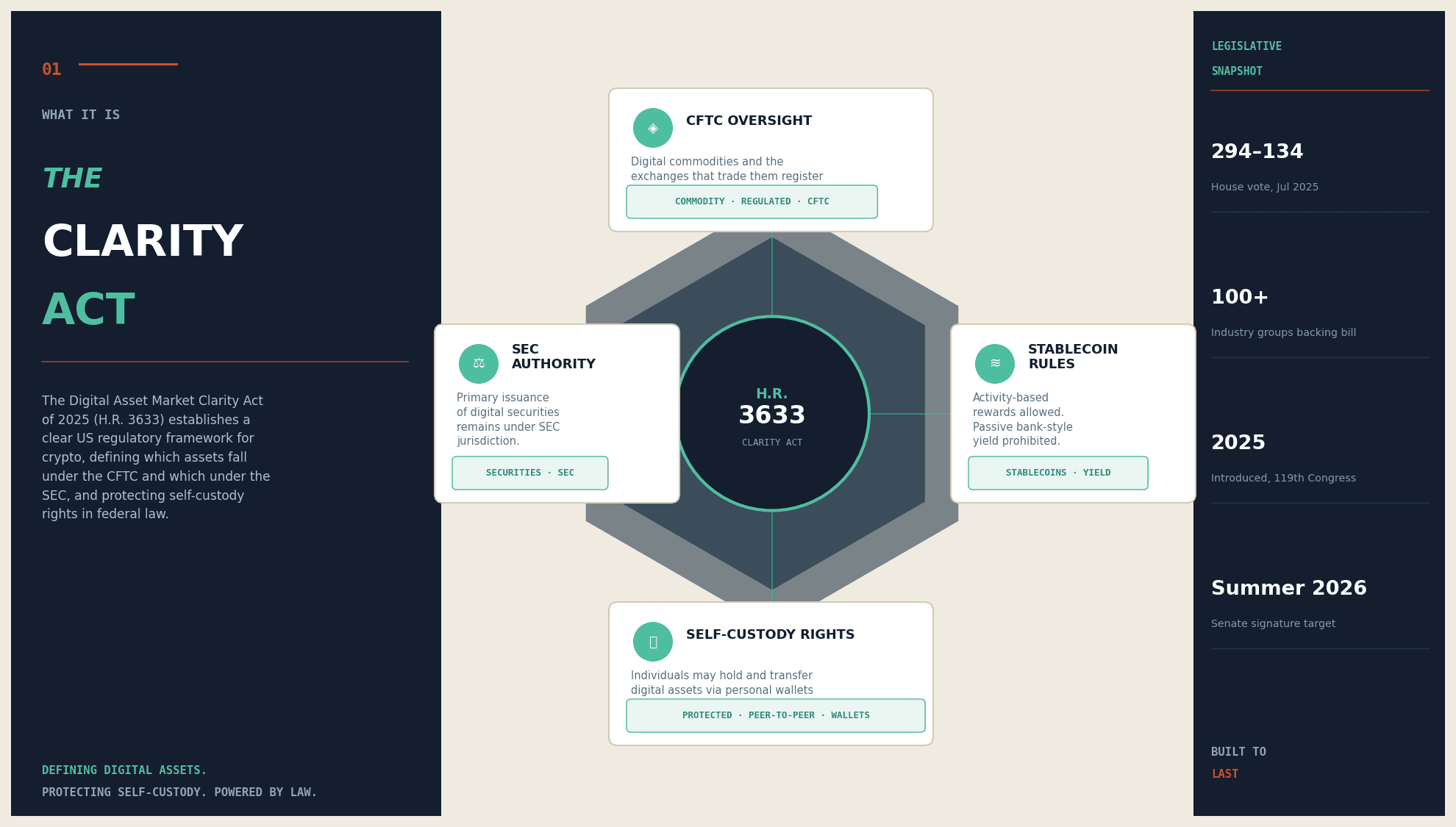
The CLARITY Act, formally the Digital Asset Market Clarity Act of 2025 (H.R. 3633), is a piece of US federal legislation designed to establish a clearer regulatory framework for cryptocurrency and digital assets. It defines which assets fall under the jurisdiction of the SEC and which fall under the CFTC, creates registration requirements for crypto exchanges and brokers, and writes self-custody protections into federal law for the first time. This guide explains what the CLARITY Act is, what it does for crypto, how it works, and where things stand today.
Key takeaways
The CLARITY Act is the Digital Asset Market Clarity Act of 2025, passed by the House in July 2025
It divides regulatory authority between the SEC and the CFTC based on asset classification
Digital commodities are placed under CFTC oversight; securities remain with the SEC
Self-custody rights are written into federal law for the first time under the bill
A stablecoin yield compromise was reached in May 2026, clearing a major Senate obstacle
Senate Banking Committee markup is expected in May 2026, with a presidential signature targeted for summer 2026
What is the CLARITY Act?
The CLARITY Act is a US federal bill that establishes a legal framework for digital asset markets. It was introduced in the 119th Congress and passed the House of Representatives by a vote of 294 to 134 on 17 July 2025. The bill addresses one of the most persistent problems in US crypto regulation: the lack of clear boundaries between SEC and CFTC authority over digital assets.
Before the CLARITY Act, whether a crypto asset was treated as a security (regulated by the SEC) or a commodity (regulated by the CFTC) was often resolved through enforcement actions and litigation rather than clear legislation. The bill replaces that uncertainty with statutory definitions.
What does the CLARITY Act do for crypto?
The CLARITY Act is designed to:
define digital commodities as a distinct asset class separate from securities
give the CFTC primary authority over digital commodity markets and intermediaries
preserve SEC authority over primary market transactions involving crypto securities
require digital commodity exchanges, brokers, and dealers to register with the CFTC
protect the right to self-custody digital assets without registering as a financial institution
set rules around stablecoin yield and reward structures for crypto firms
How does the CLARITY Act work?
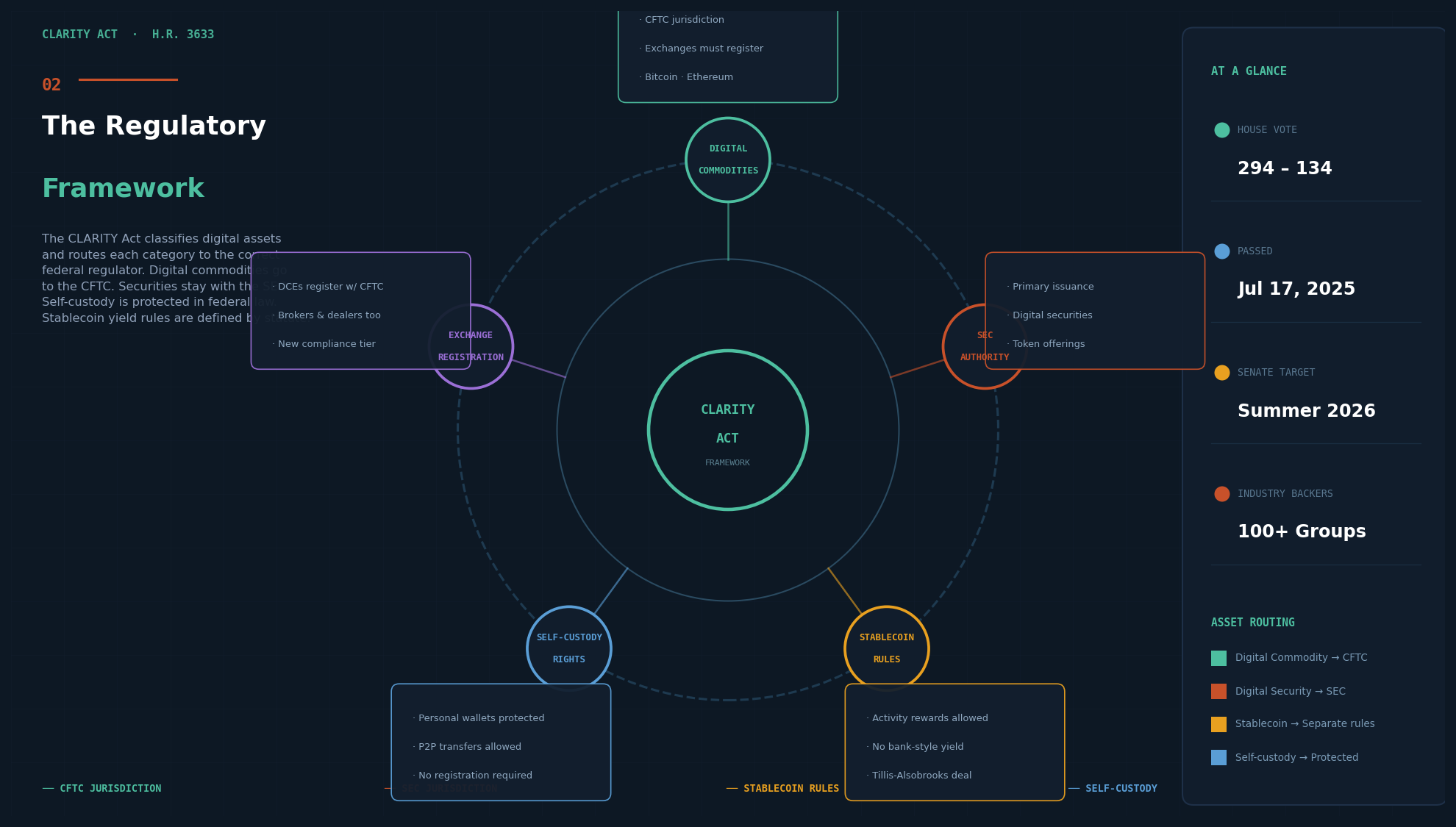
The CLARITY Act works by creating statutory definitions that determine how different digital assets are regulated. At a high level, the framework is:
a digital asset whose value is intrinsically linked to the use of a blockchain is classified as a digital commodity
digital commodities fall under CFTC jurisdiction rather than SEC jurisdiction
platforms trading digital commodities must register with the CFTC as digital commodity exchanges
brokers and dealers handling digital commodities must register separately
self-custody of digital assets in hardware or software wallets is explicitly protected
peer-to-peer transfers do not require registration as a financial institution
Securities issued on blockchain infrastructure retain their existing classification under SEC rules. The bill does not remove SEC authority from the primary issuance of digital assets that qualify as securities. It draws a clearer line between that issuance stage and secondary market trading of assets that have become sufficiently decentralised to qualify as commodities.
What is a digital commodity under the CLARITY Act?
The bill defines a digital commodity as a digital asset whose value is intrinsically linked to the use of the blockchain on which it operates. The definition excludes securities, derivatives, and stablecoins. Bitcoin and Ethereum are widely cited as the clearest examples of assets that would fall into this category under the bill's framework.
Assets that were originally issued as securities but have become sufficiently decentralised over time can transition to commodity classification under the bill's provisions. The criteria for that transition are defined in the legislation rather than left to regulatory discretion.
What does the CLARITY Act mean for self-custody?
The CLARITY Act writes self-custody protections into US federal law for the first time. Under the bill, individuals can hold digital assets in their own hardware or software wallets and make peer-to-peer transfers without being required to register as a financial institution or comply with intermediary-level regulatory obligations.
This provision directly addresses concerns that future regulation could treat non-custodial wallets or peer-to-peer activity as regulated financial services. The bill draws a legal distinction between holding and transferring assets through registered intermediaries and doing so directly without a third party.
What is the stablecoin yield provision?
One of the final obstacles in the Senate was disagreement over whether crypto firms could pay yield or interest on stablecoin balances. Senators Thom Tillis and Angela Alsobrooks released a compromise text in May 2026 that resolved the standoff.
The compromise prohibits crypto firms from paying yield on stablecoins in a way that is economically or functionally equivalent to a bank deposit interest payment. It does allow activity-based rewards tied to real participation on crypto platforms. Coinbase and Circle both backed the compromise. The distinction being drawn is between passive yield designed to replicate a bank savings product and reward structures tied to actual use of the platform.
What happens to the SEC under the CLARITY Act?
The SEC retains authority over the primary issuance of digital assets that qualify as securities. The bill does not eliminate SEC jurisdiction from crypto. It limits it to the stage where assets are being issued and are not yet sufficiently decentralised to qualify as digital commodities.
For assets that qualify as digital commodities from issuance or that transition to that classification over time, the CFTC becomes the primary federal regulator. The bill establishes joint rulemaking processes in areas where both agencies' jurisdictions overlap.
Does the CLARITY Act prohibit a digital dollar?
Yes. The CLARITY Act includes provisions designed to prevent the Federal Reserve from offering a central bank digital currency directly to individuals. The bill bars Federal Reserve banks from offering certain products or services directly to individual accounts and prohibits the use of a CBDC for monetary policy purposes. This component of the bill reflects broader congressional concerns about government surveillance of private financial activity.
Where does the CLARITY Act stand in 2026?
The bill passed the House in July 2025 and has been working through the Senate since. The stablecoin yield compromise reached in May 2026 cleared a significant obstacle. Senate Banking Committee Chairman Tim Scott indicated a committee markup was targeted for May 2026 and a presidential signature for summer 2026. More than 100 industry groups publicly backed the bill ahead of the markup.
The Senate version may differ in some respects from the House-passed text. Reconciliation between the two chambers would be required before the bill reaches the president's desk.
FAQ
What is the CLARITY Act in crypto? The CLARITY Act is the Digital Asset Market Clarity Act of 2025, a US federal bill that establishes a regulatory framework for digital assets by dividing oversight between the SEC and CFTC based on asset classification.
Has the CLARITY Act been passed into law? As of May 2026, the CLARITY Act has passed the House but not the Senate. A Senate committee markup is expected in May 2026, with a presidential signature targeted for summer 2026.
What is a digital commodity under the CLARITY Act? A digital commodity is a digital asset whose value is intrinsically linked to its blockchain. It excludes securities, derivatives, and stablecoins. Bitcoin and Ethereum are expected to fall into this category.
Does the CLARITY Act protect self-custody? Yes. The bill writes self-custody rights into federal law, allowing individuals to hold and transfer digital assets through personal wallets without registering as financial institutions.
Who regulates crypto under the CLARITY Act? The CFTC becomes the primary regulator for digital commodities and the exchanges and brokers that trade them. The SEC retains authority over primary market transactions involving digital assets that qualify as securities.
What does the CLARITY Act say about stablecoin yield? A May 2026 compromise bans crypto firms from paying yield on stablecoins in a way equivalent to bank deposit interest, while allowing activity-based rewards tied to real platform participation.
Does the CLARITY Act ban a digital dollar? Yes. The bill includes provisions prohibiting the Federal Reserve from offering a CBDC directly to individuals and from using a digital dollar for monetary policy purposes.
Who supports the CLARITY Act? Coinbase, Circle, and more than 100 industry groups have publicly backed the bill. Senate Banking Committee Chairman Tim Scott is a key proponent.
Editorial disclaimer This article is published for educational and informational purposes only and does not constitute investment, financial, legal, or tax advice. Regulatory legislation is subject to amendment and the information here reflects the bill's status and provisions as of May 2026. Readers should verify information independently and consult a qualified professional where appropriate.
Sources and methodology This article is based on official legislative text, congressional materials, and recent news coverage of the CLARITY Act's Senate progress. The goal is explanatory, not predictive.
Key reference sources: