

Sponsored
The Black Market That Accidentally Proved You Could Pay With Crypto
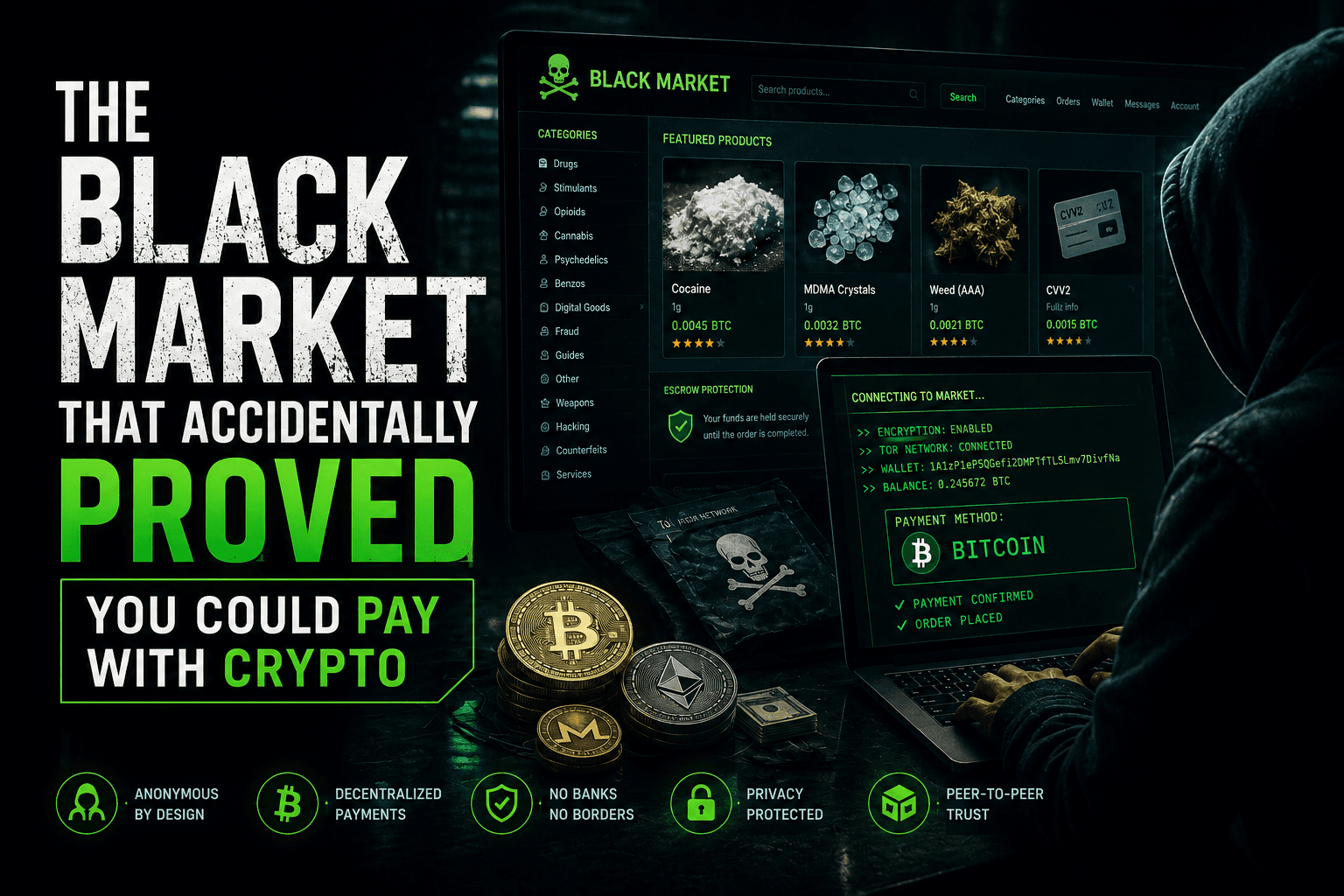
Before you could pay with crypto at a coffee shop, before Visa partnered with crypto startups, before institutional investors started treating BTC as digital gold, the only people actually using Bitcoin as a functioning currency were buying drugs on a hidden website.
That website was Silk Road. And whether its founder intended it or not, it became the most important proof of concept in cryptocurrency history.
A Physics Graduate With a Libertarian Dream
In February 2011, a 26-year-old Texan named Ross Ulbricht launched a website that almost nobody could find. It operated as a hidden service on the Tor network, accessible only to users who knew where to look, and it accepted exactly one form of payment: Bitcoin.
Ulbricht, who went by the pseudonym "Dread Pirate Roberts," wasn't primarily a drug dealer. Inspired by libertarian principles, he envisioned a digital marketplace operating entirely outside traditional economic regulations, a free market where consenting adults could buy and sell anything, trusting market forces to self-regulate without government intervention.
What he built, in practice, was a functioning e-commerce platform for illegal goods. But buried inside that criminal enterprise was something far more significant: the first large-scale, real-world test of Bitcoin as a payment system.
The Problem It Had to Solve
To understand why the Silk Road mattered technically, you need to understand the problem it was trying to solve.
Before Bitcoin, anonymous online payments were essentially impossible. Bitcoin addresses don't require a bank account, ID, social security number, or name, and are free to open and maintain. Bitcoin's decentralized ledger (the blockchain) provided a way to verify that payments had been received or sent. For the first time, two people who had never met, in different countries, with no shared institution between them, could exchange value with reasonable certainty that the transaction would clear.
That sounds mundane in 2026. In 2011, it was genuinely revolutionary.
But Ulbricht faced a deeper challenge than just payments. How do you build trust in a marketplace where neither party can reveal their identity, there's no legal recourse for fraud, and the goods are being mailed in envelopes? The answer, it turned out, was infrastructure that legitimate e-commerce platforms wouldn't build for another decade.
The Infrastructure That Proved Bitcoin Worked
To protect users from fraud, Ulbricht positioned Silk Road as mediator for all transactions on the platform, that meant escrow. In an automated system, any time a purchase was made, the buyer's Bitcoin payment was temporarily held in a wallet controlled by Silk Road. Silk Road then notified the seller that payment was received, and the seller could proceed with shipment. Once the package arrived, the buyer would confirm on the site, after which the Bitcoin was released to the seller.
This is essentially how every reputable online marketplace works today. The mechanics that Airbnb, eBay, and Amazon use to manage payments and disputes were being stress-tested on a dark web drug market in 2011, because they had to be. There was no other way to make it work.
Silk Road also built a hedging mechanism that allowed sellers to opt for the value of bitcoins held in escrow to be fixed to their US dollar value at the time of the sale, to mitigate against Bitcoin's volatility. Again: a solution to a real problem that legitimate crypto payment products would spend years trying to crack.
The platform's integration of Tor, Bitcoin, and sophisticated escrow systems created a template that influenced the development of privacy-focused cryptocurrencies and privacy tools for years to come.
The Scale Was Undeniable
Between its launch in early 2011 and its shutdown in October 2013, Silk Road facilitated roughly 1.2 million transactions, totalling approximately 9.5 million bitcoins. That is not a small experiment. That is a payment network operating at scale, processing real transactions, handling disputes, and critically not falling over.
The Silk Road attracted close to 150,000 buyers and 4,000 vendors, and facilitated total sales of $183 million.
To put that in context: in 2011, Bitcoin was trading at around $0.52 per coin. By the time the site was shut down in late 2013, it had become, however notoriously, the single largest proof that Bitcoin could function as a medium of exchange at scale. The technology worked. Wallets worked. The blockchain cleared transactions. Escrow was possible. Disputes could be resolved. A reputation economy could emerge without anyone's real name attached to it.
The Legitimate World Was Paying Attention
In the months following the Gawker article that brought Silk Road to public attention in June 2011, the price of a single Bitcoin skyrocketed from around one dollar to over thirty dollars, a rise attributable in no small part to the increased attention Bitcoin received because of Silk Road.
That price spike brought in a new wave of observers: developers, investors, and early venture capitalists who weren't interested in buying drugs but were very interested in the underlying technology. The question they were asking wasn't "how do we shut this down?" It was "why does this work, and what else can it do?"
The investigation of the Silk Road also forced law enforcement agencies to develop entirely new capabilities for investigating cryptocurrency-related crimes. The techniques developed during this investigation became the foundation for modern blockchain forensics.
The Irony Nobody Talks About
Here's the uncomfortable truth at the heart of this story: the properties that made Bitcoin useful on Silk Road are exactly the same properties that make it useful for legitimate payments today.
Permissionless. Borderless. Irreversible. No middleman required. These aren't bugs that needed to be patched out of Bitcoin after the Silk Road era. They're the features that every crypto payment product, from hardware wallets to Visa-backed crypto cards that let you pay with crypto anywhere, is built on top of.
For better or worse, Silk Road solidified Bitcoin as a network that could support "free" and anonymous activity, no matter how legal.
Technology doesn't care about its first use case. The internet carried a lot of content nobody is proud of before it carried your Netflix stream, your bank transfers, and your video calls. The printing press enabled both the scientific revolution and centuries of propaganda. Bitcoin's dark chapter isn't separate from its legitimacy story, it's part of it.
What Happened After
On January 21, 2025, U.S. president Donald Trump granted Ulbricht a full and unconditional pardon, following a promise at the 2024 Libertarian National Convention. Ulbricht was released from a federal prison in Arizona that evening.
The bitcoins that flowed through Silk Road, meanwhile, became one of the stranger subplots in crypto history. The Department of Justice received approval to sell 69,370 Bitcoin, worth approximately $6.5 billion, confiscated from the Silk Road. The US government, which spent years trying to prove Bitcoin was a tool of criminals, ended up as one of the largest Bitcoin holders in the world because of it.
Satoshi Nakamoto created Bitcoin to free the public from reliance on financial institutions. The biggest institutional holder of the resulting coins turned out to be the United States government. All thanks to the Silk Road.
The story of how you can now pay with crypto at a merchant across the world, seamlessly, on infrastructure that has proven itself over 15 years, starts in a hidden corner of the internet in 2011, where someone was trying to sell mushrooms he grew himself in a cabin in Texas.