

ETH Price Commentary - $2,126. That is where Ethereum is trading today.
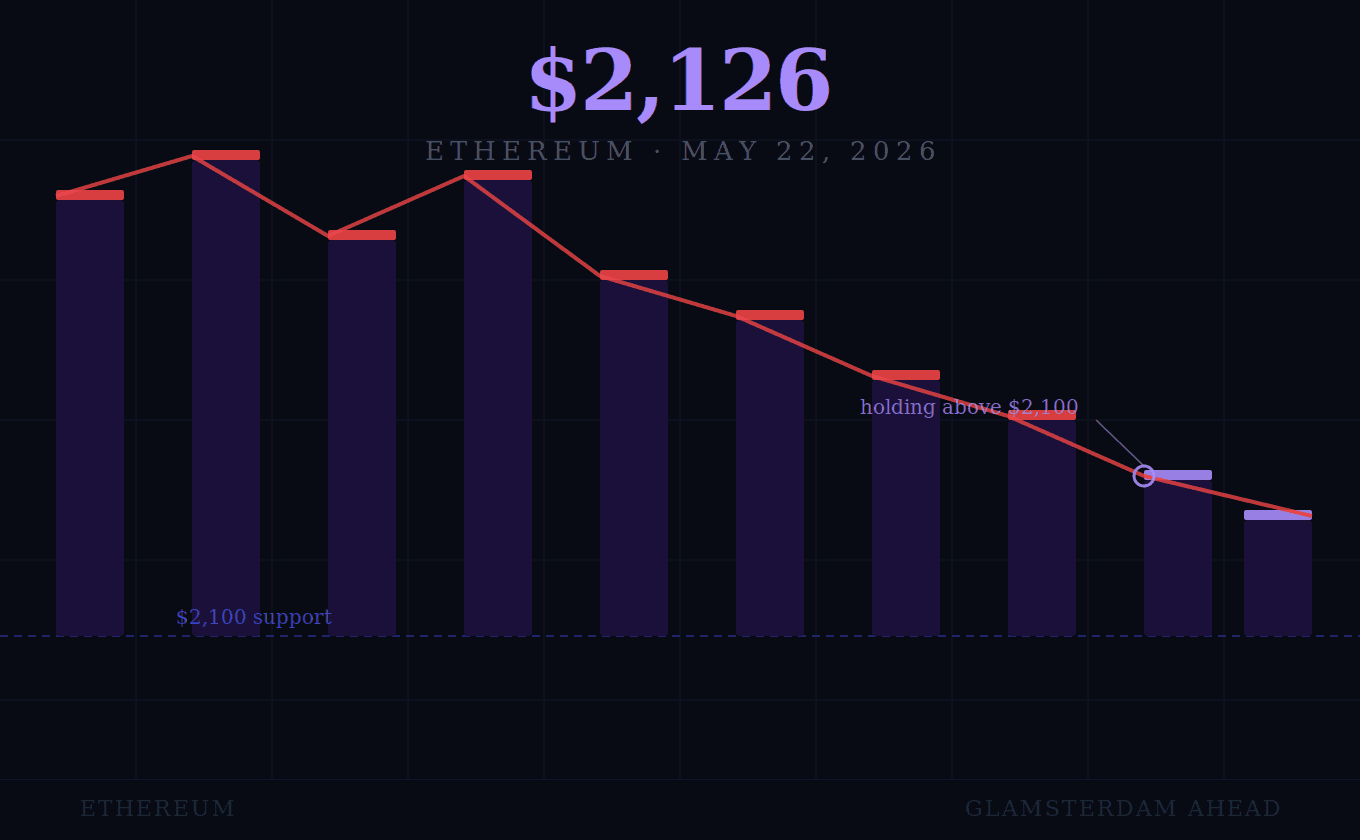
It is not a number that inspires confidence. ETH peaked near $5,000 last August. It has spent most of 2026 losing ground, sitting roughly 55% below that high with a market cap of around $233 billion and a mood that has shifted from frustration to something closer to doubt.
The chart is not offering much comfort. The 200-day moving average has been falling since late April. The 50-day is above the price and declining. Ethereum is technically bearish on every meaningful timeframe except the daily, where a faint case for stability is being made around the $2,100 shelf.
Faint is the right word.
What Ethereum Actually Is
Bitcoin has a simple story. Digital gold. Fixed supply. Institutional reserve asset. Agree with it or not, it fits on a napkin.
Ethereum does not fit on a napkin. It is a programmable blockchain, the infrastructure layer underneath most of the decentralised finance activity, NFT markets, stablecoin flows, and real-world asset tokenisation that has accumulated over the past decade. Its value is not tied to scarcity alone. It is tied to usage, to developer activity, to fee revenue, to how much of the world's financial infrastructure eventually runs on top of it.
That is a more compelling long-term thesis than Bitcoin's in some respects. It is also a harder one to trade in the short term, because the variables are more numerous and the competition is real. Solana exists. Layer 2 networks built on top of Ethereum are eating into the fee revenue that makes ETH itself valuable. The ecosystem is thriving. The asset does not always follow.
The Price Level That Matters Right Now
$2,100 is the line to watch. ETH has not closed a weekly candle below it since recovering from April's lows. It is sitting just above that level now, which means the next few days of price action carry more weight than usual.
If $2,100 holds on the weekly close, there is a case for a bounce toward $2,211 and $2,280. Those are not exciting targets, but in a market running on fumes, a stabilisation at this level would at least stop the bleeding.
If $2,100 breaks cleanly on a daily close, the next conversation is about $1,900. There is no particularly clean support between those two numbers, which makes a failure here messier than the 5% distance suggests.
One structural problem Ethereum has that Bitcoin does not: there is no Saylor. No corporate treasury buyer providing a consistent bid floor. ETF outflows in ETH have tracked BTC outflows, but without the offset of strategy-style institutional accumulation stepping in when spot demand softens. The support structure is thinner.
The Catalyst That Is Actually Worth Paying Attention To
Glamsterdam is the upgrade that changes the conversation, if it ships.
It is Ethereum's biggest protocol change since the Merge. The scope covers three things the network has been criticised for persistently: gas fees too high, throughput too slow, block building too centralised. The upgrade targets a 78% reduction in gas costs, a tenfold increase in throughput to roughly 10,000 transactions per second, and moves block building on-chain through Enshrined Proposer-Builder Separation.
The developer timeline points toward June 2026, though teams are careful to call that aspirational. Devnet testing is underway. The scope is larger than the Pectra and Fusaka upgrades that both shipped on time in 2025, so execution risk is real. Ethereum has a history of slipping major deadlines.
But if it ships, the fundamental case for the network changes materially. Cheaper transactions mean more usage. More usage means more fee burn. More burn tightens supply. The mechanism is real, even if the timing is uncertain.
Historically, ETH has advanced 20% to 40% in the weeks ahead of major network milestones. The market has not fully priced Glamsterdam in yet, partly because the date remains soft and partly because macro sentiment has kept buyers cautious across the board.
The Honest Assessment
Ethereum is cheaper than it has been in years on most valuation metrics relative to network activity. Developer engagement is high. Around 30% of circulating supply is locked in staking, structurally removing sell pressure. BlackRock's ETHA holds over $6 billion in ETH, and the firm has now launched a staked ETH product paying yield to shareholders. The institutional architecture is being built, quietly and steadily, beneath a price chart that looks ugly.
The near-term risks are real and worth naming plainly. The macro environment is not cooperating. ETF flows are negative. The $2,100 support level is being tested rather than defended. And Glamsterdam, for all its promise, is not guaranteed to ship on schedule or produce the price response the market expects.
At $2,126, Ethereum is in an uncomfortable spot: fundamentally more interesting than the chart suggests, technically weaker than bulls would like, and waiting on a catalyst that has a delivery date but no guarantee attached to it.
Watch $2,100. That number tells you what comes next.