

Bitcoin vs Ethereum: Pros & Cons, Differences, Best Choice 2026
Summary
Bitcoin and Ethereum are the two most important crypto networks, but they are built for different purposes. Bitcoin is primarily a decentralized monetary network focused on scarcity, security, and long-term value storage, while Ethereum is a programmable blockchain built for smart contracts and decentralized applications. This guide explains the main differences, pros and cons, use cases, and how to think about long-term potential in a clear and practical way.
Key takeaways
Bitcoin and Ethereum are not the same type of network
Bitcoin is mainly focused on money, scarcity, and security
Ethereum is mainly focused on programmability and applications
Bitcoin is usually easier for beginners to understand
Ethereum generally has broader onchain use cases
Bitcoin may appeal more to store-of-value and macro investors
Ethereum may appeal more to users focused on smart contracts and blockchain infrastructure
The better choice depends on what type of exposure or utility the reader is looking for
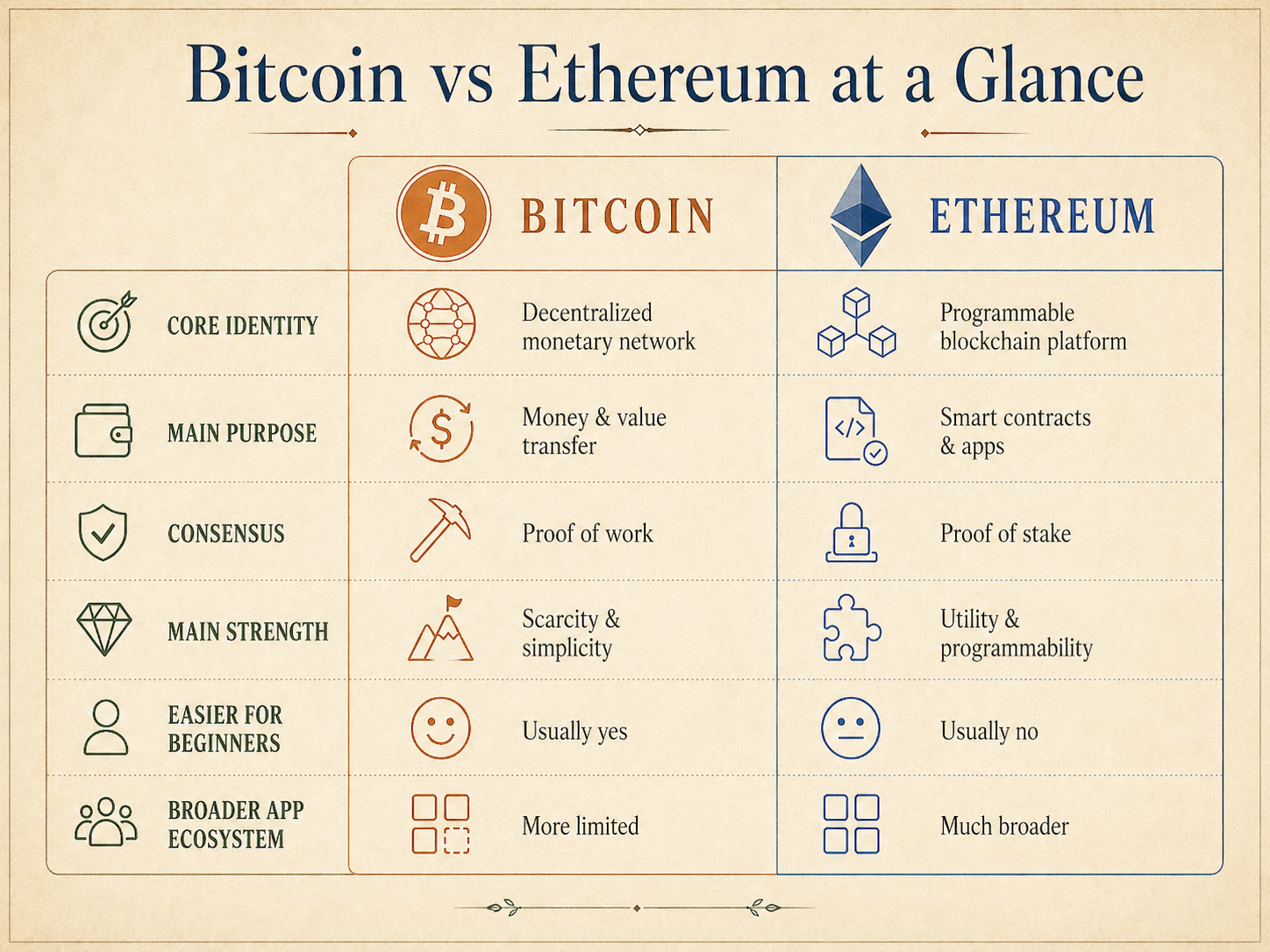
Bitcoin vs Ethereum at a glance
Core identity
Bitcoin: Decentralized monetary network
Ethereum: Programmable blockchain platform
Main purpose
Bitcoin: Money and value transfer
Ethereum: Smart contracts and applications
Consensus today
Bitcoin: Proof of work
Ethereum: Proof of stake
Main strength
Bitcoin: Scarcity and simplicity
Ethereum: Utility and programmability
Easier for beginners
Bitcoin: Usually yes
Ethereum: Usually no
Broader app ecosystem
Bitcoin: More limited
Ethereum: Much broader
What is the main difference between Bitcoin and Ethereum?
The main difference between Bitcoin and Ethereum is purpose. Bitcoin was introduced as a peer-to-peer electronic cash system and is best understood today as a decentralized monetary network with a strong scarcity narrative. Ethereum was created as a blockchain platform for running smart contracts and decentralized applications, with ETH functioning as the native asset that powers the network.
In simple terms, Bitcoin is more focused on money and value storage, while Ethereum is more focused on computation and blockchain-based applications. That is the foundation for almost every other difference between them.
Is Bitcoin or Ethereum easier for beginners?
Bitcoin is usually easier for beginners. Its core story is simpler: a decentralized network, a transparent supply model, proof-of-work security, and peer-to-peer value transfer. Ethereum can also be learned by beginners, but it introduces more concepts at once, including smart contracts, gas fees, validators, and decentralized applications.
This does not mean Ethereum is less important. It means Bitcoin is often the clearer first step for someone trying to understand crypto fundamentals. Ethereum becomes easier to appreciate once a reader already understands what blockchains can do beyond simple asset transfer.
What is Bitcoin best used for?
Bitcoin is best understood as a decentralized monetary asset and network. Its strongest use cases are usually tied to digital scarcity, long-term holding, macro narratives, and value transfer without a central issuer.
That is why Bitcoin is often treated as:
a digital store-of-value asset
a benchmark crypto asset
a monetary alternative outside traditional banking systems
a simpler entry point into crypto
The strength of the Bitcoin price comes from its clarity. It does not try to be everything.
What is Ethereum best used for?
Ethereum is best used as a programmable blockchain platform. It allows developers to build smart contracts and decentralized applications directly on the network.
That makes Ethereum especially relevant for:
smart contracts
decentralized finance
token issuance
onchain applications
blockchain-based infrastructure
In practical terms, Ethereum is not just a digital asset network. It is a platform on which other blockchain-based systems can be built and operated.
How are Bitcoin and Ethereum different technically?
Bitcoin and Ethereum differ technically in several major ways, but the most important difference is that they were designed for different types of activity.
Bitcoin’s design is narrower and more conservative. It focuses on secure value transfer, fixed monetary rules, and long-term durability. Ethereum’s design is broader and more flexible. It supports smart contracts, more extensive application logic, and a larger range of onchain behavior.
The result is that Bitcoin is often seen as simpler and more specialized, while Ethereum is seen as more adaptable but also more complex.
How are Bitcoin and Ethereum secured?
Bitcoin and Ethereum are secured through different consensus systems. Bitcoin uses proof of work, where miners perform computational work to validate transactions and add new blocks.
Ethereum uses proof of stake. Validators stake ETH as collateral and participate in block production and validation under a rewards-and-penalties model.
This difference matters because it shapes how each network’s security model is discussed. Bitcoin’s security is tied closely to mining and proof-of-work economics. Ethereum’s security is tied more closely to validator incentives, staking participation, and broader network activity.
Is Bitcoin safer than Ethereum?
Bitcoin is not automatically safer than Ethereum in every sense. The more useful question is: safer in what category?
Bitcoin is often viewed as safer from a narrative and simplicity standpoint because its purpose is narrower and its core value proposition is easier to understand. Ethereum may involve more complexity because it supports smart contracts and a wider application layer, which can introduce more moving parts for users and developers.
So if someone means “Which is easier to understand and evaluate as a core asset?” Bitcoin often has the advantage. If someone means “Which offers more functional use cases?” Ethereum often has the advantage. Safety depends heavily on what kind of risk is being discussed.
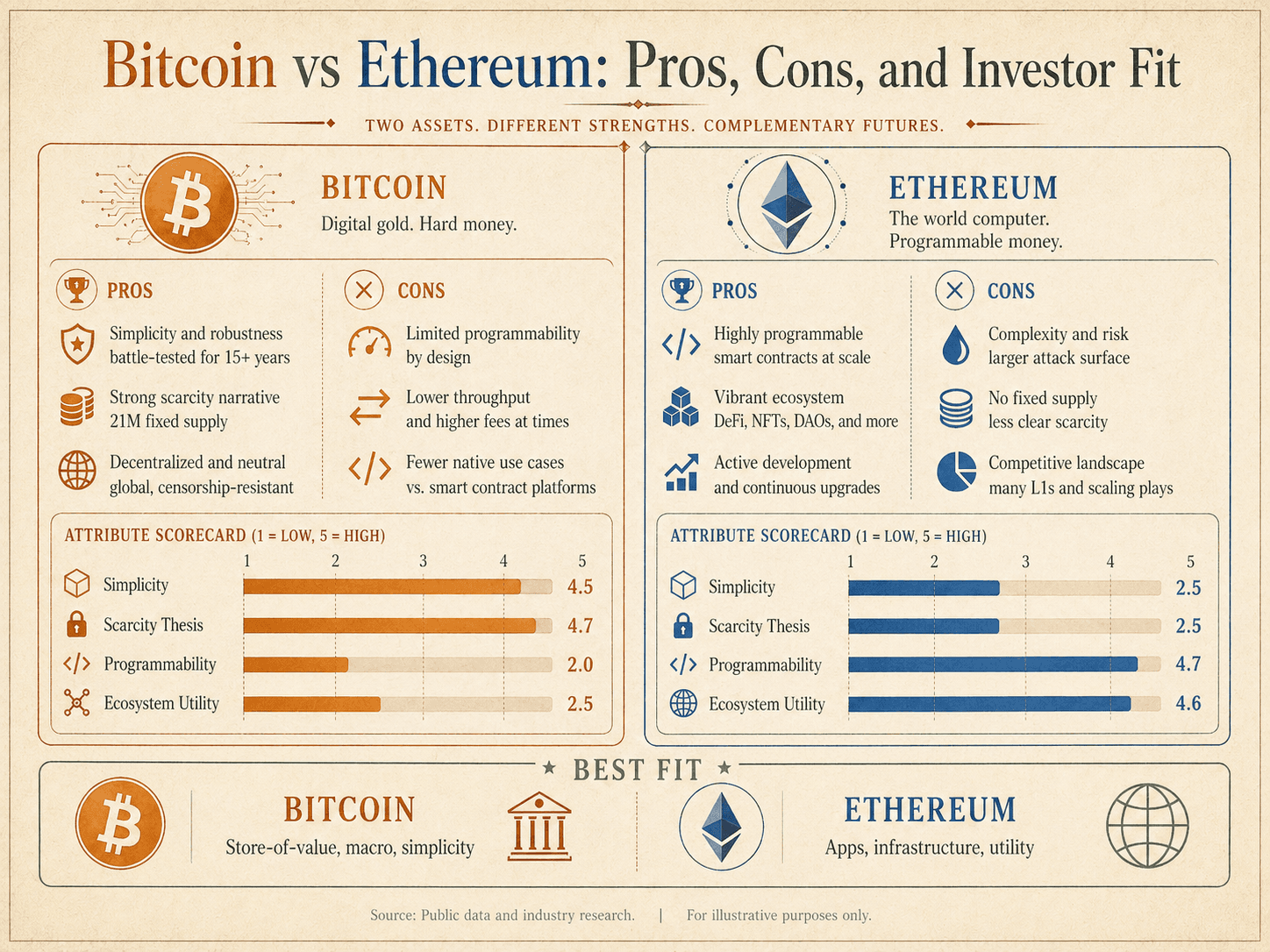
Bitcoin pros
Bitcoin’s main advantages come from simplicity, recognizability, and monetary focus.
1. Clear monetary identity
Bitcoin is easier to explain than most crypto networks because its role is tightly tied to digital money and long-term scarcity.
2. Strong scarcity narrative
Bitcoin’s supply model is transparent and limited over the long run, which reinforces its store-of-value thesis.
3. Simpler investment thesis
Compared with Ethereum, Bitcoin often requires fewer assumptions about application growth or ecosystem adoption.
4. Benchmark status
Bitcoin remains the primary reference point for the crypto market as a whole.
Bitcoin cons
Bitcoin also has important limitations depending on what the user wants from a blockchain network.
1. Narrower functionality
Bitcoin is less flexible than Ethereum as a platform for applications and smart contracts.
2. Smaller native application layer
Users looking for broad onchain utility often look beyond Bitcoin to more programmable systems.
3. Less exposure to blockchain application growth
Bitcoin’s focused design is a strength, but it also means less direct exposure to broader smart contract ecosystems.
Ethereum pros
Ethereum’s main advantages come from flexibility, utility, and developer relevance.
1. Smart contract capability
Ethereum’s core strength is programmability. Developers can create applications and services directly onchain.
2. Broader ecosystem utility
Ethereum supports decentralized finance, token systems, digital assets, marketplaces, and many other blockchain-based use cases.
3. Greater design space
Ethereum gives builders more room to experiment and create new products.
4. Infrastructure exposure
ETH offers exposure not only to an asset, but to a blockchain platform with widespread network usage.
Ethereum cons
Ethereum’s strengths also create trade-offs.
1. More complexity
Ethereum is harder to explain simply because it combines infrastructure, asset economics, smart contracts, fees, validators, and application activity.
2. More user friction
Beginners may find concepts like gas, staking, smart contracts, and app interactions more difficult to understand.
3. Broader thesis risk
Ethereum’s upside may be larger in some areas, but it also depends on a wider set of assumptions about ecosystem activity and sustained utility.
Which has more utility: Bitcoin or Ethereum?
Ethereum usually has more direct utility as a blockchain platform because it supports smart contracts and decentralized applications.
Bitcoin has utility too, but it is usually framed differently. Its utility is more closely tied to decentralized ownership, monetary transfer, and long-term asset behavior. That makes Ethereum stronger in application utility, while Bitcoin is stronger in monetary clarity.
Which is better for long-term holding?
Neither is universally better. The better long-term asset depends on the thesis behind the holding.
Bitcoin is often more attractive to people who want exposure to:
scarcity
monetary credibility
a simpler core asset thesis
benchmark crypto status
Ethereum is often more attractive to people who want exposure to:
application growth
smart contracts
onchain infrastructure
broader blockchain ecosystem development
This is why a good long-term comparison should always define the frame first. Better for what? Better as money? Better as infrastructure? Better as a simpler asset thesis? Better as a programmable network?
Which has more future potential: Bitcoin or Ethereum?
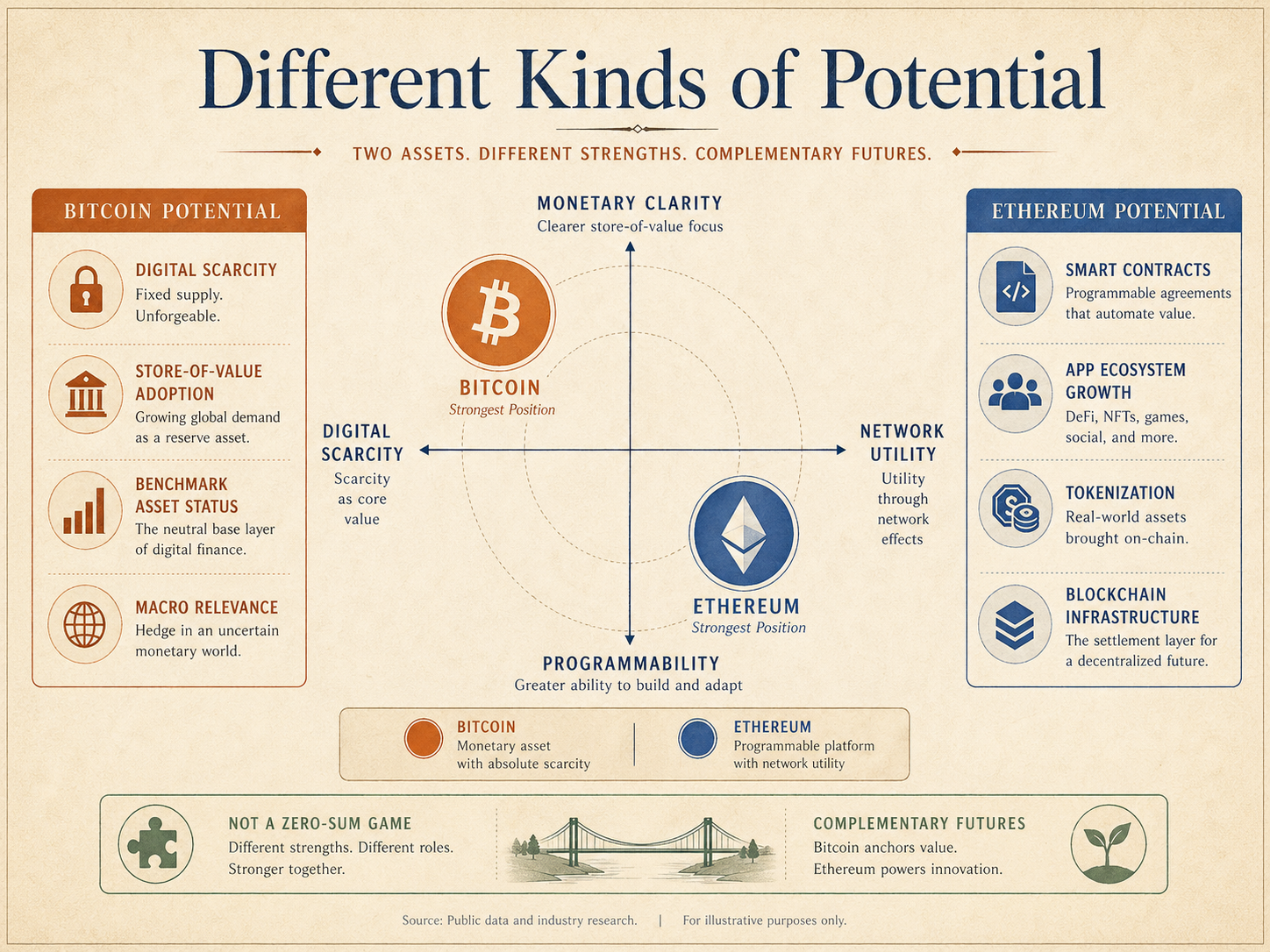
Bitcoin and Ethereum have different kinds of potential for future growth.
Bitcoin’s potential
Bitcoin may have stronger potential if the thesis centers on:
digital scarcity
store-of-value adoption
macro relevance
benchmark asset positioning
long-term monetary credibility
Ethereum’s potential
The Ethereum price may have stronger potential if the thesis centers on:
smart contract growth
developer adoption
onchain applications
tokenization
blockchain infrastructure demand
So the question should not be “Which has more potential in absolute terms?” The better question is “Potential in which category?” Bitcoin may have stronger monetary potential. Ethereum may have stronger platform potential. Both can be highly important without competing on the exact same dimension.
Is Ethereum riskier than Bitcoin?
Ethereum can feel riskier than Bitcoin for some users because the network is broader, more complex, and more tightly connected to application-layer activity. That does not mean Ethereum is weak. It means there are more variables to evaluate.
Bitcoin’s focused design often makes it easier to analyze at a high level. Ethereum may require more understanding of staking, smart contracts, app ecosystems, and network usage. In that sense, Ethereum can involve more conceptual and ecosystem risk, while Bitcoin can feel more straightforward as a core asset thesis.
Which has more use cases?
Ethereum generally has more direct onchain use cases because it was explicitly built for smart contracts and decentralized applications. Bitcoin has fewer application-layer use cases, but its core use cases are more concentrated and more recognizable.
That means Ethereum usually wins on breadth of use cases, while Bitcoin usually wins on clarity of purpose.
Key differences between Bitcoin and Ethereum
Bitcoin
Primarily designed as a decentralized monetary network
Focused on scarcity, security, and long-term monetary credibility
Easier to understand for most beginners
Narrower in functionality and application scope
Often viewed as a simpler long-term crypto thesis
Ethereum
Primarily designed as a programmable blockchain platform
Focused on smart contracts, applications, and broader network utility
More complex, but more flexible
Supports a much broader ecosystem of on-chain use cases
Often viewed as an infrastructure and ecosystem growth thesis
This comparison matters because many readers compare BTC and ETH as if they are interchangeable. They are not. Their value comes from different kinds of conviction.
Who should focus more on Bitcoin?
Bitcoin may be more relevant for readers who care most about:
digital money
scarcity
macro and monetary narratives
simpler crypto exposure
long-term store-of-value frameworks
These readers are usually looking for a more focused thesis and a network that is easier to describe in monetary terms.
Who should focus more on Ethereum?
Ethereum may be more relevant for readers who care most about:
decentralized applications
smart contracts
onchain finance
blockchain infrastructure
developer ecosystems and utility growth
These readers are often more interested in how blockchain networks are used, not just how digital assets are held.
Common mistakes in the Bitcoin vs Ethereum debate
One common mistake is comparing Bitcoin and Ethereum only through price performance. That strips away the more important difference, which is that they represent different blockchain models and different types of value.
Another mistake is assuming one must eventually replace the other. In reality, Bitcoin and Ethereum can both remain central to crypto while serving different roles.
A third mistake is asking “Which is better?” without specifying the category. The answer changes completely depending on whether the comparison is about money, applications, long-term holding, beginner-friendliness, or network utility.
The bottom line
Bitcoin and Ethereum are the two most important crypto networks because they anchor two different ideas. Bitcoin is the clearest example of a decentralized monetary asset built around scarcity, security, and long-term credibility. Ethereum is the clearest example of a programmable blockchain built for smart contracts, applications, and broader onchain utility.
For beginners, Bitcoin is usually the easier starting point. For users interested in smart contracts and blockchain applications, Ethereum is usually more compelling. And for anyone asking which has more potential, the honest answer is that Bitcoin and Ethereum have different kinds of potential because they are optimized for different things.
FAQ
What is the biggest difference between Bitcoin and Ethereum?
Bitcoin is primarily a decentralized monetary network, while Ethereum is primarily a programmable blockchain for smart contracts and decentralized applications.
Is Bitcoin better than Ethereum?
Not in every category. Bitcoin is stronger in monetary clarity and scarcity narratives, while Ethereum is stronger in programmability and broader network utility.
Which is easier for beginners?
Bitcoin is usually easier for beginners because its core story is simpler and easier to explain.
Which has more use cases?
Ethereum generally has more direct use cases because it supports smart contracts and decentralized applications.
Which has higher long-term potential?
That depends on the thesis. Bitcoin may have stronger potential as a monetary asset, while Ethereum may have stronger potential as programmable blockchain infrastructure.
Editorial disclaimer
This article is published for educational purposes only and does not constitute investment, financial, legal, or tax advice. Bitcoin, Ethereum, and other digital assets involve risk, including volatility, custody risk, regulatory uncertainty, and possible loss of capital. Readers should verify important information independently and consult a qualified professional where appropriate.
Sources and methodology
This article is based on primary Bitcoin documentation, Ethereum educational and technical resources, and general market structure concepts related to blockchain networks, monetary design, programmability, consensus models, and digital asset utility. The goal is explanatory, not predictive.
Key reference sources:
https://coinlib.io/coin/BTC/Bitcoin
https://coinlib.io/coin/ETH/Ethereum
https://bitcoin.org/bitcoin.pdf
https://ethereum.org/en/developers/docs/intro-to-ethereum/
https://ethereum.org/en/whitepaper/